

As a crypto API provider, part of our job is to understand what other providers build. We review public documentation, pricing, product flows, and evidence we can verify. This review explains what we confirmed about Vaultody, where it may fit, and its important limits.
This review covers public information only. We did not use an account to test Vaultody response times, settlement speed, support, uptime, or production behaviour.
Vaultody at a Glance
| Decision Point | Vaultody |
|---|---|
| Best for | Businesses building their own wallet and custody operations |
| Main products | Direct Custody, Treasury Management, and Wallet-as-a-Service |
| Custody model | Non-custodial technology; customer or end user retains control |
| Security model | MPC/TSS signing, policies, roles, and audit trails |
| Developer access | REST APIs, webhooks, documentation, and testnet trial |
| Current entry plan | $249 per month |
| Trial | Seven days, testnet only |
| Mainnet on trial | No |
| Direct NGN bank settlement | Not publicly confirmed |
| Direct GHS bank settlement | Not publicly confirmed |
| Main product model | Wallet and custody infrastructure |
How Breet Compares
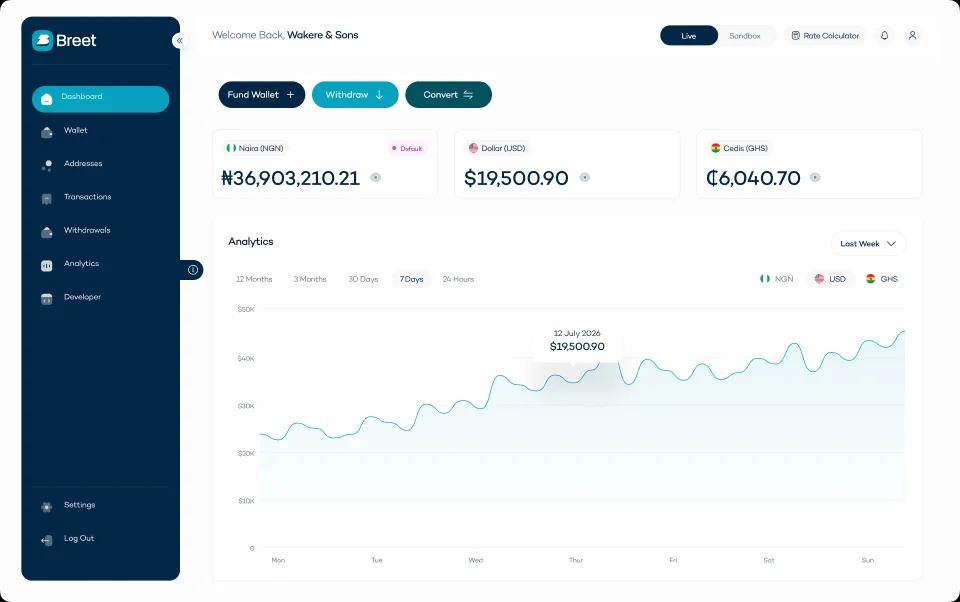
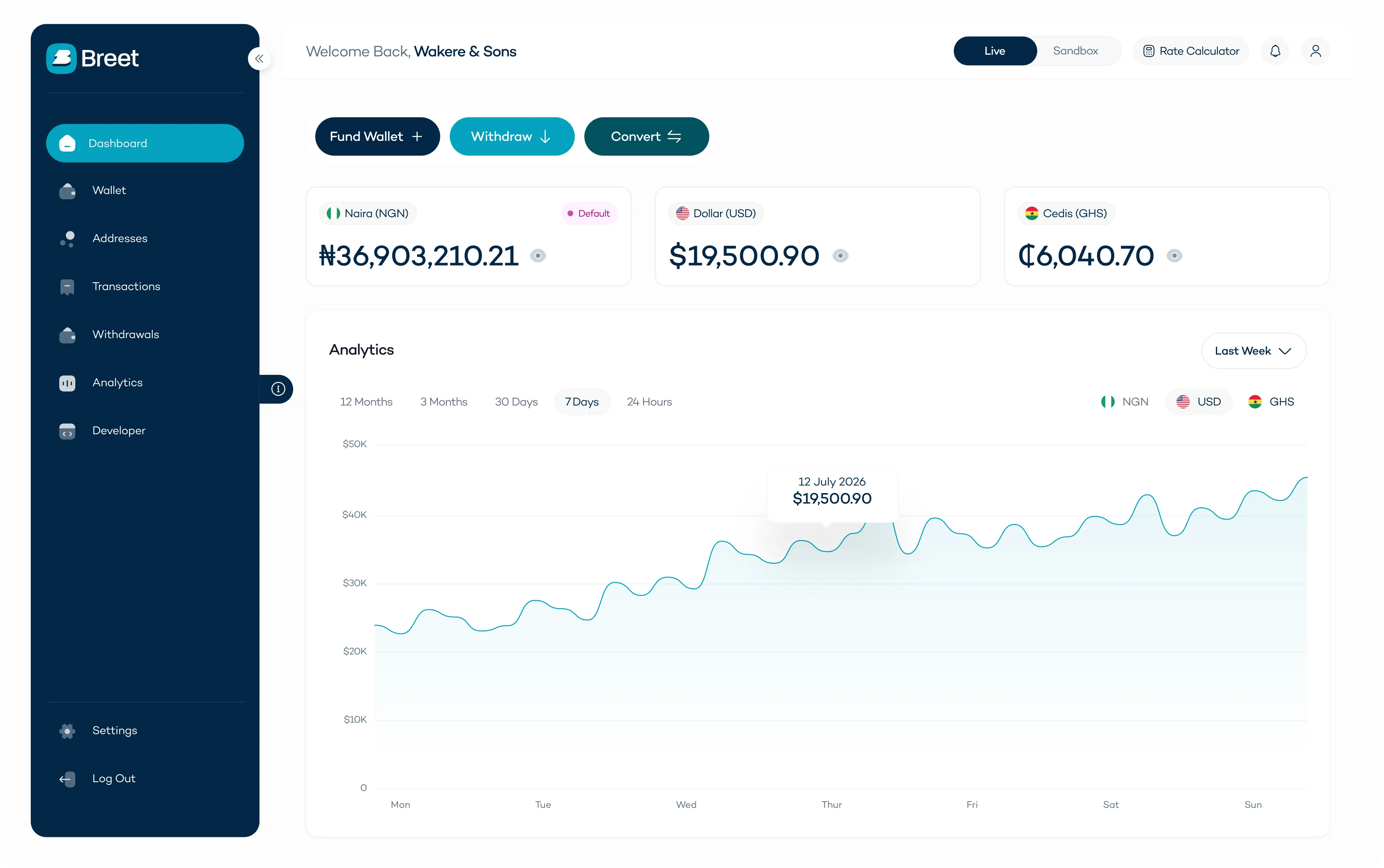
Vaultody provides wallet and custody infrastructure that businesses operate themselves. Breet manages the crypto acceptance, conversion, and settlement flow for the business.
- Accept 12+ supported crypto assets using permanent or single-use wallet addresses.
- Convert deposits automatically after blockchain confirmation.
- Keep funds in stablecoins or USD, or settle directly to an NGN or GHS bank account.
- Withdraw through the API or Breet business dashboard at any time.
- Avoid liquidity management and wallet sweeping.
- Pay one volume-based transaction fee with no separate setup, monthly, or wallet-sweeping fees and no gas fee for receiving crypto.
- Test integrations in a public sandbox with webhooks, live asset discovery, and clear API documentation.
- Get direct integration support through dedicated Slack channel support.
What Does Vaultody Provide?
Vaultody supplies software for businesses that want to create and control digital-asset wallets. Its current product groups cover custody, treasury, and wallets for customer-facing applications.
The platform includes:
- vaults, vault accounts, and blockchain addresses;
- MPC-based transaction signing;
- users, roles, approval policies, and operating rules;
- mobile or API signing options;
- webhooks and transaction monitoring;
- gas sponsorship;
- audit trails and reporting data.
This is a broad infrastructure layer. A fintech can use it to create a wallet product, manage treasury assets, or operate policies for business transactions. The customer still needs to define its asset flows, controls, liquidity, conversion, compliance, settlement, and user support.
Non-Custodial MPC Model
Vaultody states that it does not take possession of customer assets or control private keys. Its MPC system distributes signing work instead of holding one complete private key in one place.
For a business, this can reduce single-key risk and preserve control. Policies can add approvals and limits before a transfer is signed. Audit data can help the team trace actions.
This model is a good fit when custody control is a product requirement. It is a larger responsibility when the buyer only wants to receive crypto and settle local currency to a bank. Wallet security is then one part of the total route, not the final business outcome.
APIs, Webhooks, and Test Access
Vaultody publishes developer documentation for its REST APIs and data-flow limits. The available limits depend on the selected subscription. Its platform uses webhooks to notify an application about important events, which can reduce repeated status requests.
The public pricing page offers a seven-day trial. It is limited to testnet, and mainnet use is not included. This lets an engineering team inspect the model before it commits funds, but it does not prove production route performance.
Buyers should confirm current rate limits, enabled networks, webhook access, signing requirements, and support response times for the exact plan. They should also test retry behaviour and reconciliation before launch.
Vaultody Pricing
The Vaultody pricing page currently lists four paid tiers:
| Plan | Monthly Price | Accounts or Addresses | Included Annual Outgoing Volume | Overage |
|---|---|---|---|---|
| Entry | $249 | 500 | $0 | 0.20% |
| Standard | $699 | 10,000 | $2 million | 0.15% |
| Business | $1,699 | 40,000 | $7.5 million | 0.10% |
| Enterprise | From $1,999 | Custom | Custom | Custom |
Annual billing discounts are available. Rate limits and support also change by tier. The current table lists a response target of up to one week for Entry, two business days for Standard, and live support for Business.
This price is for wallet infrastructure and outgoing volume, not a managed crypto-to-bank payment. Add conversion, liquidity, compliance, and bank-rail costs before comparing total price.
Stablecoins and Local Bank Settlement
Vaultody can support wallets for stablecoins and other assets on enabled networks. Its current public material also refers to a Stablecoin Operations Platform as coming soon.
That wording matters. A planned stablecoin product is not evidence of an active direct NGN or GHS bank-settlement service. The public sources reviewed do not confirm a managed route that receives a customer deposit, converts it, and pays a Nigerian or Ghanaian bank account.
A Vaultody customer can add other providers to create that route. The buyer must then assess those providers, their licences, liquidity, rates, fees, settlement times, and support ownership.
Security and Company Position
Vaultody presents itself as a Bulgaria-based, technology-only B2B SaaS company and displays SOC 2 Type 1. This does not mean it supplies regulated conversion or local payment services.
What Vaultody Does Well
- Gives the customer control of wallet and custody operations.
- Uses MPC signing and policy controls.
- Supports treasury and customer-wallet use cases.
- Provides APIs, webhooks, audit trails, and gas tools.
- Publishes plan prices and key capacity limits.
- Offers a testnet trial before a paid mainnet plan.
Important Limits and Trade-Offs
- Direct NGN and GHS bank settlement is not publicly confirmed.
- The customer owns more security, operating, and provider decisions.
- Entry costs $249 per month and includes no annual outgoing volume.
- Mainnet is unavailable in the public trial.
- Rate limits, support, and some features depend on the plan.
- The current Stablecoin Operations Platform is described as coming soon.
Who should choose the Vaultody API?
Vaultody is worth considering when your business needs:
- Direct ownership of wallet and custody operations;
- MPC policies and approval workflows;
- Treasury or embedded-wallet functions;
- A non-custodial technology provider;
- An API layer that your team will combine with other services.
Final Verdict on Vaultody
Vaultody is an infrastructure component when wallet custody, policies, signing control, and operational ownership are the main requirements. It suits teams that want to assemble and operate their own stack and can evaluate custom pricing and any additional payment providers required.
However, if you want the payment result without building custody, signing, gas, and wallet-sweeping operations, try Breet API to receive crypto and settle in stablecoins, NGN, or GHS.
Comparing Vaultody with Breet?
For a direct side-by-side decision, compare Breet and Vaultody by product scope, fees, settlement, strengths, and the business cases each provider suits.