

As a crypto API provider, part of our job is to understand what other providers build. We review public documentation, pricing, product flows, and evidence we can verify. This review explains what we confirmed about Paychant, where it may fit, and its important limits.
This review covers public information only. We did not use an account to test Paychant response times, settlement speed, support, uptime, or production behaviour.
Paychant review at a glance
| Decision point | Paychant |
|---|---|
| Best for | Businesses that need embedded stablecoin ramps |
| Main product | B2B2C stablecoin on-ramp and off-ramp |
| Published countries | Nigeria, Ghana, Kenya, Uganda, and Zambia |
| Payment methods | Bank transfer in all five countries; mobile-money availability varies by country |
| Published stablecoins | USDT, USDC, CUSD, and CEUR variants on supported networks |
| Published transaction fees | Buy: 1% to 2%; sell: 1% to 2.5%, depending on payment method |
| Integration | Redirect widget, overlay widget, price and discovery API, parameters, and webhooks |
| Sandbox | Yes |
| Customer verification | Paychant says it manages KYC and AML checks in the widget flow |
How Breet Compares
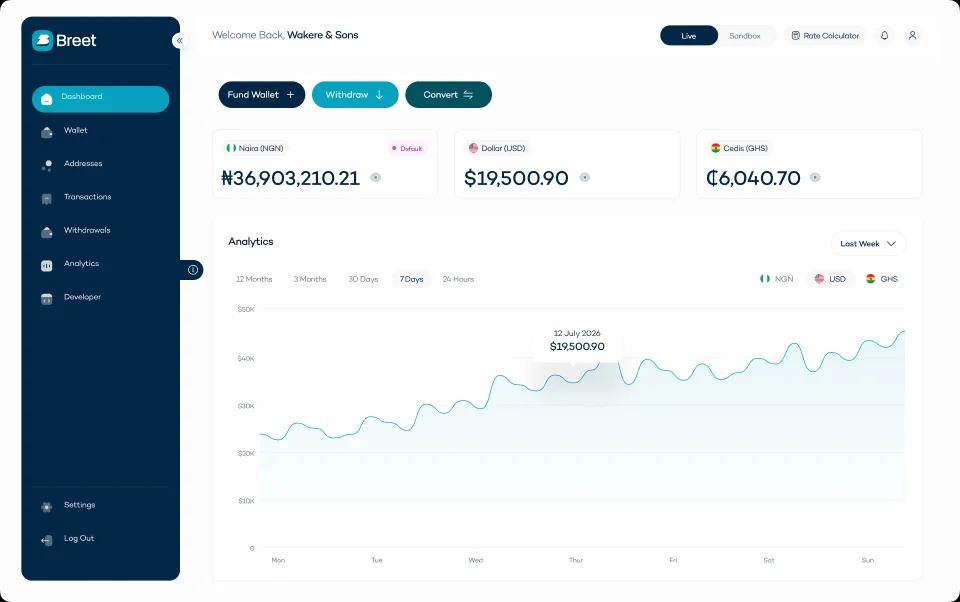
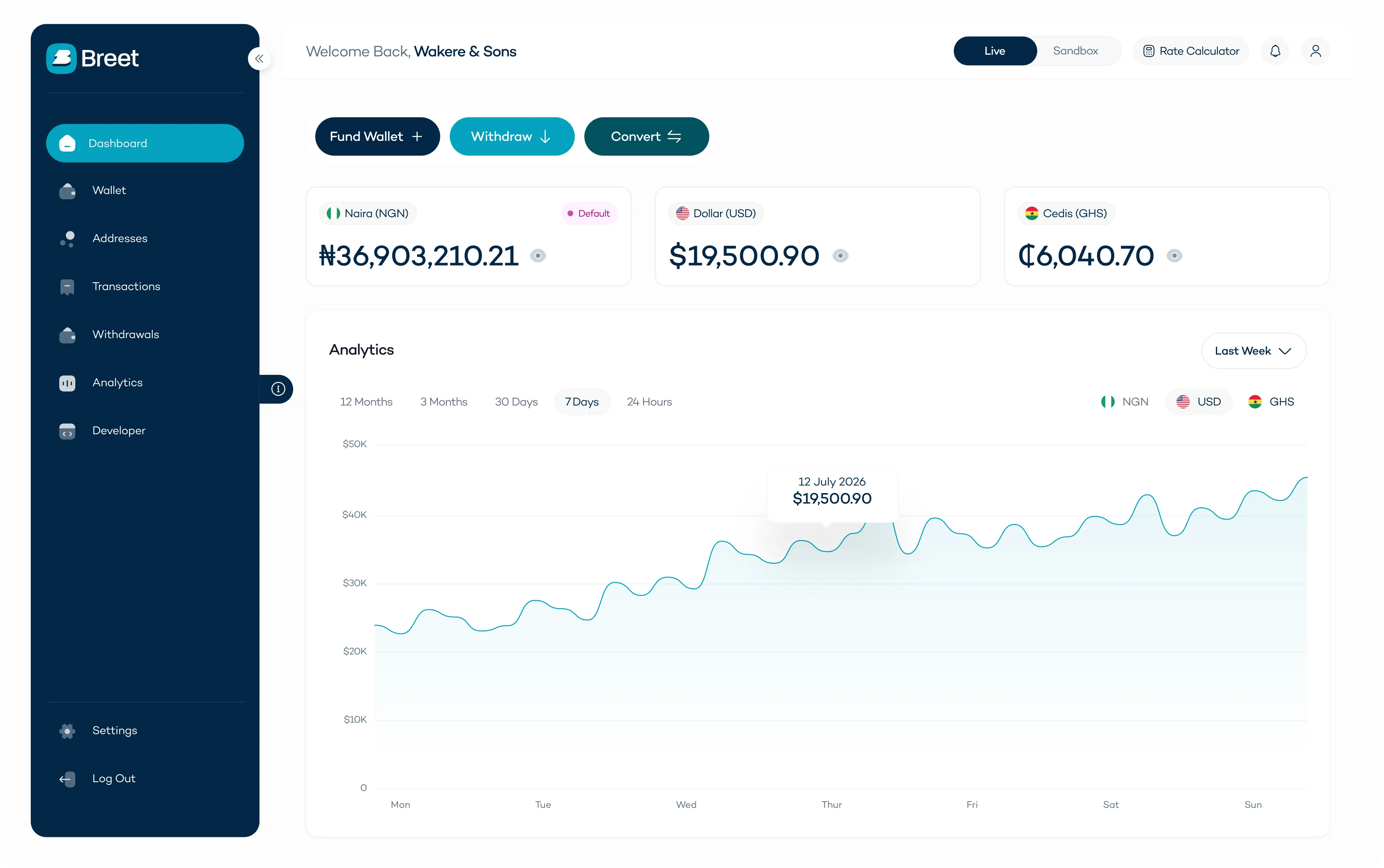
Paychant provides hosted stablecoin on-ramp and off-ramp widgets. Breet lets businesses generate customer wallet addresses, accept supported crypto, and manage settlement through an API or dashboard.
- Accept 12+ supported crypto assets using permanent or single-use wallet addresses.
- Convert deposits automatically after blockchain confirmation.
- Keep funds in stablecoins or USD, or settle directly to an NGN or GHS bank account.
- Withdraw through the API or Breet business dashboard at any time.
- Avoid liquidity management and wallet sweeping.
- Pay one volume-based transaction fee with no separate setup, monthly, or wallet-sweeping fees and no gas fee for receiving crypto.
- Test integrations in a public sandbox with webhooks, live asset discovery, and clear API documentation.
- Get direct integration support through dedicated Slack channel support.
What does Paychant do?
Paychant describes itself as a B2B2C stablecoin on-ramp and off-ramp provider. A business adds Paychant to its app, and the end user can buy stablecoins with local money or sell stablecoins for local money.
The API overview lists Nigeria, Ghana, Kenya, Uganda, and Zambia. Bank transfer is available in the published table for all five. Mobile-money options differ by market and include services such as M-Pesa, MTN MoMo, Airtel Money, AirtelTigo, Vodafone Cash, and Zamtel.
What Paychant does well
- Five-country African coverage. Paychant publishes bank-transfer support across five countries, with mobile money available on selected routes.
- Both directions. The same integration supports buying and selling stablecoins.
- Hosted user interface. A redirect page or overlay widget lets Paychant manage the transaction interface.
- Useful configuration. The business can preselect the asset, fiat currency, payment method, environment, and webhook URL.
- Price and discovery endpoints. The REST API can return supported assets, fiat currencies, methods, rates, and applicable fee fields.
- Documented retry behaviour. When a webhook endpoint does not return a successful response, Paychant says it retries every 30 minutes for 24 hours.
- Managed customer checks. Paychant says KYC and AML checks are part of its widget flow.
Paychant fees
Paychant's developer documentation publishes the following transaction-fee ranges:
| Transaction | Published fee |
|---|---|
| Buy stablecoins | 1% to 2% per transaction |
| Sell stablecoins | 1% to 2.5% per transaction |
The exact percentage depends on the payment method. Paychant's terms say the final fee is included in the shown price and can change. Compare the exchange rate, network, payment method, fee, and final amount delivered for your expected routes.
Supported stablecoins and networks
Paychant's detailed asset page lists variants of:
- USDT;
- USDC;
- CUSD;
- CEUR.
The listed networks include Celo, Stellar, BNB Smart Chain, Ethereum, Polygon, and Tron. Not every asset is available on every network.
Integration choices
The redirect sends the user to a Paychant-hosted page. The overlay opens the Paychant interface above the business app. Supporting endpoints return prices and available payment choices, while parameters can preselect the asset, fiat currency, payment method, and webhook URL.
Paychant provides a sandbox. Access still requires an application, and the getting-started material says a valid production key is required for the live widget.
Important limits and trade-offs
1. The hosted widget shapes the customer experience
A hosted flow can reduce build time, but it also gives the provider more control over the interface, verification steps, and transaction sequence. Test the redirect and overlay options on the devices and network conditions your users have.
2. Webhook verification is not clear in the public guide
Paychant documents webhook events and retry behaviour. The public webhook page we reviewed does not explain a signature-verification method. Ask how the receiving server should authenticate each event before production use.
3. Documentation dates and live values need checks
Some documentation pages show different update dates. Use the current discovery endpoints and confirm the assets, networks, methods, fees, limits, and settlement terms for your account.
Who should choose the Paychant API?
Paychant deserves a close look when the business needs:
- A hosted stablecoin purchase and sale interface;
- Support for Kenya, Uganda, or Zambia as well as Nigeria and Ghana;
- Mobile-money payment methods on supported routes;
- USDT, USDC, CUSD, or CEUR rather than a broad crypto list;
- The provider to manage the customer verification flow inside the widget;
- A redirect or overlay integration that can reduce front-end work.
Final verdict on Paychant
Paychant has a clear use case for African fintechs that need an embedded stablecoin on-ramp or off-ramp. It covers five countries and several bank and mobile-money methods. Its hosted widgets and managed verification flow can reduce integration work, while route pricing and webhook controls need confirmation.
However, if you want to receive a broader set of supported crypto assets and settle in stablecoins, NGN, or GHS without managing gas fees or wallet sweeping, try Breet API.
Comparing Paychant with Breet?
For a direct side-by-side decision, compare Breet and Paychant by product scope, fees, settlement, strengths, and the business cases each provider suits.