

As a crypto API provider, part of our job is to understand what other providers build. We review public documentation, pricing, product flows, and evidence we can verify. This review explains what we confirmed about Fireblocks, where it may fit, and its important limits.
This review covers public information only. We did not use an account to test Fireblocks response times, settlement speed, support, uptime, or production behaviour.
Fireblocks at a Glance
| Decision Point | Fireblocks |
|---|---|
| Best for | Institutions building digital-asset infrastructure |
| Main products | Vaults, wallets, payments, Flow, Network, compliance, automation, trading, and tokenization |
| Asset coverage | Thousands of assets across dozens of networks, subject to workspace support |
| Payment connectivity | 40+ providers and on/off-ramps for 60+ fiat currencies |
| Merchant acceptance | Fireblocks Flow for crypto acceptance and stablecoin settlement |
| Developer access | REST API, TypeScript and Python SDKs, webhooks, guides, and Postman resources |
| Sandbox | Free Developer Sandbox |
| Entry pricing | Essentials at $999 per month for up to six months |
| Essentials included volume | $1 million quarterly outbound volume |
| Essentials overage | 0.20% per transaction |
| Custom pricing | Starts at $36,000 per year |
| Direct native NGN/GHS bank settlement | Not a standalone Fireblocks promise; partner-dependent |
How Breet Compares
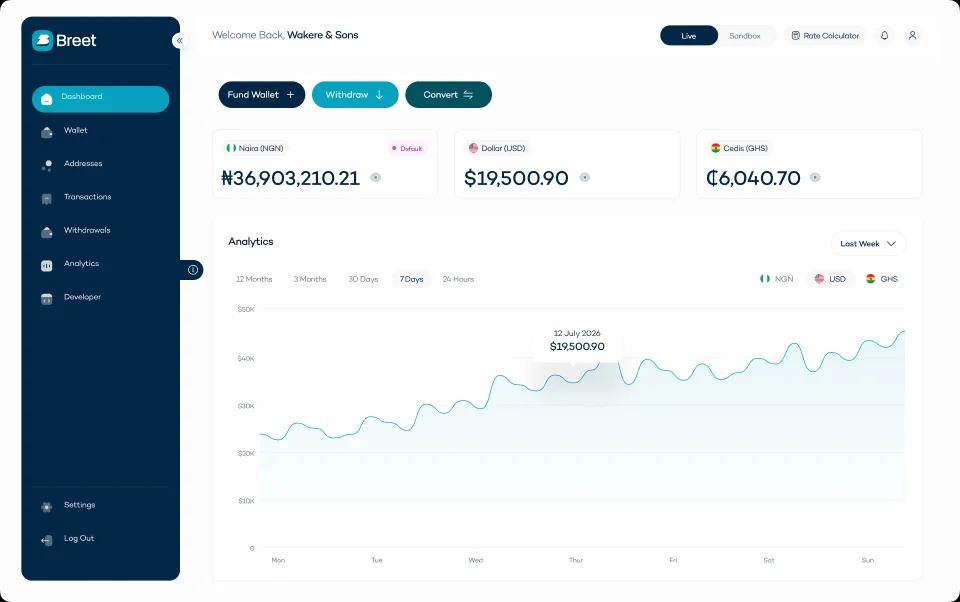
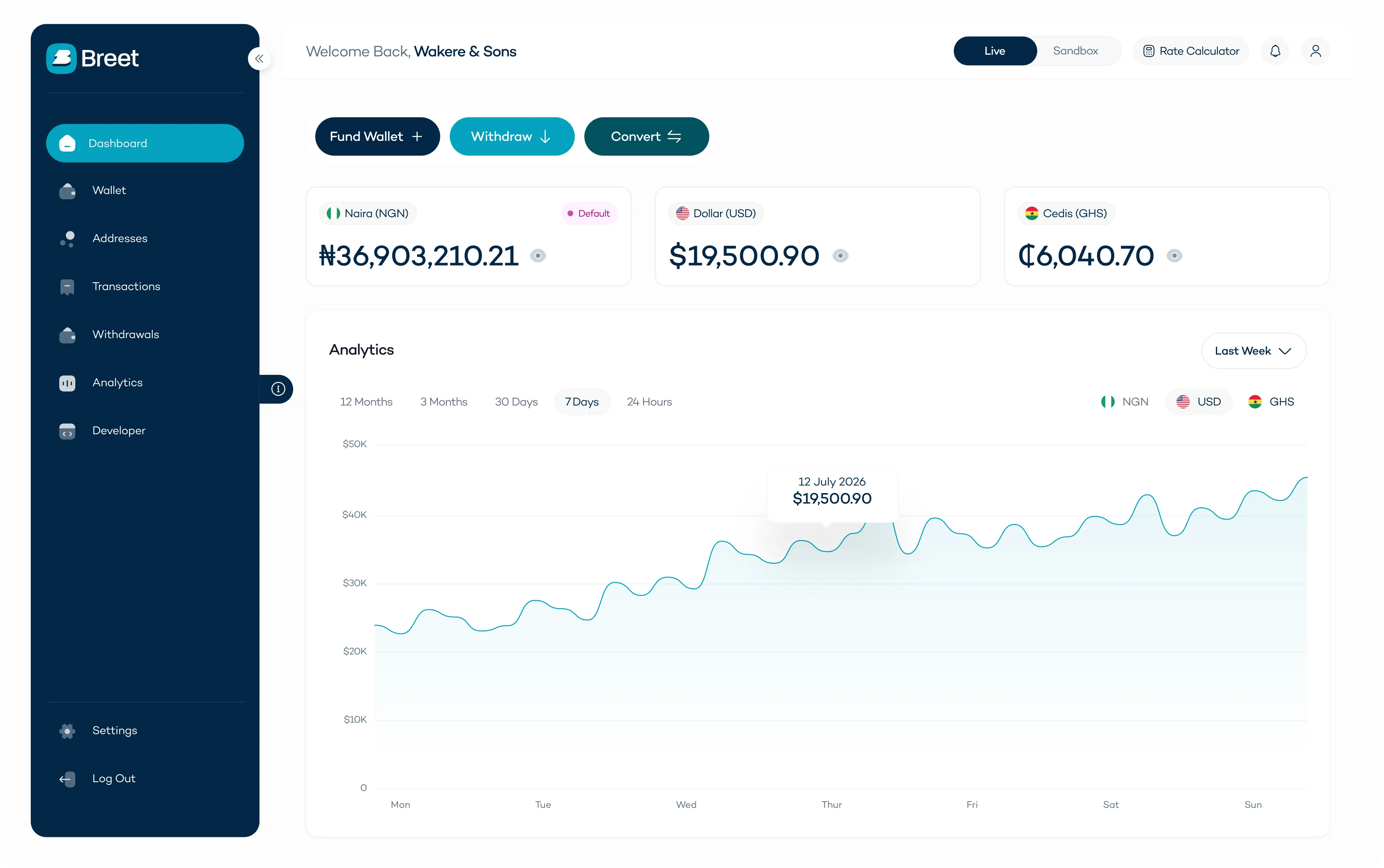
Fireblocks provides institutional custody, wallet infrastructure, and transaction-policy controls. Breet is designed for businesses that want a managed crypto acceptance and settlement flow.
- Accept 12+ supported crypto assets using permanent or single-use wallet addresses.
- Convert deposits automatically after blockchain confirmation.
- Keep funds in stablecoins or USD, or settle directly to an NGN or GHS bank account.
- Withdraw through the API or Breet business dashboard at any time.
- Avoid liquidity management and wallet sweeping.
- Pay one volume-based transaction fee with no separate setup, monthly, or wallet-sweeping fees and no gas fee for receiving crypto.
- Test integrations in a public sandbox with webhooks, live asset discovery, and clear API documentation.
- Get direct integration support through dedicated Slack channel support.
Fireblocks Payments and Provider Network
The Fireblocks Network for Payments connects local rails, blockchains, stablecoin issuers, liquidity providers, foreign-exchange providers, and on/off-ramps. Its current provider directory states that the network has more than 2,400 institutional participants.
The payments page says more than 40 providers cover on/off-ramps for over 60 fiat currencies. That can reduce the number of direct technical integrations a large PSP must maintain.
However, connection is not the same as native settlement. Each provider has its own countries, rails, licences, onboarding, prices, and service levels. A Fireblocks customer must still choose and contract the providers that complete its corridor.
What Fireblocks Flow Adds
Fireblocks Flow is closer to a managed crypto-acceptance product. It lets PSPs add crypto or stablecoin acceptance to merchant checkout and settle the merchant in a chosen stablecoin.
Fireblocks says Flow can accept tokens from USDC to DOGE, connect to more than 800 wallet types and major exchanges, run compliance and reconciliation, and prevent the original payment asset from touching the PSP's infrastructure or books.
The public page describes stablecoin settlement. It does not confirm direct NGN or GHS bank settlement as the final Fireblocks Flow outcome. A local-bank route still needs another provider or operating layer.
Wallets, Security, and Policy Controls
Fireblocks differentiates itself through control over digital-asset operations. MPC divides signing authority so one complete private key is not kept in one vulnerable place. Policy rules can decide which users, destinations, assets, values, and workflows are allowed.
The platform supports different wallet designs, API co-signers, transaction simulation, roles, and audit logs. Fireblocks' 2026 security material states SOC 2 Type II and several ISO certifications. Its pricing page reports more than 99.97% monthly uptime across its systems.
These controls matter when an institution wants direct ownership of its wallet and transaction architecture.
Assets and Networks
Fireblocks supports thousands of assets across dozens of blockchain networks. Availability can differ by workspace, service, network, and asset type.
The supported-assets documentation divides assets into globally supported and locally supported assets. Developers should query the workspace API because a general support list does not guarantee that an asset is enabled in every account or product.
Developer Experience and Sandbox
The Fireblocks REST API is the foundation for its SDKs. The company maintains TypeScript and Python SDKs and publishes guides for other languages.
Fireblocks Pricing
Fireblocks now publishes a useful entry price. As of 14 August 2026, the Fireblocks pricing page lists:
- Essentials at $999 per month for up to six months;
- $1 million of quarterly outbound volume;
- a 0.20% per-transaction overage above that volume;
- 1,000 embedded wallets, two workspaces, five users, API access, and basic 8x5 support;
- Custom plans starting at $36,000 per year.
Several advanced features are custom-plan items or paid add-ons. Final payment-provider, liquidity, compliance, and local-rail charges can also sit outside the Fireblocks platform price.
Nigeria and Ghana Settlement
Fireblocks can connect customers to providers that operate in African markets. Its network includes companies with African routes, and its payments pages discuss local banking rails.
Fireblocks also states that it provides technology infrastructure only. Payment and financial services come from partners under their own licences. The specific NGN or GHS route therefore depends on the selected provider.
What Fireblocks Does Well
Fireblocks combines institutional MPC controls, broad asset coverage, a large provider network, Flow acceptance, compliance tools, mature APIs, and support for custom payment or treasury systems.
Important Limits and Trade-Offs
Direct NGN and GHS bank settlement depends on connected partners. Essentials costs $999 per month before third-party route costs. Advanced functions can require add-ons or custom plans, and the customer still owns the architecture and provider choices.
Who should choose the Fireblocks API?
Fireblocks is designed for:
- Banks and regulated financial institutions;
- Large payment service providers;
- Exchanges and custodians;
- Businesses that need MPC policies and transaction governance;
- Multi-provider global payment orchestration;
- Embedded wallet, trading, tokenization, or treasury products.
Final Verdict on Fireblocks
Fireblocks is an institutional infrastructure platform for security, policy control, asset breadth, payment-provider connectivity, and complex product architecture. It best suits teams that need to design and operate a larger digital-asset stack and can evaluate partner dependencies and custom pricing.
However, if you want a managed payment result without building custody, liquidity, gas, and wallet-sweeping operations, try Breet API to receive crypto and settle in stablecoins, NGN, or GHS.
Comparing Fireblocks with Breet?
For a direct side-by-side decision, compare Breet and Fireblocks by product scope, fees, settlement, strengths, and the business cases each provider suits.