

As a crypto API provider, part of our job is to understand what other providers build. We review public documentation, pricing, product flows, and evidence we can verify. This review explains what we confirmed about HoneyCoin, where it may fit, and its important limits.
This review covers public information only. We did not use an account to test HoneyCoin response times, settlement speed, support, uptime, or production behaviour.
HoneyCoin review at a glance
| Decision point | HoneyCoin |
|---|---|
| Best for | Businesses that need cross-border African payment infrastructure |
| Main capabilities | Collections, payouts, on-ramps, off-ramps, managed wallets, virtual accounts, cards, swaps, OTC services, and escrow |
| On-ramp and off-ramp assets | USDC and USDT on supported networks |
| Public reach | Coverage page states 26+ markets and currencies across Africa, Europe, and North America; route coverage differs by product |
| Relevant local routes | NGN bank payouts; GHS bank and mobile-money payouts; other routes are listed in the live coverage table |
| Public comparable transaction fee | No standard amount published; account-specific fees appear after login |
| Sandbox | Yes |
| Webhooks | Yes, with a shared-secret signature header documented |
| Important off-ramp rule | Send the exact expected amount to an address that is valid for one hour |
How Breet Compares
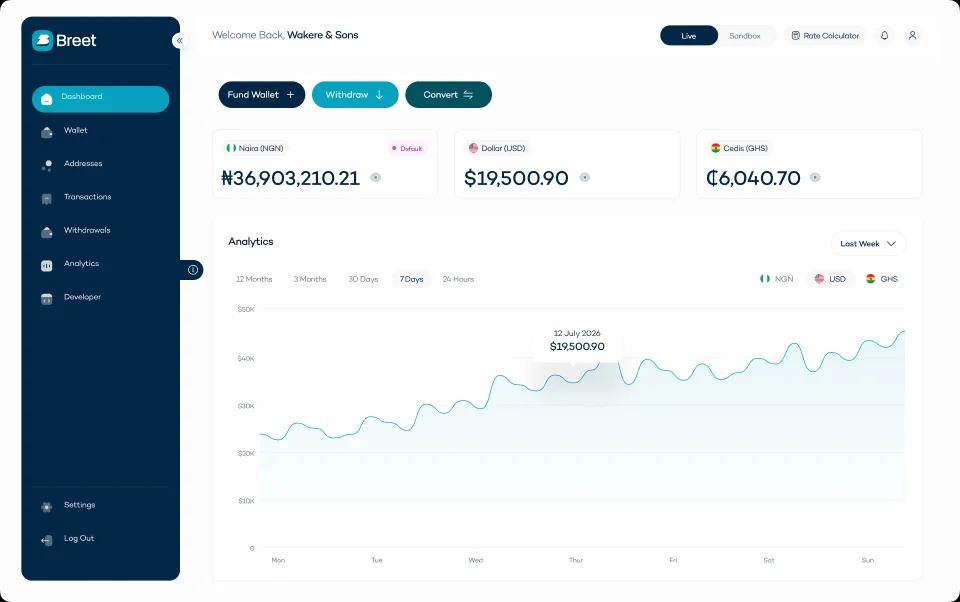
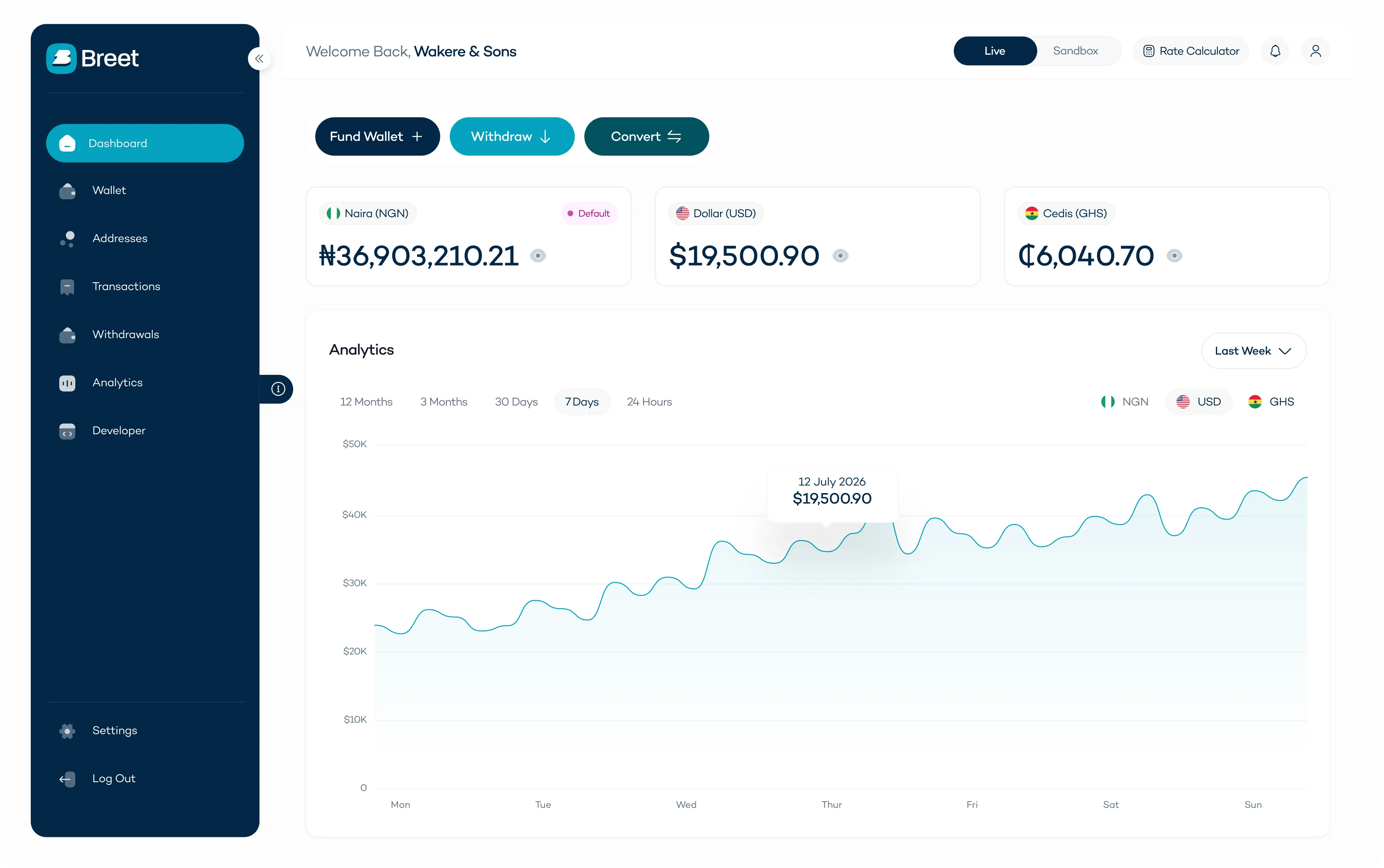
HoneyCoin combines collections, payouts, mobile money, accounts, cards, and treasury services. Breet provides a focused route from supported crypto deposits to stablecoin, USD, NGN, or GHS settlement.
- Accept 12+ supported crypto assets using permanent or single-use wallet addresses.
- Convert deposits automatically after blockchain confirmation.
- Keep funds in stablecoins or USD, or settle directly to an NGN or GHS bank account.
- Withdraw through the API or Breet business dashboard at any time.
- Avoid liquidity management and wallet sweeping.
- Pay one volume-based transaction fee with no separate setup, monthly, or wallet-sweeping fees and no gas fee for receiving crypto.
- Test integrations in a public sandbox with webhooks, live asset discovery, and clear API documentation.
- Get direct integration support through dedicated Slack channel support.
What does the HoneyCoin API do?
HoneyCoin's developer portal groups its API into collections, payouts, on-ramps, off-ramps, wallets, and webhooks. Its wider business site also presents virtual accounts, cards, swaps, OTC services, escrow, and a Universal Payment SDK.
What HoneyCoin does well
- Wide product range. A business can combine fiat collection, payout, stablecoin, wallet, account, card, swap, and escrow functions.
- African routes. Public documentation includes NGN bank payouts, GHS bank or mobile-money payouts, and other African destinations.
- Both ramp directions. Its documented stablecoin flow supports buying and selling USDC and USDT.
- Developer test tools. HoneyCoin publishes sandbox URLs, test-wallet instructions, sample flows, and webhook guidance.
- Webhook authentication. The documentation describes an `X-Webhook-Signature` header that can be checked against the stored webhook secret.
- Broader treasury options. Virtual accounts, collections, cards, managed wallets, swaps, and escrow can reduce the number of providers needed for a larger product.
HoneyCoin fees
HoneyCoin does not publish one standard percentage for the comparable off-ramp flow. Its account-fee guide says fees can depend on:
- transaction type;
- currency and country;
- payment method;
- transaction amount band;
- negotiated account rules.
The exact values appear in the authenticated dashboard, so a buyer cannot calculate a public like-for-like total before account access.
Request written price examples for the exact asset, network, source amount, local currency, destination method, and monthly volume. Compare the final recipient amount and exchange rate as well as the visible fee.
Stablecoin assets and networks
HoneyCoin's on-ramp and off-ramp guide lists USDC and USDT across Ethereum, Arbitrum, Base, Polygon, BNB Smart Chain, and Optimism.
The separate managed Wallets product supports a wider chain and asset set. Do not treat that wallet catalogue as proof that every asset can use the on-ramp or off-ramp. The relevant product page and live route response should decide what appears to the customer.
Country and payment-method coverage
HoneyCoin's coverage page states 26+ platform markets and currencies. Exact product and route access can differ.
The current supported-country and limit documentation shows direct bank payouts in Nigeria and bank or mobile-money payouts in Ghana. Its stablecoin off-ramp guide also lists mobile-money destinations in 12 African countries and bank destinations in Kenya, Nigeria, Tanzania, Malawi, and Ghana.
Before launch, confirm the exact product, direction, currency, destination type, limits, settlement time, and account permission through the live API.
The one-hour address and exact-amount rule
HoneyCoin documents two important off-ramp requirements:
- The generated address is valid for one hour.
- The business must send the exact USDC or USDT amount expected for that transaction.
If the asset or amount does not match, the transaction can fail. HoneyCoin says it may attempt an automatic refund, but some cases can require support-assisted recovery.
This demands clear customer timers, amount validation, transaction monitoring, and an exception process. Test late deposits, underpayments, overpayments, wrong networks, refunds, and support escalation before release.
Integration and operational controls
HoneyCoin publishes production and sandbox URLs, test collections, test wallets, transaction records, and reconciliation fields. Its webhook guide documents a signature header based on the webhook secret. Test duplicate events, ordering, retries, secret rotation, and delayed delivery before launch.
Legal and provider structure
HoneyCoin's company information names HoneyCoin, Inc. and describes the business as a financial-services aggregator, not a bank. It says payment and custody services are provided by licensed financial institutions and banking partners.
The general statement is not proof of permission for every route. Confirm the contracting entity, regulated provider, custody role, and customer-verification duties.
Who should choose the HoneyCoin API?
HoneyCoin deserves a close look when the business needs:
- Coverage across several African markets;
- Mobile-money payouts;
- Local-fiat collection as well as payout;
- Stablecoin on-ramps and off-ramps for USDC or USDT;
- Virtual accounts, cards, managed wallets, swaps, or escrow;
- One provider for a broad treasury and payments roadmap.
Final verdict on HoneyCoin
HoneyCoin supports broad market coverage, mobile money, fiat collections, virtual accounts, cards, escrow, and treasury operations. Its documented stablecoin flow has clear test resources, but the one-hour address and exact-amount rules require careful operational design.
However, if you want a focused way to receive supported crypto, settle in stablecoins, NGN, or GHS, and withdraw at any time without managing gas fees or wallet sweeping, try Breet API.
Comparing HoneyCoin with Breet?
For a direct side-by-side decision, compare Breet and HoneyCoin by product scope, fees, settlement, strengths, and the business cases each provider suits.