

As a crypto API provider, part of our job is to understand what other providers build. We review public documentation, pricing, product flows, and evidence we can verify. This review explains what we confirmed about Yellow Card, where it may fit, and its important limits.
This review covers public information only. We did not use an account to test Yellow Card response times, settlement speed, support, uptime, or production behaviour.
Yellow Card API review at a glance
| Decision point | Yellow Card Payment API |
|---|---|
| Best for | Businesses that need multi-country African payment routes |
| Main capabilities | Local fiat pay-ins and payouts, stablecoin conversion, FX quotes, transaction history, KYC metadata, wallets, and treasury |
| Country coverage | 20 African countries |
| Payment methods | Bank transfer, mobile money, and other local methods where available |
| Partner settlement balance | USD, USDT, or USDC, according to their B2B FAQ |
| Wallet scope | Buying, selling, sending, receiving, and saving across 30+ blockchains |
| Nigeria collection fees | Published table lists 1% below NGN 100,000 and 0.5% above NGN 100,000, with minimum fees |
| Sign-up fee | None, according to their B2B FAQ |
| Sandbox | Keys supplied through the business onboarding process |
How Breet Compares
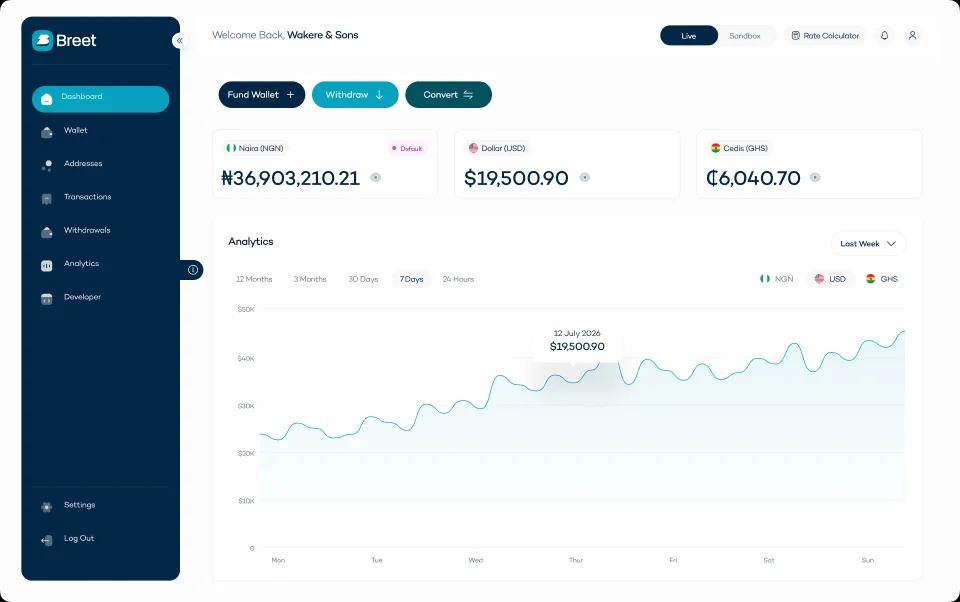
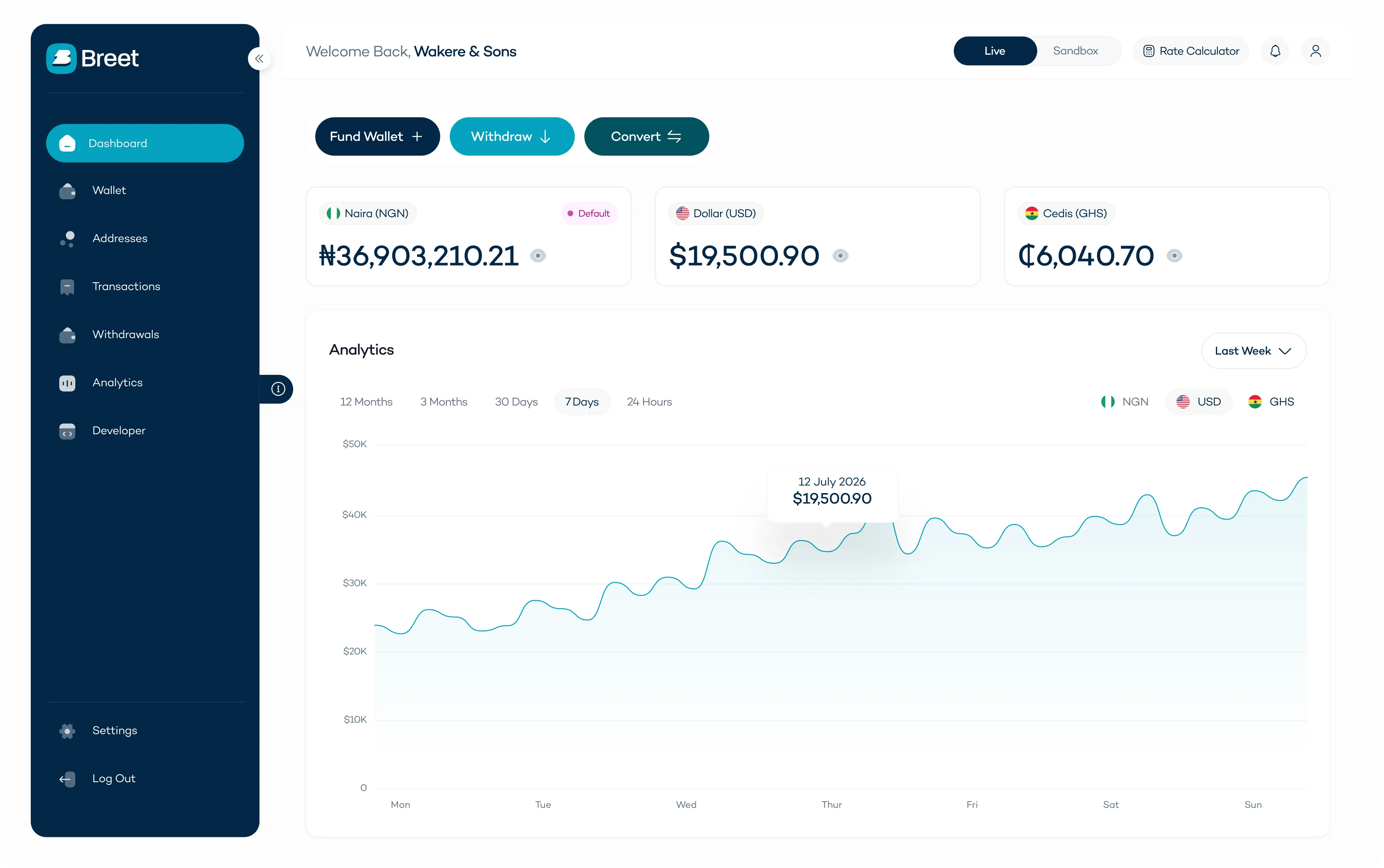
Yellow Card focuses on local-fiat collections, payouts, mobile money, and stablecoin treasury across African markets. Breet starts with customer crypto and provides direct settlement in stablecoins, USD, NGN, or GHS.
- Accept 12+ supported crypto assets using permanent or single-use wallet addresses.
- Convert deposits automatically after blockchain confirmation.
- Keep funds in stablecoins or USD, or settle directly to an NGN or GHS bank account.
- Withdraw through the API or Breet business dashboard at any time.
- Avoid liquidity management and wallet sweeping.
- Pay one volume-based transaction fee with no separate setup, monthly, or wallet-sweeping fees and no gas fee for receiving crypto.
- Test integrations in a public sandbox with webhooks, live asset discovery, and clear API documentation.
- Get direct integration support through dedicated Slack channel support.
What does the Yellow Card Payment API do?
The Yellow Card API overview describes a REST interface for local-currency collections and payouts, stablecoin settlement, real-time FX rates, transaction status, history, KYC submissions, and direct cryptocurrency settlement.
Its API Suite page adds cross-border payments, local payment collection, supplier payments, wallet functions, and stablecoin savings. Yellow Card says businesses can create wallets for buying, selling, sending, receiving, and saving crypto across 30+ blockchains, with custody or self-custody options.
This is broader than a crypto checkout. Yellow Card is designed to move value between local African payment methods and USD stablecoins across several markets.
What Yellow Card does well
Yellow Card covers multiple African markets. Few providers publish this many local payment corridors through one API.
- Twenty-country footprint. The Payment API covers bank and mobile-money methods across 20 African countries.
- Local-fiat collection and payout. Businesses can collect from end users and disburse to supported local destinations.
- Stablecoin treasury. Partners can settle balances in USD, USDT, or USDC and convert local fiat to or from stablecoins.
- Wallet choice. The API Suite describes both custody and self-custody options.
- Technical support. Yellow Card says partner support forms part of its service level agreement, or SLA.
This is useful for a company launching several corridors. One contract can replace a very untidy spreadsheet of local providers.
Important limits and trade-offs
1. The main flow and settlement model
Yellow Card's B2B Payment API is centred on local-fiat collection and disbursement, with stablecoins used for conversion and settlement. It also supports stablecoin checkout and wallet functions. The published B2B FAQ frames partner settlement as USD, USDT, or USDC, so buyers should compare the exact starting asset and final destination.
2. Pricing changes by country and amount
Yellow Card's current standard fee table lists Nigeria bank collection at 1% below NGN 100,000 and 0.5% above NGN 100,000. The table also contains minimum fees, and other countries use different percentages, fixed amounts, and bands.
The B2B agreement controls final pricing. A headline percentage alone will not show the complete corridor cost.
3. Ghana sources conflict
The current fee table says Ghana collection and payout channels are unavailable. An older coverage map lists GHS mobile-money collection and payout.
This may reflect a product change, documentation delay, or account-specific access. We cannot confirm which explanation is correct from public sources. A Ghana buyer should request a live coverage response and written commercial confirmation.
Who should choose the Yellow Card API?
Yellow Card deserves a close look when the business needs:
- Local-fiat collections and payouts across many African countries;
- Bank and mobile-money coverage through one integration;
- USD, USDT, or USDC treasury settlement;
- Supplier, payroll, or cross-border payment corridors;
- Custody or self-custody wallet options;
- A wider emerging-market payment network.
Final verdict on the Yellow Card API
Yellow Card supports broad African local-fiat coverage, mobile money, cross-border payouts, and stablecoin treasury. It is best suited to businesses that need several corridors and can verify current Ghana availability and route-level commercial terms.
However, if your users pay in crypto and you want a focused way to settle in stablecoins, NGN, or GHS without managing liquidity, gas fees, or wallet sweeping, try Breet API.
Comparing Yellow Card with Breet?
For a direct side-by-side decision, compare Breet and Yellow Card by product scope, fees, settlement, strengths, and the business cases each provider suits.