
As a crypto API provider, researching what other providers build is part of our job. This comparison gives Vaultody credit where it is due and states the limits we could verify.
We used public product pages, developer documentation, support pages, and regulator information available on 14 August 2026. We did not test Vaultody through a production account. Products, prices, and coverage can change.
Overview
Choose Vaultody when the business wants to own MPC wallet, custody, signing, policy, and treasury operations. Choose Breet when it wants a managed route from customer crypto to stablecoins, USD, NGN, or GHS without operating the wallet stack.
Breet vs Vaultody at a Glance
| Decision Point | Breet | Vaultody |
|---|---|---|
| Primary job | Convert supported crypto and settle NGN or GHS | Supply wallet, custody, and treasury infrastructure |
| Best for | Payment collection and local bank settlement | Teams operating their own digital-asset wallets |
| Custody model | Managed within the payment service | Non-custodial technology; customer or end user controls assets |
| Wallet controls | Payment addresses and managed operations | MPC signing, roles, policies, vaults, and audit trails |
| Conversion | Automatic for supported deposits | Requires the customer's selected providers and process |
| NGN bank settlement | Direct | Not publicly confirmed |
| GHS bank settlement | Direct | Not publicly confirmed |
| Pricing model | Volume-based transaction fee; no setup, monthly, or wallet-sweeping fees and no gas fee for receiving crypto | From $249 monthly plus volume overage |
| Test access | Sandbox | Seven-day testnet-only trial |
| Public uptime commitment | 99.9% SLA | Not found in the reviewed public pages |
The Main Difference Is the Outcome
This comparison is not only about API endpoints. It is about where responsibility ends.
Breet's route starts with a customer deposit address. When a supported asset arrives, Breet handles the conversion and settles the value to a Nigerian or Ghanaian bank account. The business does not need to assemble its own custody, liquidity, and local bank providers for that route.
Vaultody supplies the wallet and control layer. Its customer can create vaults and addresses, assign users and policies, sign transfers, receive event notifications, and manage treasury activity. The customer then combines that infrastructure with the other services needed for a complete payment product.
Both approaches are valid. The right one depends on whether infrastructure ownership is the objective or a means to a local payment result.
- Wallet and Custody Control
Breet: Breet does not ask a payment customer to operate that stack. It creates permanent or single-use addresses and manages the deposit and conversion process. This is less flexible for a custom custody product, but it reduces the work needed for payment collection.
Vaultody: For businesses that require this capability, Vaultody's broader scope may be relevant. Its current products use MPC/TSS technology and include: Vaultody says it never controls customer private keys or assets. That design lets the customer preserve custody responsibility. Vaultody's documented capabilities include Direct Custody; Treasury Management; Wallet-as-a-Service; vault and address management; roles, approval policies, and signing options; gas sponsorship, webhooks, and audit trails.
Decision: For wallet and custody control, Breet is the better fit when the priority is a focused route from customer crypto to stablecoins, USD, NGN, or GHS. Consider Vaultody only when its additional product scope is required.
- Conversion and Bank Settlement
Breet: Breet wins when the target is a bank account in Nigeria or Ghana. It supports automatic conversion and direct NGN or GHS settlement as part of its documented API service.
Vaultody: Vaultody can hold and transfer relevant blockchain assets on supported networks. It does not publicly document a current native route that converts a normal customer deposit and settles it to an NGN or GHS bank account. Its public material describes a Stablecoin Operations Platform as coming soon. A business can build local settlement around Vaultody. It must select the conversion, liquidity, regulated-service, and bank-rail providers. It must also reconcile the route and decide who owns failed transactions and customer support.
Decision: For conversion and bank settlement, Breet is the better fit when the priority is a focused route from customer crypto to stablecoins, USD, NGN, or GHS. Consider Vaultody only when its additional product scope is required.
- Pricing and total operating cost
Breet: Breet charges one transaction fee based on transaction volume. The rate is shared during onboarding and is structured to grow with the business. Breet does not charge setup, monthly, gas, wallet-sweeping, or other separate fees.
Vaultody: Vaultody publishes monthly infrastructure plans. Its listed Entry plan starts at $249 per month, with higher plans and outgoing-volume overage pricing. Those plans price wallet infrastructure, not automatic conversion and local-bank settlement.
Decision: A fair model must add conversion, liquidity, compliance, bank-rail, engineering, and support costs required to produce the same outcome. Compare the complete operating design, not only the subscription.
- Developer Experience
Breet: Breet exposes a smaller payment surface. Its API documentation (opens in new tab) covers addresses, transactions, settlement data, webhooks, and sandbox use. The simpler scope can reduce design and testing time when the product requirement is already clear. Breet provides a sandbox for integration testing. In both cases, production route behaviour must be tested before launch.
Vaultody: Vaultody exposes a larger wallet-control surface. Its REST APIs cover infrastructure that a team can adapt to different custody and treasury products. Webhooks support status updates, and subscription tiers set different data-flow limits. Vaultody's public trial lasts seven days and is testnet only.
Decision: Both providers publish developer documentation and support event-led integrations.
- Security and Compliance Boundaries
Breet: Breet manages more of the payment operation. It publishes a 99.9% uptime SLA, is a Canadian FINTRAC money service business, and has a Nigeria SEC ARIP application pending. A pending application must not be described as approval.
Vaultody: Vaultody's non-custodial design and MPC controls are its main strengths. Its site displays SOC 2 Type 1. The customer still owns policies, access design, approvals, and the wider service stack.
Decision: Each buyer remains responsible for its own legal assessment. Infrastructure security, custody status, conversion permission, and local payment licensing are separate questions.
- Asset Support
Breet: Breet supports 12+ deposit assets across its listed networks. Its value is not the largest possible list. It is that the supported assets connect to automatic conversion and local bank settlement.
Vaultody: Vaultody supports wallet activity on multiple networks, subject to product and plan. Confirm every required asset, token standard, function, and mainnet before committing.
Decision: For asset support, Breet is the better fit when the priority is a focused route from customer crypto to stablecoins, USD, NGN, or GHS. Consider Vaultody only when its additional product scope is required.
- Operational Responsibility
Breet: With Breet, more of those steps are inside one managed route. Breet also automatically recovers certain supported-asset mismatches on Breet-generated addresses. That statement does not mean every wrong asset or network can be recovered.
Vaultody: With Vaultody, the customer normally owns more decisions: Vaultody's documented capabilities include wallet and approval design; key-share and signing operations; provider selection; conversion and liquidity; local settlement; reconciliation and exception handling; customer support across the assembled stack.
Decision: For operational responsibility, Breet is the better fit when the priority is a focused route from customer crypto to stablecoins, USD, NGN, or GHS. Consider Vaultody only when its additional product scope is required.
When wallet ownership and policy control matter
These functions matter when they are core product requirements. If the business only needs crypto acceptance and settlement, they can add unnecessary integration work and ongoing operations.
Why Breet removes wallet-stack operations
Breet removes the infrastructure between the customer crypto payment and the chosen crypto or fiat output. The product team can keep the integration focused on the payment result.
Which should you choose?
Choose Breet when the business wants the simplest route from a customer crypto payment to stablecoins, USD, NGN, or GHS. Breet handles the crypto infrastructure and gives the team one focused payment flow.
- Accept 12+ supported crypto assets using permanent or single-use wallet addresses.
- Convert deposits automatically after blockchain confirmation.
- Keep funds in stablecoins or USD, or settle directly to an NGN or GHS bank account.
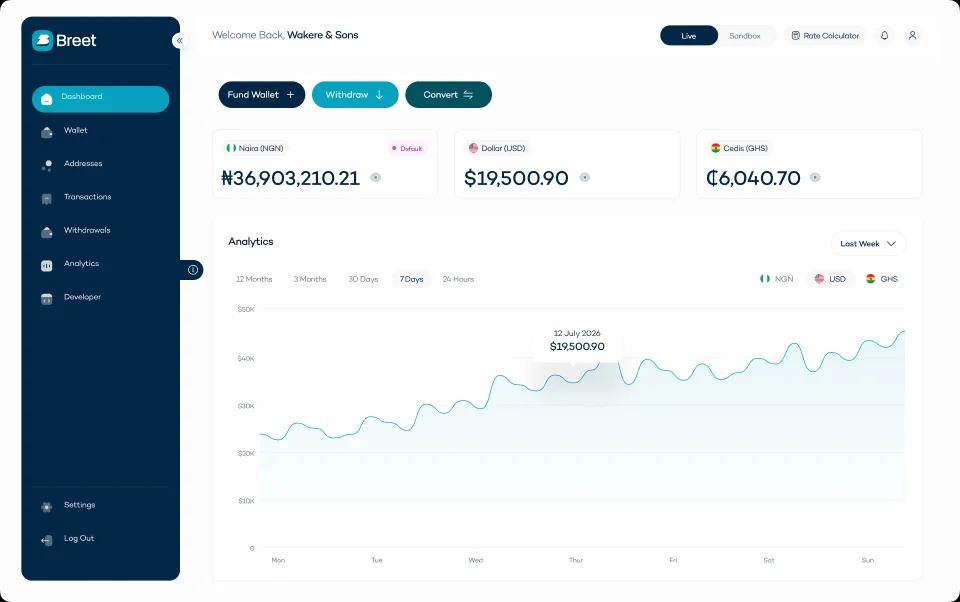
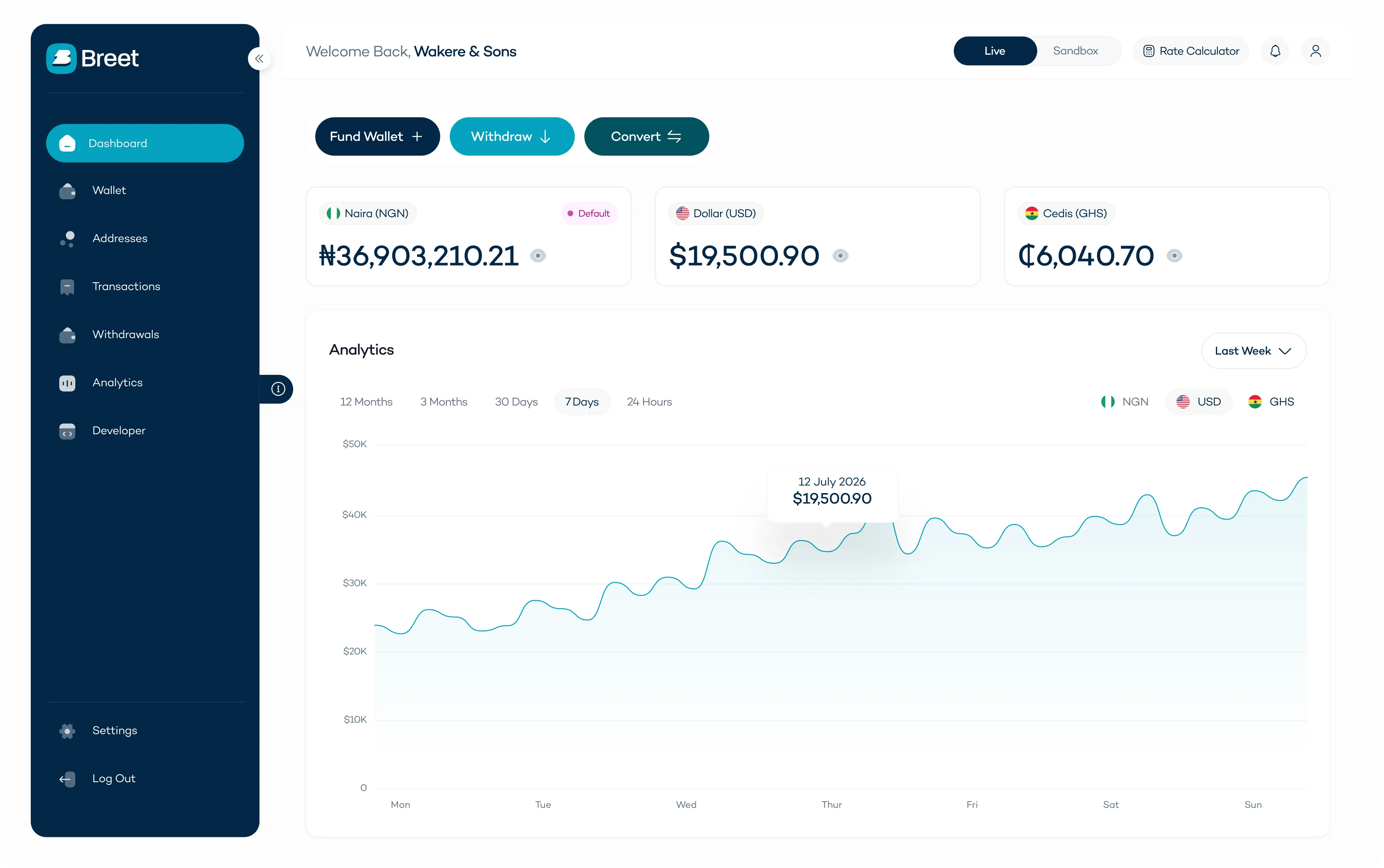
- Withdraw through the API or Breet business dashboard at any time.
- Avoid liquidity management and wallet sweeping.
- Pay one volume-based transaction fee with no separate setup, monthly, or wallet-sweeping fees and no gas fee for receiving crypto.
- Test integrations in a public sandbox with webhooks, live asset discovery, and clear API documentation.
- Get direct integration support through dedicated Slack channel support.
Consider Vaultody only when the product requires one or more of these additional capabilities: custody control is a product requirement; your team needs MPC signing and detailed policies; you are building embedded wallets or treasury operations. For a focused crypto acceptance and settlement flow, Breet removes more product decisions and operating work.
Need more detail on Vaultody?
Read the Vaultody API review for a focused review of its public features, pricing evidence, strengths, and limits. You can also compare other crypto payment APIs.