

As a crypto API provider, part of our job is to understand what other providers build. We review public documentation, pricing, product flows, and evidence we can verify. This review explains what we confirmed about Luno, where it may fit, and its important limits.
This review covers public information only. We did not use an account to test Luno response times, settlement speed, support, uptime, or production behaviour.
Luno API Review at a Glance
| Decision Point | Luno |
|---|---|
| Best for | Products that need exchange trading and market data |
| Business account | Yes, subject to review and business verification |
| Main API functions | Accounts, balances, market data, orders, buy/sell, send/receive, addresses, and transfers |
| Nigeria | Supported, with business accounts and NGN functions |
| Ghana | Not in the current supported-country list |
| Transaction costs | Nigeria instant buy/sell: 2%; exchange fees are volume and order-type dependent |
| Receive addresses | Yes, with published creation limits |
| WebSocket data | Yes |
| Separate sandbox | Not confirmed in current public sources |
| Payment webhooks | Not confirmed in current public API material |
| Current Nigeria status | Approval in Principle through admission to SEC ARIP |
How Breet Compares
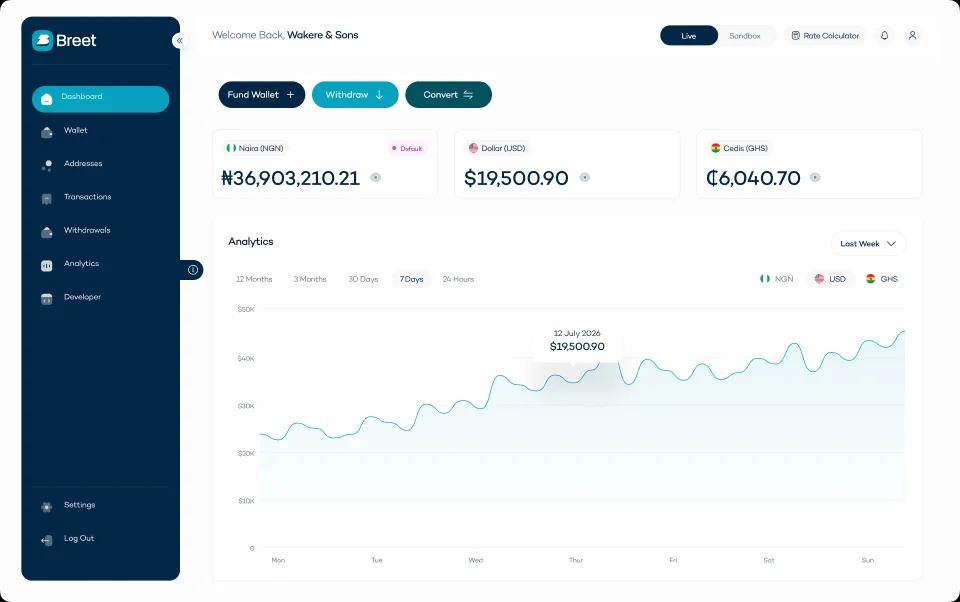
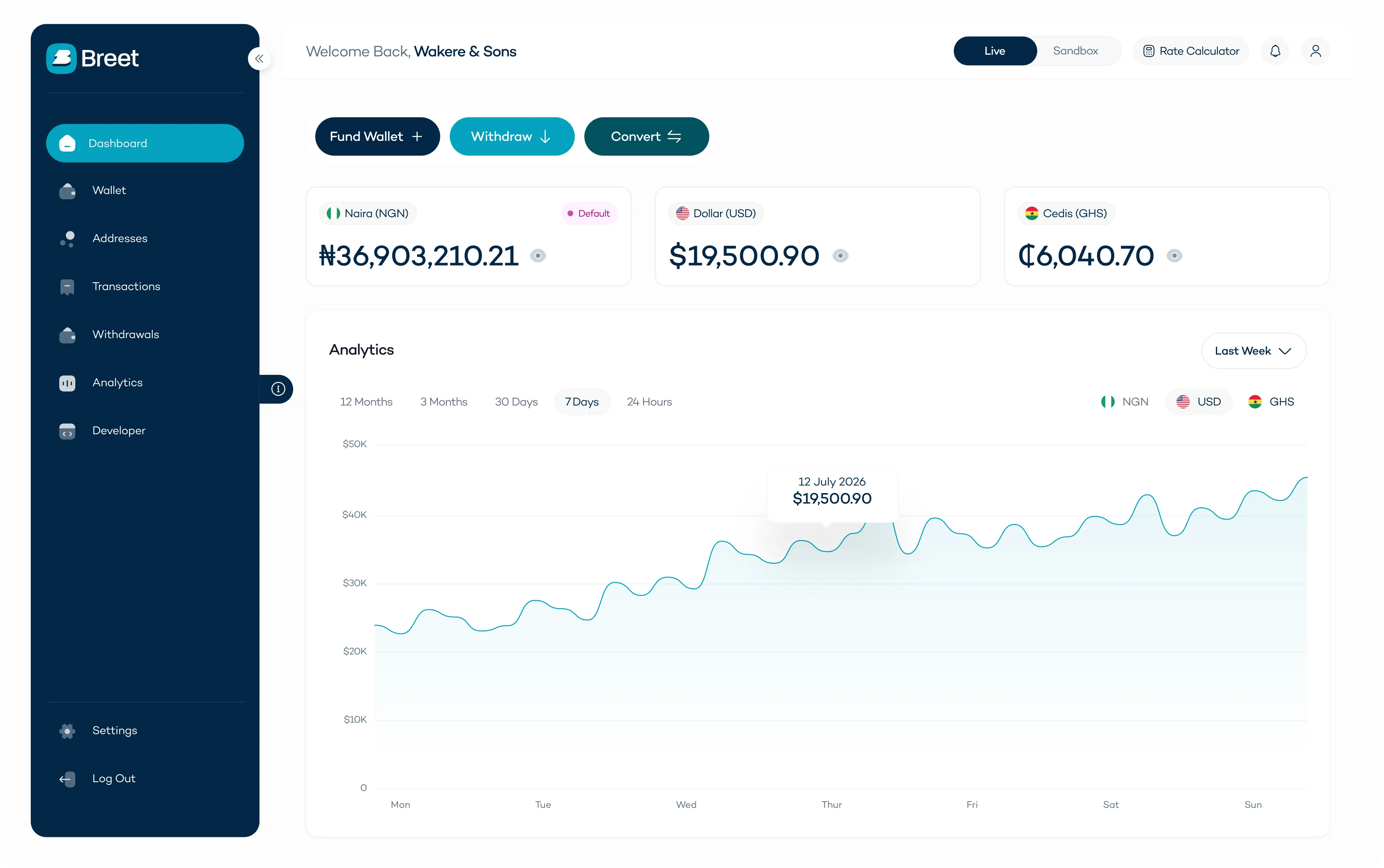
Luno focuses on exchange trading, market data, wallets, and crypto transfers. Breet focuses on accepting customer crypto and settling the value without operating an exchange flow.
- Accept 12+ supported crypto assets using permanent or single-use wallet addresses.
- Convert deposits automatically after blockchain confirmation.
- Keep funds in stablecoins or USD, or settle directly to an NGN or GHS bank account.
- Withdraw through the API or Breet business dashboard at any time.
- Avoid liquidity management and wallet sweeping.
- Pay one volume-based transaction fee with no separate setup, monthly, or wallet-sweeping fees and no gas fee for receiving crypto.
- Test integrations in a public sandbox with webhooks, live asset discovery, and clear API documentation.
- Get direct integration support through dedicated Slack channel support.
What Does the Luno API Do?
The Luno API is mainly an exchange and account API. It gives developers access to:
- current and historical market data;
- order books and recent trades;
- account balances and transaction entries;
- buy, sell, send, and receive functions;
- wallet address creation;
- bank transfer and beneficiary functions where available;
- WebSocket streams for lower-latency market data and order updates.
These functions support trading, treasury, broker, wallet, or payment products. The buyer must still design the payment, conversion, reconciliation, and settlement workflow.
Luno Business Accounts
Luno's business-account guide says a company can fund from its legal entity's bank, buy crypto, and integrate the API.
Payment-acceptance businesses can apply. Companies that handle third-party funds must show suitable licences plus anti-money-laundering and customer-verification policies.
Nigerian applicants provide incorporation, ownership, tax, address, identity, and authority documents.
Nigeria, Ghana, and Bank Functions
Luno lists Kenya, Nigeria, South Africa, Indonesia, and Malaysia. Users in supported countries can fund with local currency and withdraw to a bank in their name.
The API lists `NGN_EFT` as a Nigerian bank-transfer method. Access still depends on verification, permissions, beneficiaries, and local rules.
Ghana is not in the current supported-country list. A company that needs direct GHS bank settlement has a clear coverage gap to resolve.
Wallet Addresses and Crypto Transfers
Luno can get or create receive addresses and return their confirmed or unconfirmed totals.
The documentation states one new address per hour, bursts up to 10, and only one Ethereum receive address. Test this against any per-customer design.
Crypto sends need suitable permissions. Address validation also supports travel-rule fields.
Trading and Market Data
Trading and market data are core Luno functions. Its endpoints cover tickers, order books, trades, market information, and orders. WebSocket streams reduce polling.
Luno API Fees Explained
Luno's Nigerian fee page lists two different transaction models:
- Instant buying or selling from the Portfolio screen costs 2%.
- Luno Exchange uses maker and taker fees based on volume, order role, and pair. Nigerian taker fees start at 0.10% and decrease at higher volume.
Compare the final local amount for the same deposit, execution, and settlement route.
Developer Experience
Luno uses HTTP Basic authentication and granular key permissions. Limits are 300 calls per minute and 50 streaming sessions.
The API page names Go, Python, and PHP SDKs. The reference recommends Go and warns that other libraries may be third-party or inactive. Confirm maintenance status.
We found no separate sandbox or payment-event webhooks in current public material. Ask Luno for its non-production testing method.
Regulatory Status in Nigeria
In July 2026, Luno announced Approval in Principle through admission to the Nigeria SEC Accelerated Regulatory Incubation Program, within a defined scope and ongoing conditions.
This status differs from a pending application, but it is not an unrestricted permanent licence. Confirm the approved scope.
What Luno Does Well
- Exchange order books, trading, and market data.
- Crypto account, wallet, send, and receive functions.
- WebSocket data streams.
- Current Nigerian business-account support.
- Published NGN transfer methods and transaction costs.
- Granular API-key permissions.
- Current Approval in Principle in Nigeria's SEC ARIP.
Important Limits and Trade-Offs
- It is an exchange-led API, not a ready automatic crypto-to-bank gateway.
- Ghana is not in the current supported-country list.
- Exchange fees are not a complete merchant payment-processing price.
- Receive-address creation limits can affect per-customer wallet design.
- A separate sandbox and payment webhooks were not confirmed publicly.
- Business access depends on verification and regulatory fit.
Who should choose the Luno API?
Luno is relevant when you need:
- Order books, trades, and market data;
- Maker and taker order execution;
- Exchange accounts and balances;
- Wallet and crypto transfer functions;
- WebSocket market streams;
- A verified Nigerian business account;
- API access tied to an established exchange.
Final Verdict on the Luno API
Luno supports products that need trading, market data, exchange accounts, crypto transfers, and active Nigerian exchange access. It is less direct when the primary requirement is automatic conversion from customer crypto deposits to a local bank account.
However, if you only want to receive crypto from users, settle in stablecoins, NGN, or GHS, and withdraw at any time without running exchange, liquidity, gas, or wallet-sweeping operations, try Breet API.
Comparing Luno with Breet?
For a direct side-by-side decision, compare Breet and Luno by product scope, fees, settlement, strengths, and the business cases each provider suits.