

As a crypto API provider, part of our job is to understand what other providers build. We review public documentation, pricing, product flows, and evidence we can verify. This review explains what we confirmed about Bitnob, where it may fit, and its important limits.
This review covers public information only. We did not use an account to test Bitnob response times, settlement speed, support, uptime, or production behaviour.
Bitnob API review at a glance
| Decision point | Bitnob |
|---|---|
| Best for | Businesses that need global payouts and broader financial infrastructure |
| Main capabilities | Payouts, wallets, trading, bulk transfers, cards, Bitcoin Lightning, customer records, and webhooks |
| Crypto-funded payout assets | BTC, USDT, and USDC |
| Local African payout examples | NGN bank transfer; GHS bank transfer and mobile money; KES bank and M-Pesa |
| Wider payout reach | Live supported-country endpoint; docs say the full response lists about 100 countries |
| Public comparable transaction fee | No standard percentage published; quotes return fees and effective rates |
| Wallet models | Custodial business wallets and non-custodial enterprise wallet infrastructure |
| Sandbox | Yes |
| API resources | OpenAPI 3.0 files, Postman, examples, test data, and webhooks |
How Breet Compares
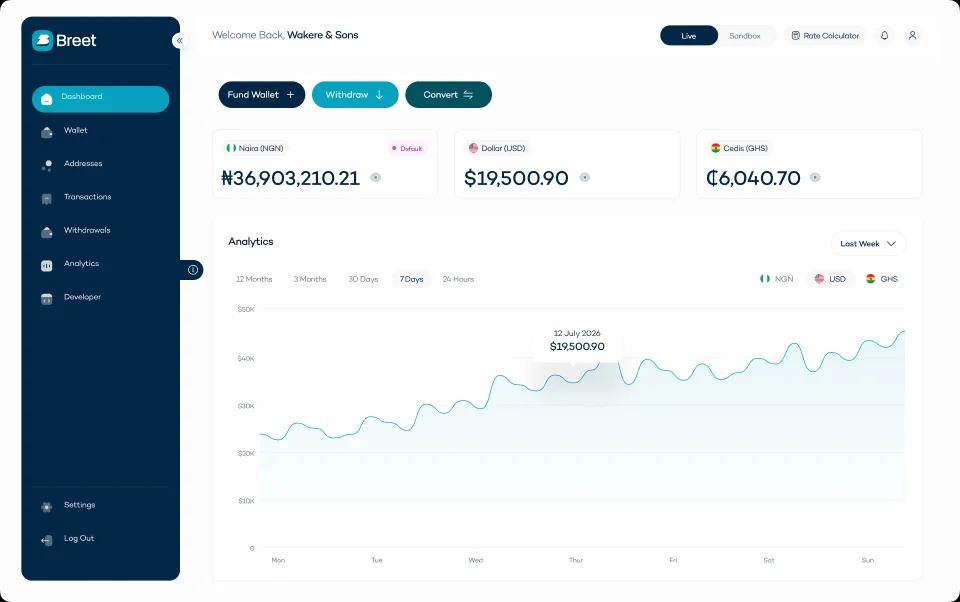
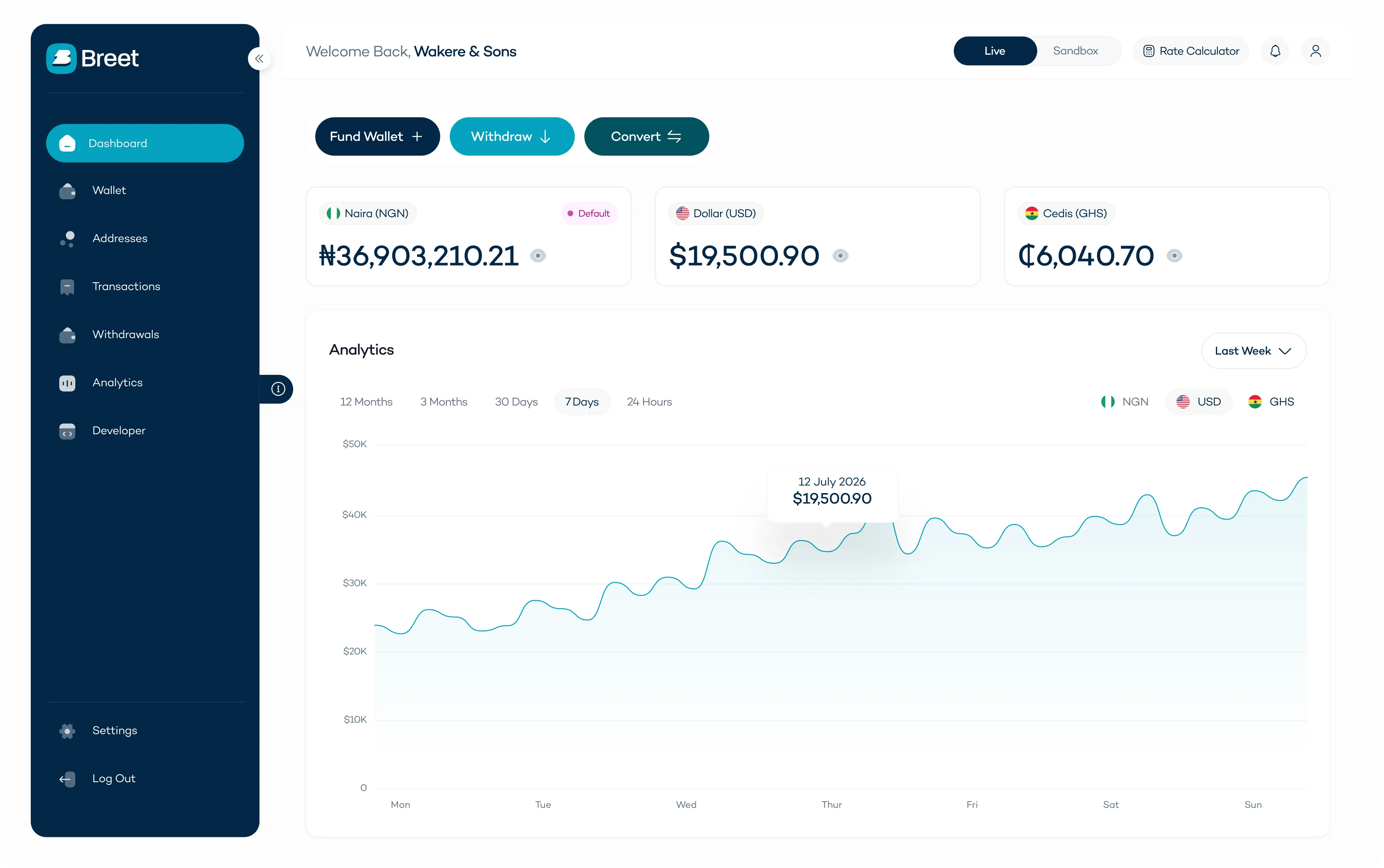
Bitnob combines global payouts with wallets, cards, trading, and Bitcoin infrastructure. Breet provides a more focused route for accepting crypto and settling in stablecoins, USD, NGN, or GHS.
- Accept 12+ supported crypto assets using permanent or single-use wallet addresses.
- Convert deposits automatically after blockchain confirmation.
- Keep funds in stablecoins or USD, or settle directly to an NGN or GHS bank account.
- Withdraw through the API or Breet business dashboard at any time.
- Avoid liquidity management and wallet sweeping.
- Pay one volume-based transaction fee with no separate setup, monthly, or wallet-sweeping fees and no gas fee for receiving crypto.
- Test integrations in a public sandbox with webhooks, live asset discovery, and clear API documentation.
- Get direct integration support through dedicated Slack channel support.
What does the Bitnob API do?
The Bitnob developer portal presents one broad financial API. Its current OpenAPI material covers balances, deposit addresses, transaction history, withdrawals, exchange rates, trading, bulk transfers, payouts, cards, Lightning, customers, and beneficiaries.
The wider platform can also hold business balances, issue cards, create customer wallets, and run trading functions. That breadth makes Bitnob useful for a product team building several financial services through one provider.
What Bitnob does well
Bitnob combines product and geographic breadth. It covers more payment jobs than a focused crypto conversion API.
- Global payout reach. The API exposes a live country and rail endpoint. Bitnob's documentation says the full response lists about 100 countries.
- African payout rails. Published examples include NGN bank transfers and GHS bank or mobile-money payouts.
- Several funding choices. Payouts can start with BTC, USDT, USDC, a Bitnob wallet balance, or supported fiat.
- More business products. Cards, bulk transfers, trading, Lightning, wallets, and customer records can sit beside payouts.
- Detailed developer material. Bitnob publishes OpenAPI files, Postman collections, sandbox flows, examples, and test data.
- Custody choice. The wallet product describes both provider-managed and non-custodial infrastructure options.
The platform targets fintechs with a broad roadmap. A team can inspect many of the integration details before it speaks to sales.
Important limits and trade-offs
1. Comparable transaction pricing is not public
Bitnob does not publish one standard transaction percentage for the complete crypto-to-local-fiat flow. Its payout quote response includes the fee, exchange rate, effective rate, and final settlement amount for the selected route.
That quote model can be precise, but it makes public cost planning harder. Get written examples for the same asset, amount, blockchain, destination currency, and payout method that your product will use.
2. Product breadth adds decisions
Cards, wallets, trading, Lightning, and global payouts are useful when they belong on the roadmap. They also add decisions about balances, customer onboarding, permissions, reconciliation, treasury, and compliance.
A company that only needs customer crypto converted to an NGN or GHS bank account may not need the full platform.
3. Static coverage pages are not the final answer
Bitnob's supported-currency guide lists major currencies and rails. Its API reference says the live production country response is larger and that the sandbox contains only a subset.
Do not hard-code a corridor from a marketing page. Query the live endpoint and confirm the account has the required destination type, currency, limits, and compliance approval.
4. Public licence detail is limited
Bitnob's business page describes the company as regulated and compliant. Its legal page names Bitnob Technologies Limited and says payment services may be supplied by licensed financial institutions. It does not give one complete public licence map for every country and product.
Procurement should confirm the contracting entity, provider partners, regulated activity, and responsibility split for the proposed route.
Who should choose the Bitnob API?
Bitnob deserves a close look when the business needs:
- Payouts into many countries and payment rails;
- GHS mobile-money payouts as well as bank settlement;
- BTC, USDT, or USDC-funded disbursements;
- Virtual card issuing or spend controls;
- Bitcoin Lightning, trading, or scheduled orders;
- Custodial or non-custodial wallet infrastructure;
- Bulk transfers and broader customer-account tools.
Final verdict on the Bitnob API
Bitnob supports businesses that need global payouts, mobile money, cards, Bitcoin products, trading, bulk transfers, and wallet infrastructure. Its broad product range suits teams building several financial functions from one platform. Buyers should confirm current corridor coverage, limits, licensing, and transaction pricing during onboarding.
However, if you want a simpler way to receive crypto from users, settle in stablecoins, NGN, or GHS, and withdraw at any time without managing liquidity, gas fees, wallet sweeping, or extra financial modules, try Breet API.
Comparing Bitnob with Breet?
For a direct side-by-side decision, compare Breet and Bitnob by product scope, fees, settlement, strengths, and the business cases each provider suits.