

As a crypto API provider, part of our job is to understand what other providers build. We review public documentation, pricing, product flows, and evidence we can verify. This review explains what we confirmed about Ivorypay, where it may fit, and its important limits.
This review covers public information only. We did not use an account to test Ivorypay response times, settlement speed, support, uptime, or production behaviour.
Ivorypay API review at a glance
| Decision point | Ivorypay |
|---|---|
| Best for | Businesses that need African stablecoin payment tools |
| Main capabilities | Crypto and fiat collection, permanent wallet addresses, bank transfers, crypto transfers, virtual accounts, swaps, webhooks, and sandbox |
| Public crypto assets | USDT, USDC, BTC, and ETH on 8+ blockchain networks |
| Public coverage statement | One crypto collection price across 17 countries; specific payment methods can vary by country |
| Settlement options | Bank account, mobile-money wallet, or crypto wallet, subject to route availability |
| Crypto collection price | 1% per transaction, capped at $25 |
| Address price | First 500 static wallet addresses are free, then $0.10 per address |
| Setup price | No setup cost stated |
| Sandbox and webhooks | Yes |
How Breet Compares
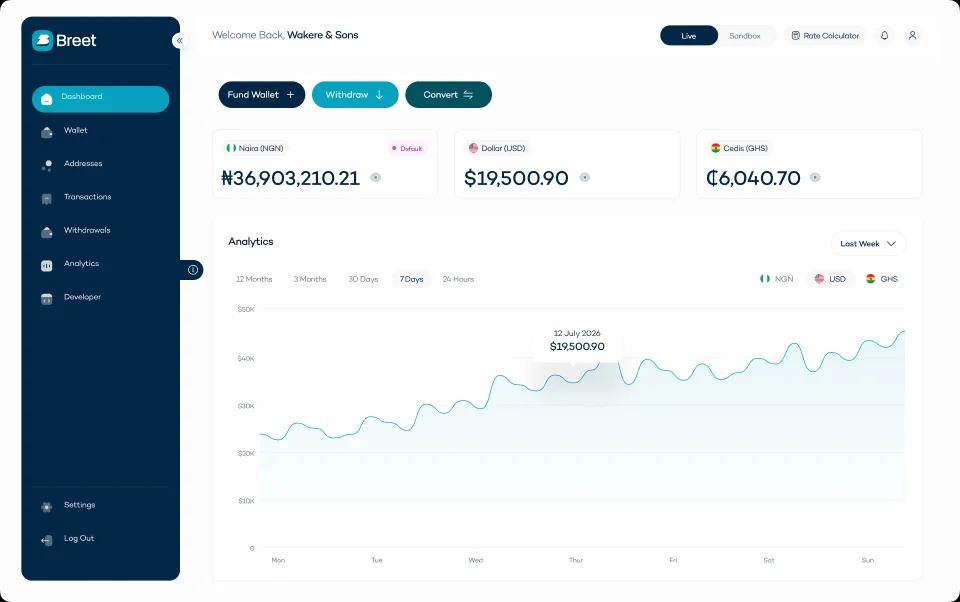
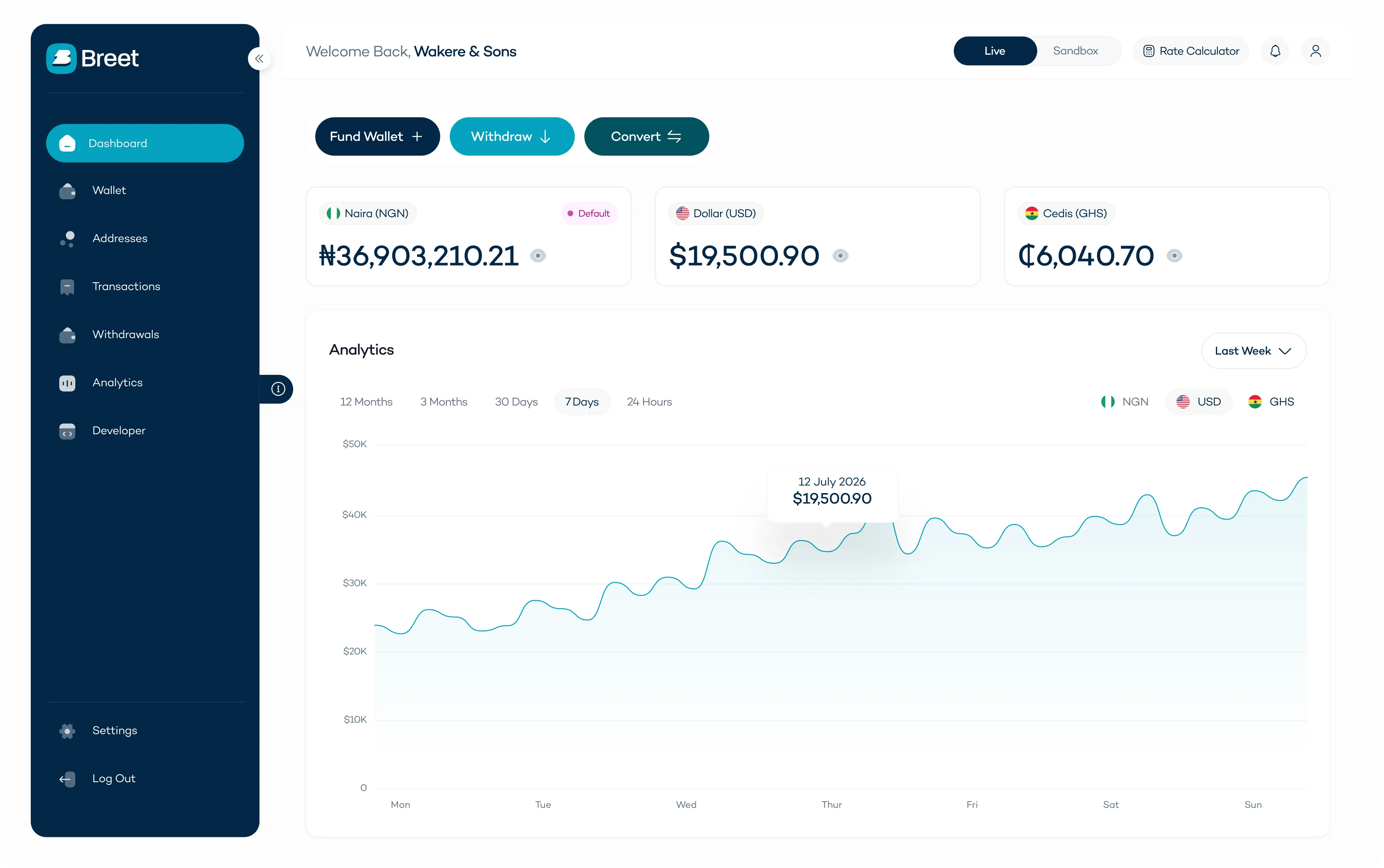
Ivorypay combines crypto and fiat collection with virtual accounts, transfers, and mobile-money routes. Breet focuses on automatic crypto conversion and direct NGN or GHS bank settlement.
- Accept 12+ supported crypto assets using permanent or single-use wallet addresses.
- Convert deposits automatically after blockchain confirmation.
- Keep funds in stablecoins or USD, or settle directly to an NGN or GHS bank account.
- Withdraw through the API or Breet business dashboard at any time.
- Avoid liquidity management and wallet sweeping.
- Pay one volume-based transaction fee with no separate setup, monthly, or wallet-sweeping fees and no gas fee for receiving crypto.
- Test integrations in a public sandbox with webhooks, live asset discovery, and clear API documentation.
- Get direct integration support through dedicated Slack channel support.
What does the Ivorypay API do?
The Ivorypay API documentation describes one REST API for crypto and fiat payment collection. A business can create payment requests, generate a permanent wallet address for each customer, send crypto to an external address, send fiat to a bank account, and receive transaction events through webhooks.
Ivorypay also provides virtual bank accounts, swaps, a hosted payment gateway, and white-label integration. The current documentation includes test and live environments. It also provides endpoints for discovering the tokens and networks enabled for an account.
This product range makes Ivorypay more than a stablecoin checkout. It can support an embedded payment product that moves value between crypto, bank, and mobile-money rails.
What Ivorypay does well
Ivorypay combines African reach with public pricing.
- Several settlement choices. The public pricing page says a business can settle to a bank account, mobile-money wallet, or crypto wallet.
- A capped crypto collection fee. The 1% price stops at $25, which can help businesses that process large transactions.
- Permanent customer addresses. A platform can allocate an address to each customer for repeated deposits and easier attribution.
- Fiat and crypto tools in one API. Collection, bank transfer, blockchain transfer, swaps, and virtual accounts can support more than one payment flow.
- Useful webhook controls. Ivorypay documents HMAC SHA512 signatures and retries failed webhook deliveries every minute for 24 hours.
- A sandbox. Test keys let developers use the API without moving real funds.
The public documentation is detailed enough for a developer to inspect the main endpoints and event model before production access.
Important limits and trade-offs
1. The capped fee changes effective pricing by transaction size
Ivorypay charges 1% for crypto collection, capped at $25. The cap is reached at $2,500: a $1,000 collection costs $10, while a $5,000 collection still costs $25 before conversion or route-specific costs. This is not a complete landed-cost calculation because rates, enabled routes, account terms, and volume pricing can change the result.
2. Static wallet addresses can add a usage charge
Ivorypay includes the first 500 static wallet addresses, then lists a price of $0.10 for each address. This matters for an app that assigns one permanent address to every customer. Ask whether inactive, repeated, or network-specific addresses count toward the bill.
3. Public coverage needs route-level confirmation
Ivorypay says its crypto collection price applies across 17 countries, and its product pages describe bank and mobile-money settlement. The public material does not give one complete, current table that maps every country to every bank, mobile-money, currency, and settlement method.
An older virtual-account page says that feature is available only to Nigerian businesses. An older currency endpoint example lists GHS as active. Treat these as product clues, not proof of current account access. Confirm the exact country, currency, payment method, and transaction limits before launch.
4. Regulatory checks remain part of procurement
Ivorypay's public user agreement identifies Ivorychain Technologies INC as the service company. Public pages do not provide enough current, market-by-market detail to state which licence covers each business flow. Ask for the contracting entity and regulatory basis for the exact corridor during due diligence.
Who should choose the Ivorypay API?
Ivorypay deserves a close look when the business needs:
- Bank and mobile-money settlement across several African markets;
- Both fiat and crypto collection;
- A $25 cap for large crypto collection transactions;
- Permanent wallet addresses for repeated customer deposits;
- Virtual bank accounts or white-label payment infrastructure;
- Bank, blockchain, and swap functions in one integration.
Final verdict on the Ivorypay API
Ivorypay supports businesses that need crypto collection and broader African payment coverage. Its stated country reach, mobile-money settlement, virtual accounts, and capped pricing can be useful, but buyers should compare the same source asset, destination, amount, and settlement method.
However, if you want a simple customer-address flow that receives crypto and settles in stablecoins, NGN, or GHS without gas fees or wallet sweeping, try Breet API.
Comparing Ivorypay with Breet?
For a direct side-by-side decision, compare Breet and Ivorypay by product scope, fees, settlement, strengths, and the business cases each provider suits.