

As a crypto API provider, part of our job is to understand what other providers build. We review public documentation, pricing, product flows, and evidence we can verify. This review explains what we confirmed about Coinbase Payments, where it may fit, and its important limits.
This review covers public information only. We did not use an account to test Coinbase Payments response times, settlement speed, support, uptime, or production behaviour.
Coinbase Payments at a Glance
| Decision Point | Coinbase Payments |
|---|---|
| Best for | Businesses that need enterprise stablecoin checkout |
| Main acceptance assets | USDC and USDT |
| Listed acceptance networks | Ethereum, Base, Arbitrum, Optimism, and Polygon |
| Buyer methods | Coinbase account, 500+ self-custody wallets, and x402-enabled agents |
| Payment controls | Authorization, capture, partial capture, void, refund, fee splits, and disbursement |
| Checkout choices | Hosted page, redirect, or embeddable component |
| Settlement | Fedwire, SWIFT, or USDC for Payment Acceptance, subject to onboarding and configuration |
| Direct NGN/GHS bank settlement | Not confirmed in current public sources |
| Standard transaction fee | Not publicly stated |
| Sandbox and webhooks | Yes |
| Onboarding | Team-led for Payment Acceptance |
How Breet Compares
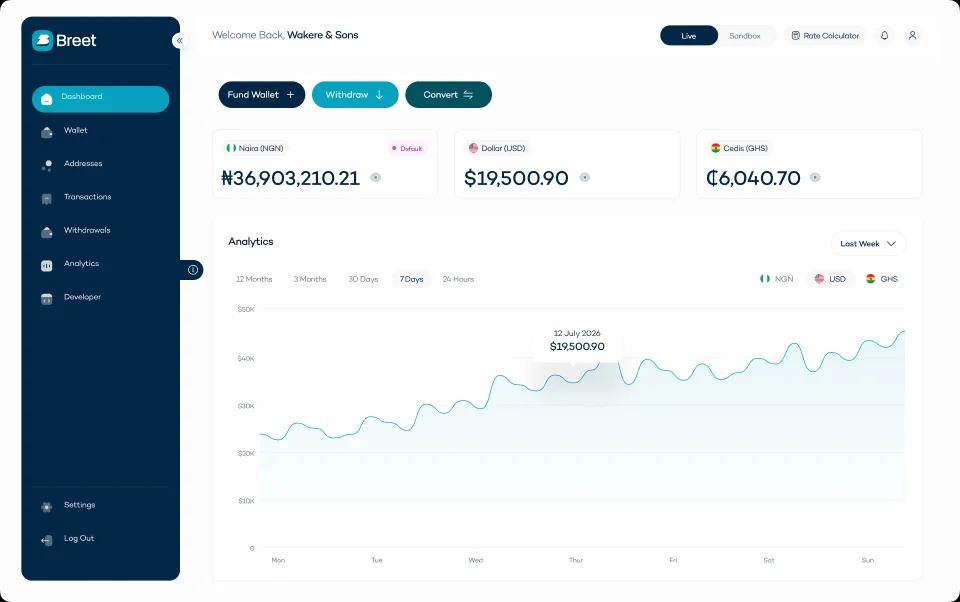
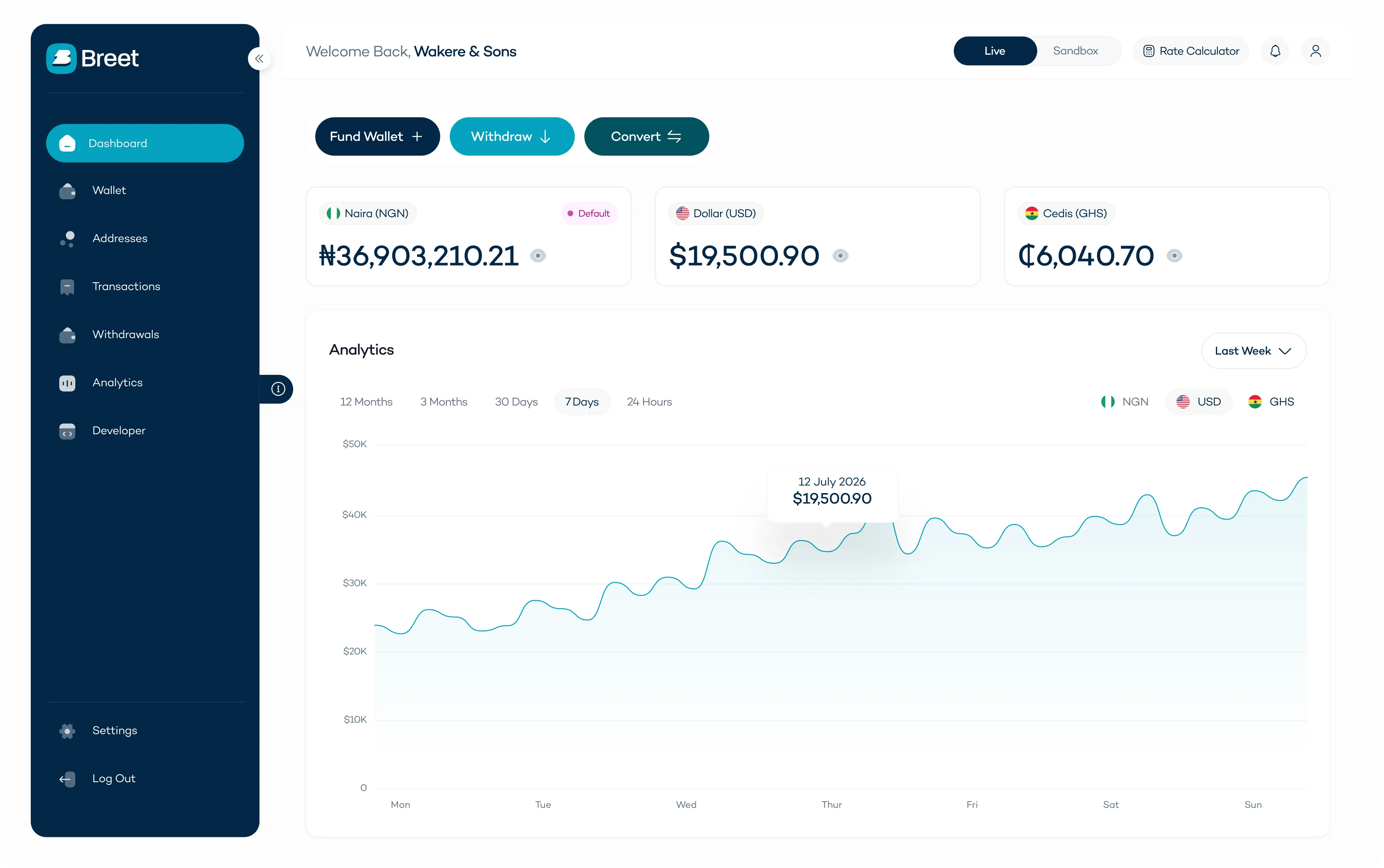
Coinbase Payments focuses on enterprise stablecoin checkout and payment controls. Breet accepts a broader range of supported crypto assets and provides direct NGN and GHS settlement.
- Accept 12+ supported crypto assets using permanent or single-use wallet addresses.
- Convert deposits automatically after blockchain confirmation.
- Keep funds in stablecoins or USD, or settle directly to an NGN or GHS bank account.
- Withdraw through the API or Breet business dashboard at any time.
- Avoid liquidity management and wallet sweeping.
- Pay one volume-based transaction fee with no separate setup, monthly, or wallet-sweeping fees and no gas fee for receiving crypto.
- Test integrations in a public sandbox with webhooks, live asset discovery, and clear API documentation.
- Get direct integration support through dedicated Slack channel support.
What Is Coinbase Payments?
Coinbase Payments covers merchant payments, deposits, payouts, treasury management, fiat ramps, custody, and stablecoin infrastructure. Two acceptance paths matter:
- Coinbase Business gives eligible businesses a dashboard, hosted payment links, invoices, a checkout API, custody, and bank offramps.
- Coinbase Payment Acceptance gives payment service providers, marketplaces, and enterprise platforms more control over payment sessions and the payment lifecycle.
Coinbase Commerce Has Changed
Coinbase says the Commerce portal became inaccessible after 31 March 2026 and directs eligible merchants to Coinbase Business. The official transition guide named the United States and Singapore as eligible Business markets at that time.
Business is custodial and adds payment links, invoicing, bank offramps, trading, accounting integrations, and a sandbox. Existing Commerce API users must change APIs and authentication. Confirm whether you need Coinbase Business or Payment Acceptance before using an old Commerce review.
Payment Assets, Networks, and Wallet Reach
The current Payment Acceptance overview says buyers can pay in USDC or USDT. It lists Ethereum, Base, Arbitrum, Optimism, and Polygon for the acceptance flow.
Buyers can pay from a Coinbase account or more than 500 self-custody wallets. Coinbase names MetaMask, Trust Wallet, and Base Pay. It also supports x402 authorization for machine-to-machine payments.
Payment Lifecycle and Checkout Control
Coinbase supports card-like payment controls. Its current API supports:
- payment-session creation;
- wallet, Coinbase account, or x402 authorization;
- automatic or manual capture;
- partial captures, voids, and partial refunds;
- expiry rules, fee splits, and disbursements.
Settlement and African Bank Coverage
Coinbase Payment Acceptance lists Fedwire, SWIFT, or USDC settlement, plus bank sweeps and reconciliation files. Coinbase Business settles to the business's Coinbase account and offers bank offramps where supported.
We found no current public confirmation of a direct NGN or GHS local-bank route. A buyer must get the legal entity, rail, currency, timing, and eligibility in writing.
Coinbase Payments Fees
Coinbase does not publish one standard Payment Acceptance transaction fee. Its comparison table refers to configurable fee splits and custom billing models.
The Commerce transition page lists 1% for Commerce and migrating Business merchants. That does not prove every Payment Acceptance account costs 1%.
Developer Experience and Onboarding
Coinbase offers a sandbox, API reference, OpenAPI specification, webhooks, reports, and reconciliation files. Coinbase Business is self-serve for eligible entities. Payment Acceptance requires enhanced due diligence and gives a public onboarding estimate of about one month, not a guarantee.
What Coinbase Payments Does Well
- Full payment lifecycle controls for enterprise checkout.
- USDC and USDT acceptance across five listed EVM networks.
- Access from a Coinbase account or 500+ self-custody wallets.
- Partial captures, partial refunds, voids, fee splits, and disbursements.
- Sandbox, webhooks, reports, and reconciliation files.
Important Limits and Trade-Offs
- Standard Payment Acceptance pricing is not public.
- Payment Acceptance requires team-led onboarding.
- The current acceptance product is stablecoin-first, not a broad volatile-asset gateway.
- Direct NGN and GHS bank settlement is not publicly confirmed.
Who should choose the Coinbase Payments API?
Coinbase Payments is relevant when you need:
- USDC and USDT checkout for an enterprise payment platform;
- Authorization, manual capture, voids, and partial refunds;
- Coinbase account and broad self-custody wallet reach;
- Fedwire, SWIFT, or USDC settlement;
Final Verdict on Coinbase Payments
Coinbase Payments supports enterprise stablecoin checkout, payment controls, and access to the Coinbase wallet ecosystem. Buyers should confirm current pricing, onboarding eligibility, supported assets, and settlement corridors for every launch market.
However, if you want a focused way to receive crypto from users, settle in stablecoins, NGN, or GHS, and withdraw at any time without managing custody, liquidity, gas fees, or wallet sweeping, try Breet API.
Comparing Coinbase Payments with Breet?
For a direct side-by-side decision, compare Breet and Coinbase Payments by product scope, fees, settlement, strengths, and the business cases each provider suits.