

As a crypto API provider, part of our job is to understand what other providers build. We review public documentation, pricing, product flows, and evidence we can verify. This review explains what we confirmed about Crypto APIs, where it may fit, and its important limits.
This review covers public information only. We did not use an account to test Crypto APIs response times, settlement speed, support, uptime, or production behaviour.
Crypto APIs at a Glance
| Decision Point | Crypto APIs |
|---|---|
| Best for | Businesses building blockchain infrastructure |
| Network claim | 30+ blockchain networks on the current product site |
| Main tools | Data, nodes, transactions, fees, contracts, HD wallets, events, AML, market data, AI/MCP, and x402 |
| Wallet model | HD-wallet management with xPub synchronisation and local transaction signing |
| Webhooks | Yes, through Blockchain Events and callbacks |
| x402 settlement | On-chain USDC for paid API requests |
| Free plan | $0 with 100,000 monthly credits and one event |
| Paid entry plan | Starter at $49 per month |
| Direct NGN bank settlement | Not publicly confirmed |
| Direct GHS bank settlement | Not publicly confirmed |
| Main product model | Credit-based blockchain infrastructure |
How Breet Compares
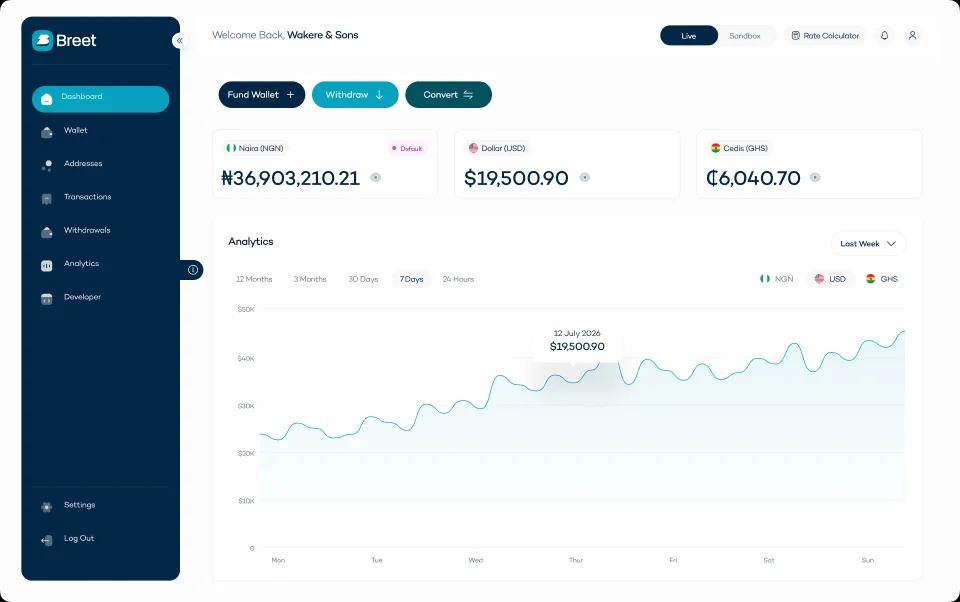
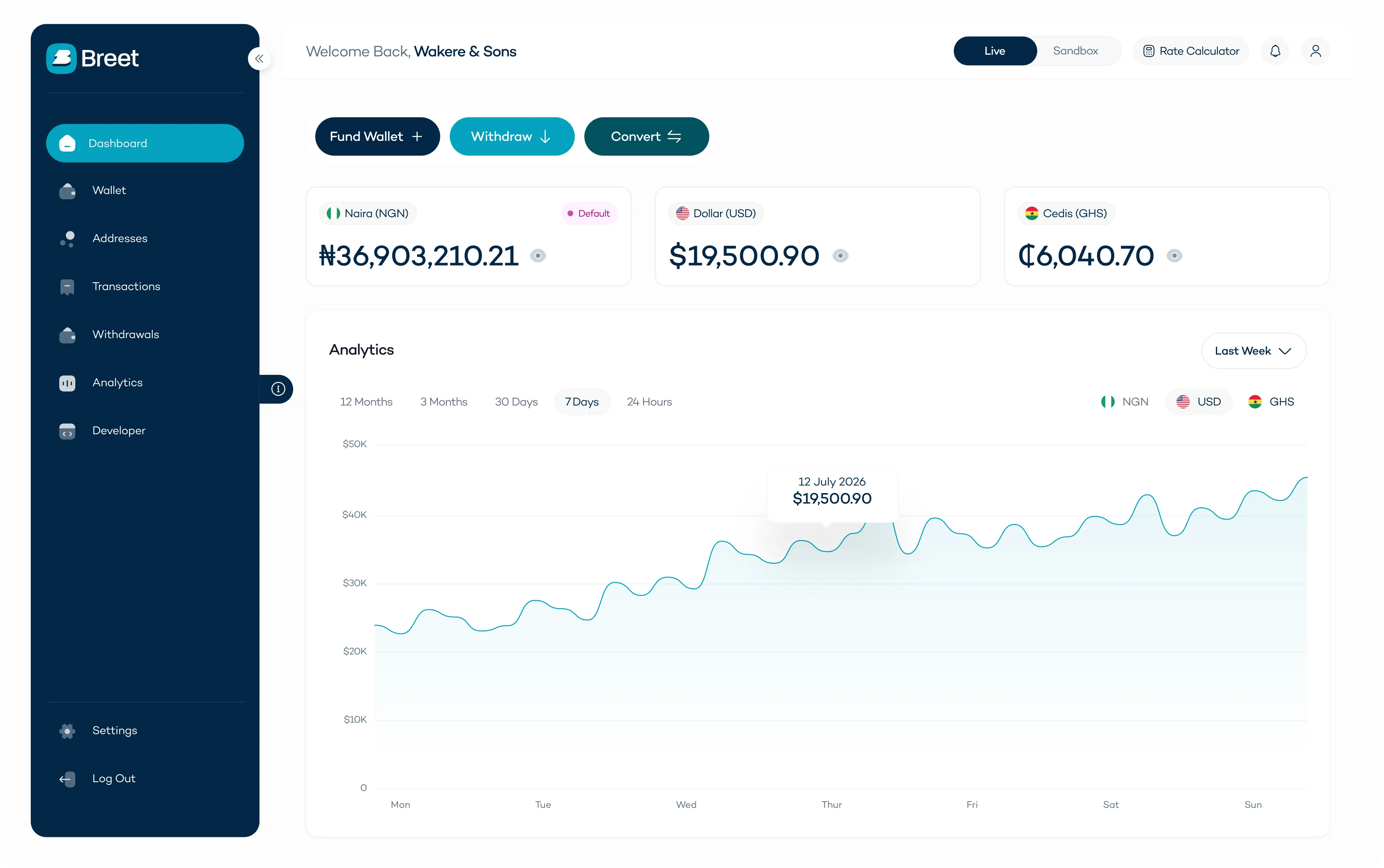
Crypto APIs provides blockchain data, nodes, transaction tools, and wallet infrastructure. Breet manages the payment flow so businesses do not need to assemble those blockchain components.
- Accept 12+ supported crypto assets using permanent or single-use wallet addresses.
- Convert deposits automatically after blockchain confirmation.
- Keep funds in stablecoins or USD, or settle directly to an NGN or GHS bank account.
- Withdraw through the API or Breet business dashboard at any time.
- Avoid liquidity management and wallet sweeping.
- Pay one volume-based transaction fee with no separate setup, monthly, or wallet-sweeping fees and no gas fee for receiving crypto.
- Test integrations in a public sandbox with webhooks, live asset discovery, and clear API documentation.
- Get direct integration support through dedicated Slack channel support.
What Does Crypto APIs Provide?
Crypto APIs provides one infrastructure layer for several blockchain systems.
Its current product range includes:
- blockchain, block, address, token, and transaction data;
- shared and dedicated node access;
- smart-contract and token information;
- fee estimates and transaction simulation;
- transaction preparation and broadcast;
- HD-wallet management;
- event subscriptions and callbacks;
- AML address and transaction screening;
- exchange-rate and market data;
- AI and MCP tools;
- x402 payments for applications and software agents.
The buyer must still design the final product.
Blockchain Data and Node Access
Crypto APIs gives one interface for data from multiple chains. Developers can retrieve blocks, transactions, address histories, token details, and other indexed information. Node endpoints support applications that need direct blockchain requests without running their own infrastructure.
The current site states coverage for more than 30 networks. Coverage can differ by product and endpoint, so a buyer should check the exact network and function matrix. A general network count is not proof that every API works on every chain.
This is useful for analytics, wallets, exchanges, compliance products, and back-office systems.
HD Wallets and Transaction Flow
The HD-wallet product lets a team synchronise extended public keys, derive addresses, and monitor related transactions. This supports deposit tracking without sending private keys to Crypto APIs.
In the documented transaction flow, Crypto APIs can prepare transaction data. The customer signs it locally and then sends the signed transaction for broadcast. That design preserves signing control, but the customer must operate secure signing and transaction policies.
Blockchain Events and Webhooks
Blockchain Events can notify an application about blocks, incoming or outgoing transactions, and confirmation changes. Callbacks reduce the need to poll every address and can support status updates or reconciliation.
Event capacity depends on the price plan. The Free plan includes one event, while paid plans list unlimited events. Buyers should still confirm callback retry rules, signing or verification, throughput, and retention for their use case.
What Is Crypto APIs x402?
Crypto APIs x402 supports machine-to-machine payments for HTTP services. An API can return a payment requirement, and a buyer application or agent can pay before it receives the protected resource.
The current product uses on-chain USDC. The buyer signs locally, and the facilitator remains non-custodial. Merchant and buyer SDKs help teams add the protocol.
This is an important current product, but it is not a standard crypto checkout with local bank settlement. It is designed for paid API calls and agent activity. The settlement asset is USDC, not NGN or GHS in a bank account.
Crypto APIs Pricing
The current Crypto APIs pricing page lists:
| Plan | Monthly Price | Monthly Credits | Events | Support Response |
|---|---|---|---|---|
| Free | $0 | 100,000 | 1 | Self-serve or community |
| Starter | $49 | 30 million | Unlimited | 72 hours |
| Scale | $299 | 200 million | Unlimited | 48 hours |
| Pro | $799 | 600 million | Unlimited | 24 hours, dedicated |
| Enterprise | Custom | Custom | Custom | Enterprise terms |
Annual billing reduces the stated monthly equivalent to $40 for Starter, $249 for Scale, and $665 for Pro. Paid accounts can use Pay As You Go credits after included credits are exhausted. Extra-credit prices and soft or hard throughput limits depend on the plan.
Starter includes quotas of 10,000 x402 merchant settlements and 30,000 buyer payments per billing cycle. Higher plans increase those quotas.
Security and Legal Position
The Crypto APIs security page states ISO/IEC 27001:2013 certification by TÜV Rheinland. Its terms identify a Delaware company. These facts do not establish that Crypto APIs provides regulated local currency conversion or bank settlement.
What Crypto APIs Does Well
- Covers many blockchain data and transaction functions.
- Reduces the need to operate nodes and indexers directly.
- Preserves local signing in its documented transaction flow.
- Supports HD-wallet monitoring and event callbacks.
- Includes AML and market-data options.
- Offers a free plan and clear paid-plan prices.
- Supports current x402 USDC payments for APIs and agents.
Important Limits and Trade-Offs
- Direct NGN and GHS bank settlement is not publicly confirmed.
- The customer must assemble conversion and financial-service providers.
- Credit and throughput limits require capacity planning.
- Product coverage differs by chain and endpoint.
- x402 serves machine payments, not every merchant-payment use case.
- Local signing creates control and operating responsibility.
Who should choose the Crypto APIs platform?
Crypto APIs is a good candidate for developers that need chain data, nodes, HD wallets, transaction tools, AML checks, event notifications, or x402 payments. It gives a capable team more control over the technical design.
Final Verdict on Crypto APIs
Crypto APIs is a developer-component platform for teams building wallets, blockchain-data systems, transaction services, webhooks, or machine-payment products. It is less suited to a business that expects one managed path from customer payment to local bank settlement.
However, if you want the payment result without building wallet infrastructure, node access, gas management, or sweeping workflows, try Breet API to receive crypto and settle in stablecoins, NGN, or GHS.
Comparing Crypto APIs with Breet?
For a direct side-by-side decision, compare Breet and Crypto APIs by product scope, fees, settlement, strengths, and the business cases each provider suits.