
As a crypto API provider, researching what other providers build is part of our job. This comparison gives Paychant credit where it is due and states the limits we could verify.
We used public product pages, developer documentation, support pages, and regulator information available on 14 August 2026. We did not test Paychant through a production account. Products, prices, and coverage can change.
Overview
Choose Paychant for a hosted stablecoin ramp across its supported African markets and selected mobile-money methods. Choose Breet when customers may pay in a wider set of crypto assets and the business wants stablecoins, USD, NGN, or GHS through a direct API.
Breet vs Paychant at a glance
| Decision point | Breet | Paychant |
|---|---|---|
| Best for | Multi-asset crypto acceptance and direct NGN/GHS bank settlement | Embedded stablecoin on-ramp and off-ramp across five African countries |
| Incoming assets | 12+ deposit assets | USDT, USDC, CUSD, and CEUR variants |
| Published markets | Direct NGN and GHS bank settlement | Nigeria, Ghana, Kenya, Uganda, and Zambia |
| Payment methods | Bank settlement | Bank transfer in all five Paychant markets; mobile money varies by country |
| API fee structure | Volume-based transaction fee; no setup, monthly, or wallet-sweeping fees and no gas fee for receiving crypto | Buy: 1% to 2%; sell: 1% to 2.5% by payment method |
| Main integration | REST API, customer addresses, and webhooks | Redirect or overlay widget with supporting API calls and webhooks |
| Customer verification | Confirm the business and end-customer duties for the intended route | Paychant says it manages KYC and AML inside the widget |
| Sandbox | Yes | Yes |
The main product difference
Paychant is an embedded stablecoin ramp. Its hosted interface lets an end user buy or sell a supported stablecoin through local bank or mobile-money methods. The business can open Paychant as a separate redirect page or as an overlay inside its app.
Breet is an API-led crypto collection and conversion service. A business generates a permanent or single-use address for its customer. Breet detects a supported deposit, converts it, and can settle NGN or GHS to the business bank account.
Paychant is closer to a ready-made customer ramp. Breet is closer to a multi-asset payment rail that the business controls through its own product.
- Transaction pricing
Breet: Breet charges one transaction fee based on transaction volume. The rate is shared during onboarding and is structured to grow with the business. Breet does not charge setup, monthly, gas, wallet-sweeping, or other separate fees. Breet does not publish a fixed rate, so the page should not claim that either provider is cheaper. Ask both providers for the same source asset, network, local currency, payout method, volume, and timing. Compare the net amount received.
Paychant: Paychant publishes buy fees from 1% to 2% and stablecoin sell fees from 1% to 2.5%, depending on the payment method.
Decision: For transaction pricing, Breet is the better fit when the priority is a focused route from customer crypto to stablecoins, USD, NGN, or GHS. Consider Paychant only when its additional product scope is required.
- Country and payment-method coverage
Breet: Breet focuses its direct local bank settlement on Nigeria and Ghana. It does not publish mobile money as a settlement method.
Paychant: For businesses that require this capability, Paychant's broader scope may be relevant. Its API overview lists Nigeria, Ghana, Kenya, Uganda, and Zambia. Bank transfer appears for each country. Selected routes also include M-Pesa, MTN MoMo, Airtel Money, AirtelTigo, Vodafone Cash, and Zamtel.
Decision: Choose Paychant if Kenya, Uganda, Zambia, or mobile money is required. Choose Breet if the target is an NGN or GHS bank account and broader incoming crypto support matters more than the number of countries.
- Assets and networks
Breet: Breet publishes 12+ deposit assets across several networks. The live Breet API is the authority for current asset and network availability. Breet is more suitable when customers may pay with Bitcoin or other supported non-stablecoin assets as well as stablecoins.
Paychant: Paychant's supported-stablecoin page lists USDT, USDC, CUSD, and CEUR variants. Networks include Celo, Stellar, BNB Smart Chain, Ethereum, Polygon, and Tron, but each stablecoin has its own network list. Paychant is suitable when the product is deliberately stablecoin-only.
Decision: For assets and networks, Breet is the better fit when the priority is a focused route from customer crypto to stablecoins, USD, NGN, or GHS. Consider Paychant only when its additional product scope is required.
- Integration and customer experience
Breet: Breet exposes REST endpoints for customer wallets, deposits, conversion, settlement, and reporting. Developers can create permanent or single-use addresses and receive transaction webhooks. Breet also provides a public development environment and shows a 99.9% uptime SLA on its API page. Breet gives the product team more direct control over the payment experience.
Paychant: Paychant offers two main front-end options: Parameters can preselect the asset, fiat currency, payment method, environment, and callback details. Supporting endpoints provide prices and available payment choices. Paychant also publishes a sandbox and transaction webhooks. Paychant can reduce interface and verification work. Paychant's documented capabilities include a redirect to a Paychant-hosted page; an overlay widget that opens above the business app.
Decision: For integration and customer experience, Breet is the better fit when the priority is a focused route from customer crypto to stablecoins, USD, NGN, or GHS. Consider Paychant only when its additional product scope is required.
- Webhooks and operational detail
Breet: Breet documents transaction webhooks, retry behaviour, IP restrictions, error responses, and reporting records. Procurement should still test duplicate events, delayed delivery, reconciliation, and recovery in each provider's non-production environment.
Paychant: Paychant documents buy and sell events. When the receiving endpoint does not return a successful status, Paychant says it retries the webhook every 30 minutes for 24 hours. The public guide we reviewed does not state how to verify a webhook signature, so an engineering team should confirm event authentication before launch.
Decision: For webhooks and operational detail, Breet is the better fit when the priority is a focused route from customer crypto to stablecoins, USD, NGN, or GHS. Consider Paychant only when its additional product scope is required.
- Customer checks and provider role
Breet: Breet onboards the business and provides payment controls for the API flow. A buyer should confirm which end-customer information is required for its exact use case and how screening, monitoring, refunds, and support are divided.
Paychant: Paychant says it handles KYC and AML checks within the widget flow. Its terms describe Paychant as a B2B2C service and state that it is not a wallet provider, exchange, broker, financial institution, or creditor. It works with payment vendors and does not control the user's connected wallet.
Decision: For both providers, request the contracting entity, local partners, regulated activity, funds flow, customer-verification duties, and prohibited-use rules for every planned country.
When a hosted stablecoin ramp is the priority
These functions matter when they are core product requirements. If the business only needs crypto acceptance and settlement, they can add unnecessary integration work and ongoing operations.
Why Breet fits broader crypto collection
Breet removes the infrastructure between the customer crypto payment and the chosen crypto or fiat output. The product team can keep the integration focused on the payment result.
Which should you choose?
Choose Breet when the business wants the simplest route from a customer crypto payment to stablecoins, USD, NGN, or GHS. Breet handles the crypto infrastructure and gives the team one focused payment flow.
- Accept 12+ supported crypto assets using permanent or single-use wallet addresses.
- Convert deposits automatically after blockchain confirmation.
- Keep funds in stablecoins or USD, or settle directly to an NGN or GHS bank account.
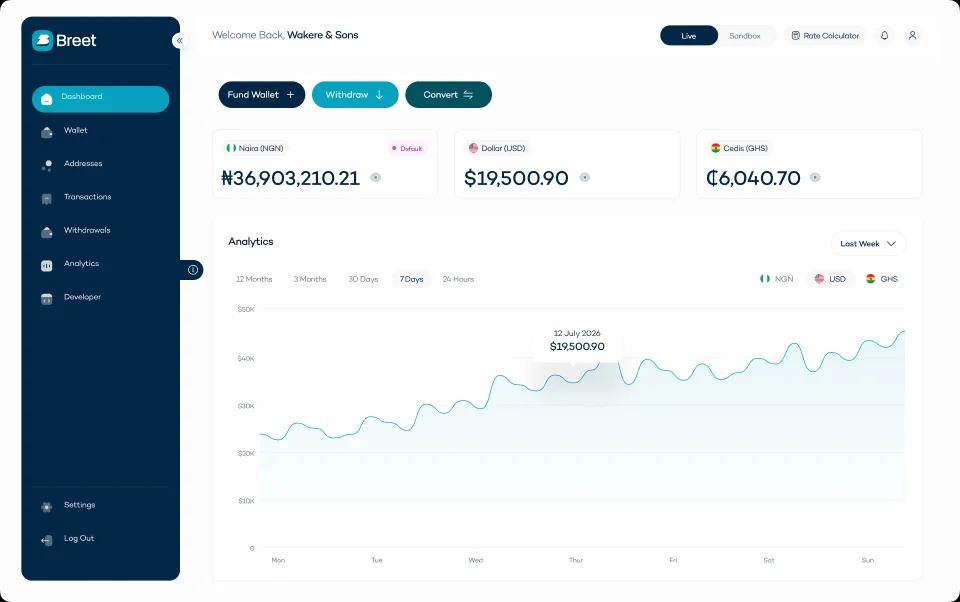
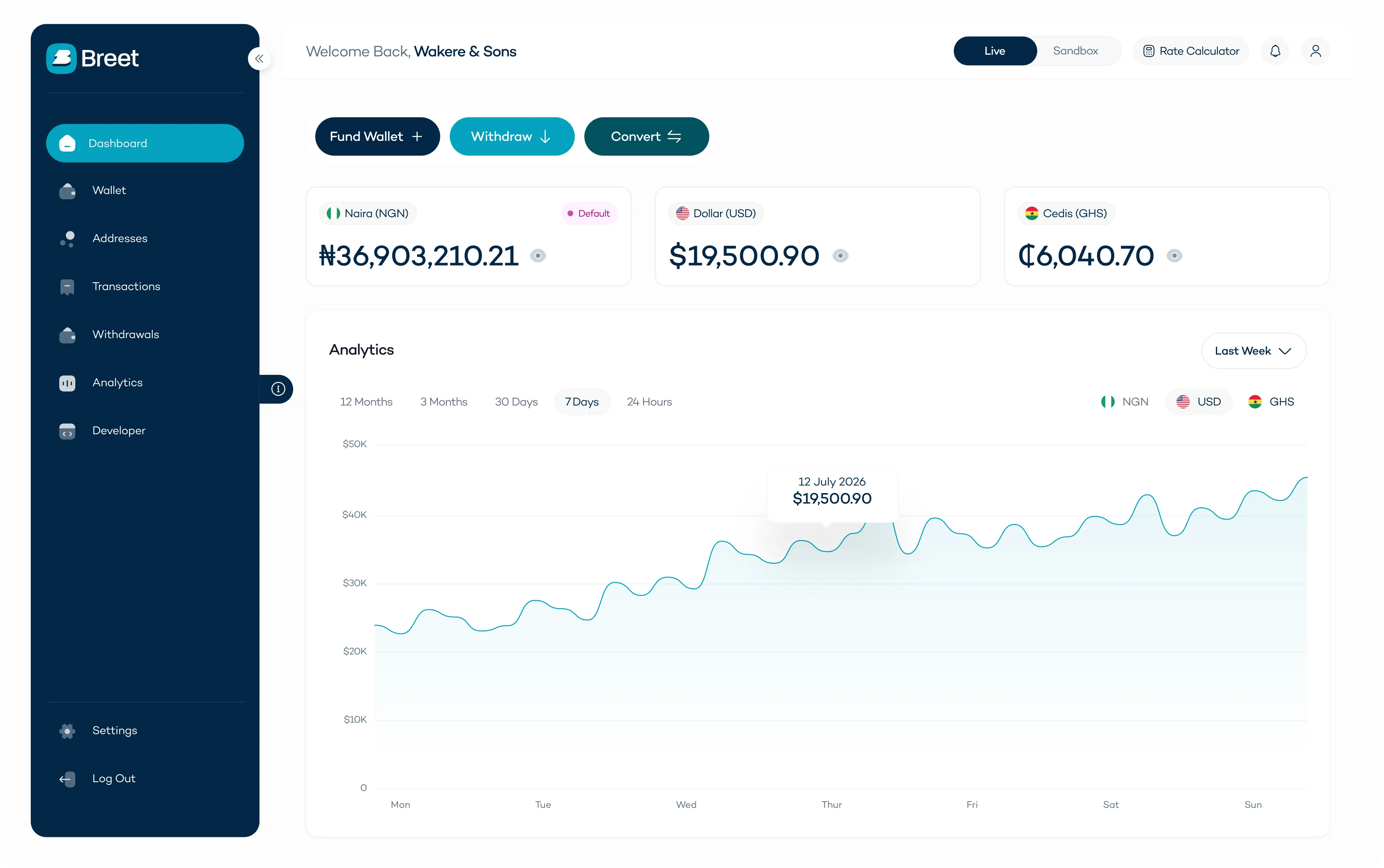
- Withdraw through the API or Breet business dashboard at any time.
- Avoid liquidity management and wallet sweeping.
- Pay one volume-based transaction fee with no separate setup, monthly, or wallet-sweeping fees and no gas fee for receiving crypto.
- Test integrations in a public sandbox with webhooks, live asset discovery, and clear API documentation.
- Get direct integration support through dedicated Slack channel support.
Consider Paychant only when the product requires one or more of these additional capabilities: a hosted on-ramp and off-ramp interface; coverage in Kenya, Uganda, or Zambia; mobile-money methods on supported routes. For a focused crypto acceptance and settlement flow, Breet removes more product decisions and operating work.
Need more detail on Paychant?
Read the Paychant API review for a focused review of its public features, pricing evidence, strengths, and limits. You can also compare other crypto payment APIs.