
As a crypto API provider, researching what other providers build is part of our job. This comparison gives Luno credit where it is due and states the limits we could verify.
We used public product pages, developer documentation, support pages, and regulator information available on 14 August 2026. We did not test Luno through a production account. Products, prices, and coverage can change.
Overview
Choose Luno for exchange trading, market data, wallet accounts, and active Nigerian business access. Choose Breet when the main job is to receive customer crypto and settle in stablecoins, USD, NGN, or GHS through one managed flow.
Breet vs Luno API at a Glance
| Decision Point | Breet | Luno |
|---|---|---|
| Best for | Automatic crypto conversion and direct NGN/GHS bank settlement | Exchange trading, market data, accounts, and wallets |
| Product type | Managed payment and settlement API | Exchange and wallet API with payment functions |
| Transaction fee | Volume-based transaction fee; no setup, monthly, or wallet-sweeping fees and no gas fee for receiving crypto | Nigeria instant buy/sell: 2%; Exchange uses maker/taker fees |
| Direct NGN bank route | Yes | NGN bank transfer method is documented; access is account-dependent |
| Direct GHS bank route | Yes | Ghana is not in the current country list |
| Customer addresses | Permanent or single-use | Receive addresses with published creation limits |
| Automatic conversion | Yes | Trading or buy/sell execution is required |
| Market data and orders | No exchange order book | Yes |
| Sandbox and webhooks | Yes | Separate sandbox and payment webhooks not confirmed |
| Nigeria regulatory status | SEC ARIP application pending | Approval in Principle through SEC ARIP admission |
The Main Product Difference
Luno is an exchange and wallet platform. Its API supports market data, order books, trades, orders, balances, crypto sends and receives, wallet addresses, and selected bank transfers.
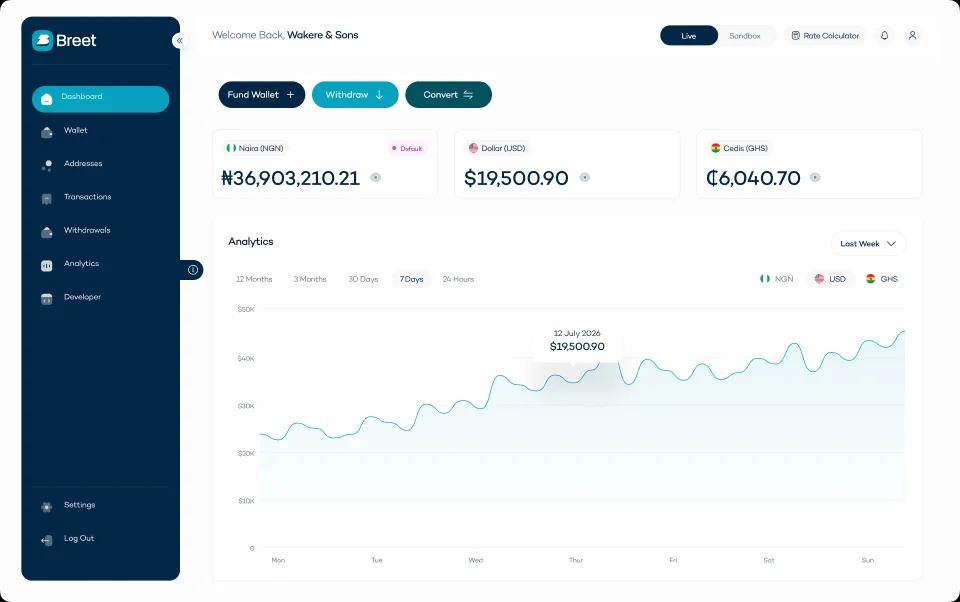
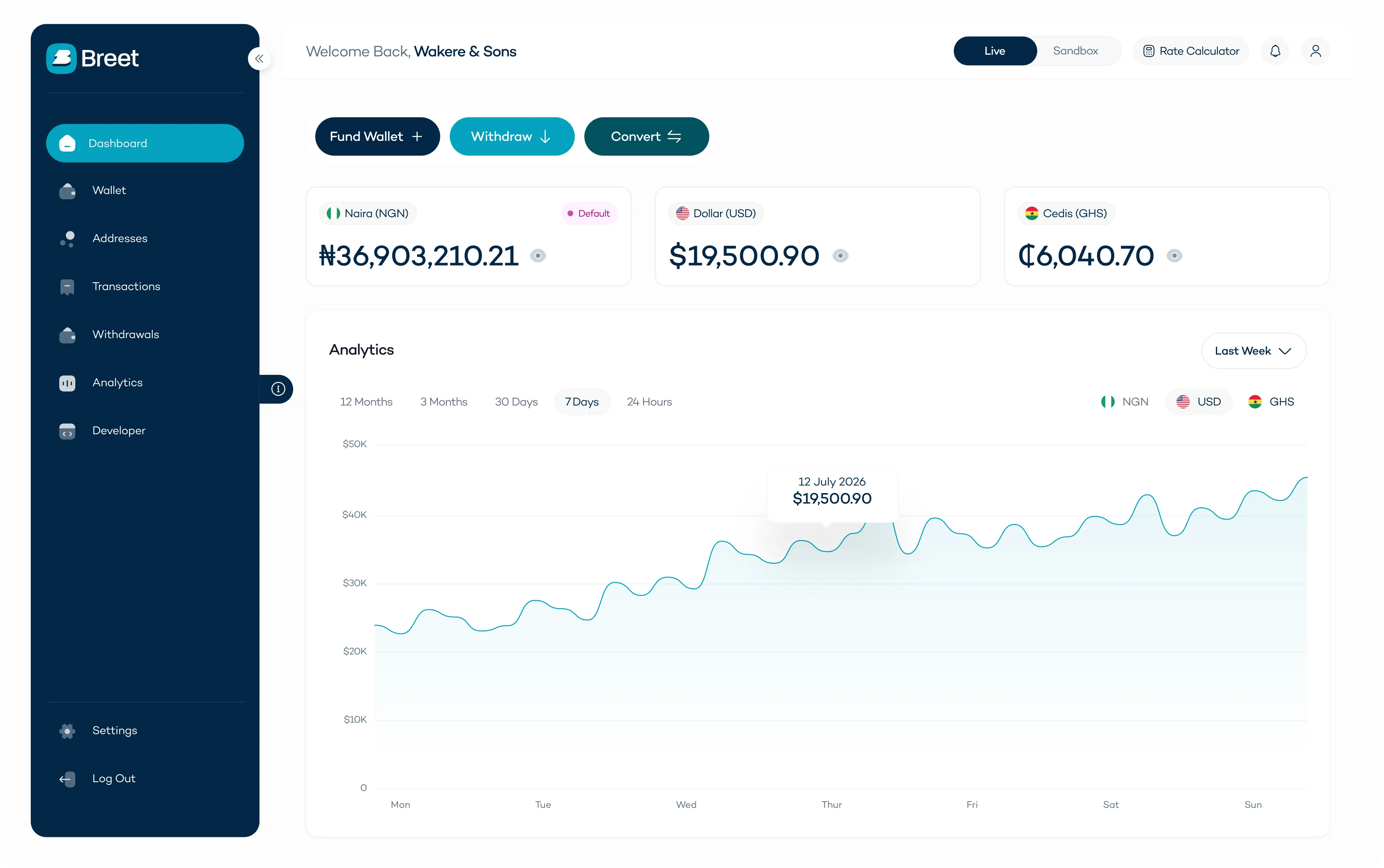
Breet is a managed payment and conversion API. It creates customer addresses, receives supported crypto, converts deposits, and can settle the result to an NGN or GHS bank account.
Choose Luno when the product needs exchange functions. Choose Breet when the product needs a crypto-to-bank result without building an order and reconciliation flow around an exchange account.
- Payment fees and trading fees
Breet: Breet charges one transaction fee based on transaction volume. The rate is shared during onboarding and is structured to grow with the business. Breet does not charge setup, monthly, gas, wallet-sweeping, or other separate fees.
Luno: Luno Nigeria lists 2% for instant buy and sell. Its exchange uses maker and taker fees, with taker pricing starting at 0.10% and changing by volume. These are trading prices, not a like-for-like managed crypto collection and bank-settlement price.
Decision: Compare the complete route: deposit attribution, execution, conversion, withdrawal, bank settlement, monthly volume, and the final amount received.
- Nigeria and Ghana Coverage
Breet: Breet directly supports bank settlement in both NGN and GHS. Breet has the clearer cross-market fit when one integration must cover Nigeria and Ghana.
Luno: Luno's country page lists Kenya, Nigeria, South Africa, Indonesia, and Malaysia. It states that users can deposit local currency and withdraw to a bank account in their name. Its API documentation lists `NGN_EFT` as a Nigerian bank-transfer method. Luno also publishes current Nigerian business-account requirements. This confirms active local capability, although product permissions depend on the account, beneficiaries, verification, and use case. Ghana is not in Luno's current supported-country list. Luno is a credible Nigeria option.
Decision: For nigeria and ghana coverage, Breet is the better fit when the priority is a focused route from customer crypto to stablecoins, USD, NGN, or GHS. Consider Luno only when its additional product scope is required.
- Wallet Addresses and Customer Attribution
Breet: Breet offers permanent or single-use customer addresses and expects partners to use them for attribution. Bank details and auto-settlement rules can be linked to the address. Breet also automatically recovers certain supported-asset mismatches on Breet-generated addresses. Breet has the more direct customer-payment model.
Luno: Luno can return a default receive address or create another address for a supported asset. Its API also returns confirmed and unconfirmed totals for an address. Luno offers flexible exchange-account addresses, subject to account and asset limits.
Decision: The current reference states a creation rate of one address per hour, with bursts of up to 10, and says only one Ethereum receive address can be created. A business that wants a separate address for every customer or order must test these limits against its design.
- Trading, Conversion, and Market Data
Breet: Breet does not provide an exchange order book. Conversion is part of the managed deposit flow, and rates can be fetched through its API. This reduces trading logic for a payment use case but does not replace an exchange for a trading use case.
Luno: For businesses that require this capability, Luno's broader scope may be relevant. It provides public ticker and order-book data, recent trades, authenticated orders, fee information, account balances, and WebSocket streams. A trading product can use Luno for price discovery and execution.
Decision: For trading, conversion, and market data, Breet is the better fit when the priority is a focused route from customer crypto to stablecoins, USD, NGN, or GHS. Consider Luno only when its additional product scope is required.
- APIs, Testing, and Events
Breet: Breet provides REST documentation, a development environment, webhooks, event retries, settlement controls, reporting data, IP restrictions, and direct integration support. Its public page states a 99.9% uptime service-level agreement.
Luno: Luno uses HTTP Basic authentication with granular API-key permissions. Its public limit is 300 calls per minute, and the streaming API allows 50 simultaneous sessions. Its API page names Go, Python, and PHP SDKs, while the detailed reference recommends Go and warns that a wider library list may be third-party or inactive. We found no separate sandbox or payment-event webhooks in the current public Luno material. The API warns developers to test carefully before irreversible sends or orders. Ask Luno what test account or low-risk environment is available.
Decision: For apis, testing, and events, Breet is the better fit when the priority is a focused route from customer crypto to stablecoins, USD, NGN, or GHS. Consider Luno only when its additional product scope is required.
- Business Accounts and Regulatory Fit
Breet: Breet's Nigerian entity has a pending application for admission to the same programme. Its Canadian entity is a Canadian FINTRAC money service business. Breet has the clearer public product for direct NGN and GHS settlement. Confirm the legal entity and approved activity for either route.
Luno: Luno Business accounts can fund with local currency and integrate the API. Companies that handle third-party funds must show suitable licences, anti-money-laundering controls, and customer-verification policies. Nigerian applicants must supply business, ownership, tax, address, and identity documents. Luno Nigeria announced Approval in Principle through admission to the Nigeria Securities and Exchange Commission Accelerated Regulatory Incubation Program in July 2026. It says operations remain within a defined scope and ongoing conditions. For businesses that require this capability, Luno's broader scope may be relevant.
Decision: For business accounts and regulatory fit, Breet is the better fit when the priority is a focused route from customer crypto to stablecoins, USD, NGN, or GHS. Consider Luno only when its additional product scope is required.
When exchange trading and market data matter
These functions matter when they are core product requirements. If the business only needs crypto acceptance and settlement, they can add unnecessary integration work and ongoing operations.
Why Breet fits automated crypto settlement
Breet removes the infrastructure between the customer crypto payment and the chosen crypto or fiat output. The product team can keep the integration focused on the payment result.
Which should you choose?
Choose Breet when the business wants the simplest route from a customer crypto payment to stablecoins, USD, NGN, or GHS. Breet handles the crypto infrastructure and gives the team one focused payment flow.
- Accept 12+ supported crypto assets using permanent or single-use wallet addresses.
- Convert deposits automatically after blockchain confirmation.
- Keep funds in stablecoins or USD, or settle directly to an NGN or GHS bank account.
- Withdraw through the API or Breet business dashboard at any time.
- Avoid liquidity management and wallet sweeping.
- Pay one volume-based transaction fee with no separate setup, monthly, or wallet-sweeping fees and no gas fee for receiving crypto.
- Test integrations in a public sandbox with webhooks, live asset discovery, and clear API documentation.
- Get direct integration support through dedicated Slack channel support.
Consider Luno only when the product requires one or more of these additional capabilities: order books, market data, and trade history; maker and taker order execution; crypto accounts and exchange balances. For a focused crypto acceptance and settlement flow, Breet removes more product decisions and operating work.
Need more detail on Luno?
Read the Luno API review for a focused review of its public features, pricing evidence, strengths, and limits. You can also compare other crypto payment APIs.