
As a crypto API provider, researching what other providers build is part of our job. This comparison gives HoneyCoin credit where it is due and states the limits we could verify.
We used public product pages, developer documentation, support pages, and regulator information available on 14 August 2026. We did not test HoneyCoin through a production account. Products, prices, and coverage can change.
Overview
Choose HoneyCoin when the product needs broad country coverage, mobile money, collections, payouts, accounts, cards, or escrow. Choose Breet for a focused multi-asset crypto collection flow with stablecoin, USD, NGN, or GHS settlement.
Breet vs HoneyCoin at a glance
| Decision point | Breet | HoneyCoin |
|---|---|---|
| Best for | Multi-asset crypto acceptance and direct NGN/GHS bank settlement | Broad African collections, payouts, stablecoin ramps, wallets, accounts, cards, and treasury functions |
| Assets in the closest flow | 12+ deposit assets | USDC and USDT for the documented on-ramp and off-ramp |
| Direct local routes | NGN and GHS bank settlement | NGN bank; GHS bank and mobile money; many other product-specific routes |
| Geographic breadth | Nigeria and Ghana for direct local bank settlement | 26+ platform markets and currencies claimed; availability varies by product |
| API fee structure | Volume-based transaction fee; no setup, monthly, or wallet-sweeping fees and no gas fee for receiving crypto | Account-specific; actual values require login |
| Deposit address model | Permanent or single-use addresses | Off-ramp address is valid for one hour and expects the exact quoted amount |
| Extra functions | On-ramp, off-ramp, wallets, settlement, dashboard, and stablecoin payouts | Collections, virtual accounts, cards, managed wallets, swaps, OTC services, and escrow |
| Sandbox and webhooks | Yes | Yes |
The main product difference
HoneyCoin is a broad financial infrastructure provider. Its API spans local collections and payouts, stablecoin ramps, managed wallets, virtual accounts, cards, swaps, and escrow. It is designed for teams that want to build several money-movement products across many markets.
Breet focuses on accepting customer crypto, converting it, and settling local money to a bank. A business can generate permanent or single-use addresses for customers, monitor deposits through webhooks, and automate NGN or GHS settlement.
HoneyCoin gives a fintech more countries, payout methods, and product modules. Breet gives a business a shorter multi-asset route to Nigerian or Ghanaian bank settlement.
- How transaction pricing works
Breet: Breet charges one transaction fee based on transaction volume. The rate is shared during onboarding and is structured to grow with the business. Breet does not charge setup, monthly, gas, wallet-sweeping, or other separate fees.
HoneyCoin: HoneyCoin says fees vary by route and account rules, and the actual values are visible after login. It does not publish one comparable price for the complete flow.
Decision: Request matched quotes for the same asset, network, collection method, destination, payout method, volume, and timing. Compare the final local amount and any operating fees outside the quoted transaction.
- Country and payment-method coverage
Breet: Breet's direct local settlement is narrower: NGN and GHS bank accounts.
HoneyCoin: For businesses that require this capability, HoneyCoin's broader scope may be relevant. Its platform coverage page states 26+ markets and currencies across Africa, Europe, and North America. Its detailed route documentation includes NGN bank payouts and GHS bank or mobile-money payouts. The stablecoin off-ramp guide lists mobile-money destinations in 12 African countries and bank destinations in Kenya, Nigeria, Tanzania, Malawi, and Ghana. Not every HoneyCoin product is available in every stated market, so route-level checks remain necessary.
Decision: Choose HoneyCoin when mobile money, several African markets, or international collection and payout rails are required. Choose Breet when Nigeria and Ghana bank settlement covers the plan.
- Crypto assets and network scope
Breet: Breet publishes 12+ deposit assets across several networks. Its live asset endpoint shows the current list. Breet has the advantage when customers may pay with Bitcoin or other supported non-stablecoin assets.
HoneyCoin: HoneyCoin's documented on-ramp and off-ramp supports USDC and USDT on Ethereum, Arbitrum, Base, Polygon, BNB Smart Chain, and Optimism. HoneyCoin has a separate managed Wallets product with wider chain coverage, but that catalogue should not be treated as stablecoin-ramp coverage. HoneyCoin is suitable when the flow is intentionally limited to USDC and USDT.
Decision: For crypto assets and network scope, Breet is the better fit when the priority is a focused route from customer crypto to stablecoins, USD, NGN, or GHS. Consider HoneyCoin only when its additional product scope is required.
- Deposit-address and exception handling
Breet: Breet can create permanent or single-use customer addresses. Breet automatically recovers certain supported-asset mismatches on Breet-generated addresses. This does not mean every wrong asset or network can be recovered, so a business must still validate the payment instruction. Breet's address options are more suitable when a customer needs a reusable deposit identity or when the business wants fewer time-sensitive steps.
HoneyCoin: HoneyCoin's off-ramp guide says its generated address is valid for one hour. The sender must transfer the exact expected amount of USDC or USDT. A mismatch can cause a failed transaction and may need support-assisted recovery, even when an automatic refund is attempted. HoneyCoin's rules can work well when the app controls the amount and timer.
Decision: For deposit-address and exception handling, Breet is the better fit when the priority is a focused route from customer crypto to stablecoins, USD, NGN, or GHS. Consider HoneyCoin only when its additional product scope is required.
- Integration and developer tools
Breet: Breet provides REST documentation, a public development environment, wallet generation, auto-settlement controls, webhooks, retry behaviour, IP restrictions, error schemas, and reporting data. Its API page displays a 99.9% uptime SLA. Breet has a narrower integration for the direct crypto-to-bank task.
HoneyCoin: HoneyCoin publishes production and sandbox base URLs, test collections, test-wallet flows, authentication guidance, transaction records, and webhooks. It documents an `X-Webhook-Signature` header that the receiver can compare with its stored secret. HoneyCoin has the larger object and product surface.
Decision: Both providers expose enough public material for a technical evaluation.
- Collections, accounts, cards, and treasury tools
Breet: Breet provides on-ramp, off-ramp, wallets, conversion, settlement, dashboard controls, and stablecoin payouts. It does not publish an equivalent virtual-card or escrow API.
HoneyCoin: For businesses that require this capability, HoneyCoin's broader scope may be relevant. Its product set includes local-fiat collections, payouts, virtual accounts, cards, managed wallets, swaps, OTC services, and escrow. These HoneyCoin features are material for a fintech with a broad roadmap. They should not decide the selection if the planned funds flow only needs customer crypto to reach an NGN or GHS bank.
Decision: For collections, accounts, cards, and treasury tools, Breet is the better fit when the priority is a focused route from customer crypto to stablecoins, USD, NGN, or GHS. Consider HoneyCoin only when its additional product scope is required.
- Compliance and contracting
Breet: Breet states that its Canadian entity is a Canadian FINTRAC money service business. Its Nigerian entity has a pending application to the SEC Accelerated Regulatory Incubation Program.
HoneyCoin: HoneyCoin names HoneyCoin, Inc. and describes itself as a financial-services aggregator rather than a bank. Its company information says payments and custody are supplied by licensed financial institutions and banking partners.
Decision: For either provider, request the contracting entity, regulated provider, custody and safeguarding role, customer-verification split, monitoring duties, refund process, and complaint route for each intended product and market.
When cross-border financial tools matter
These functions matter when they are core product requirements. If the business only needs crypto acceptance and settlement, they can add unnecessary integration work and ongoing operations.
Why Breet fits multi-asset crypto collection
Breet removes the infrastructure between the customer crypto payment and the chosen crypto or fiat output. The product team can keep the integration focused on the payment result.
Which should you choose?
Choose Breet when the business wants the simplest route from a customer crypto payment to stablecoins, USD, NGN, or GHS. Breet handles the crypto infrastructure and gives the team one focused payment flow.
- Accept 12+ supported crypto assets using permanent or single-use wallet addresses.
- Convert deposits automatically after blockchain confirmation.
- Keep funds in stablecoins or USD, or settle directly to an NGN or GHS bank account.
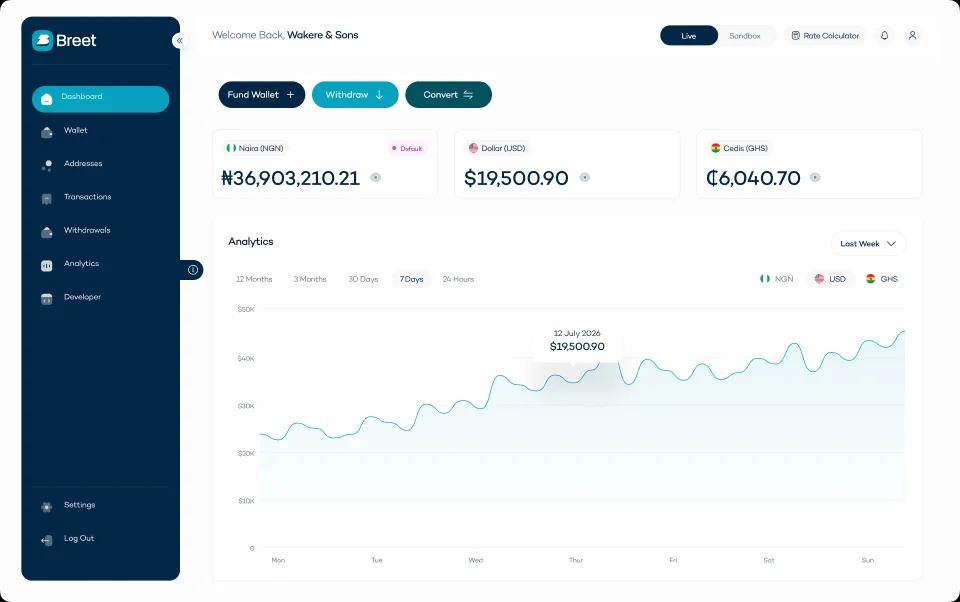
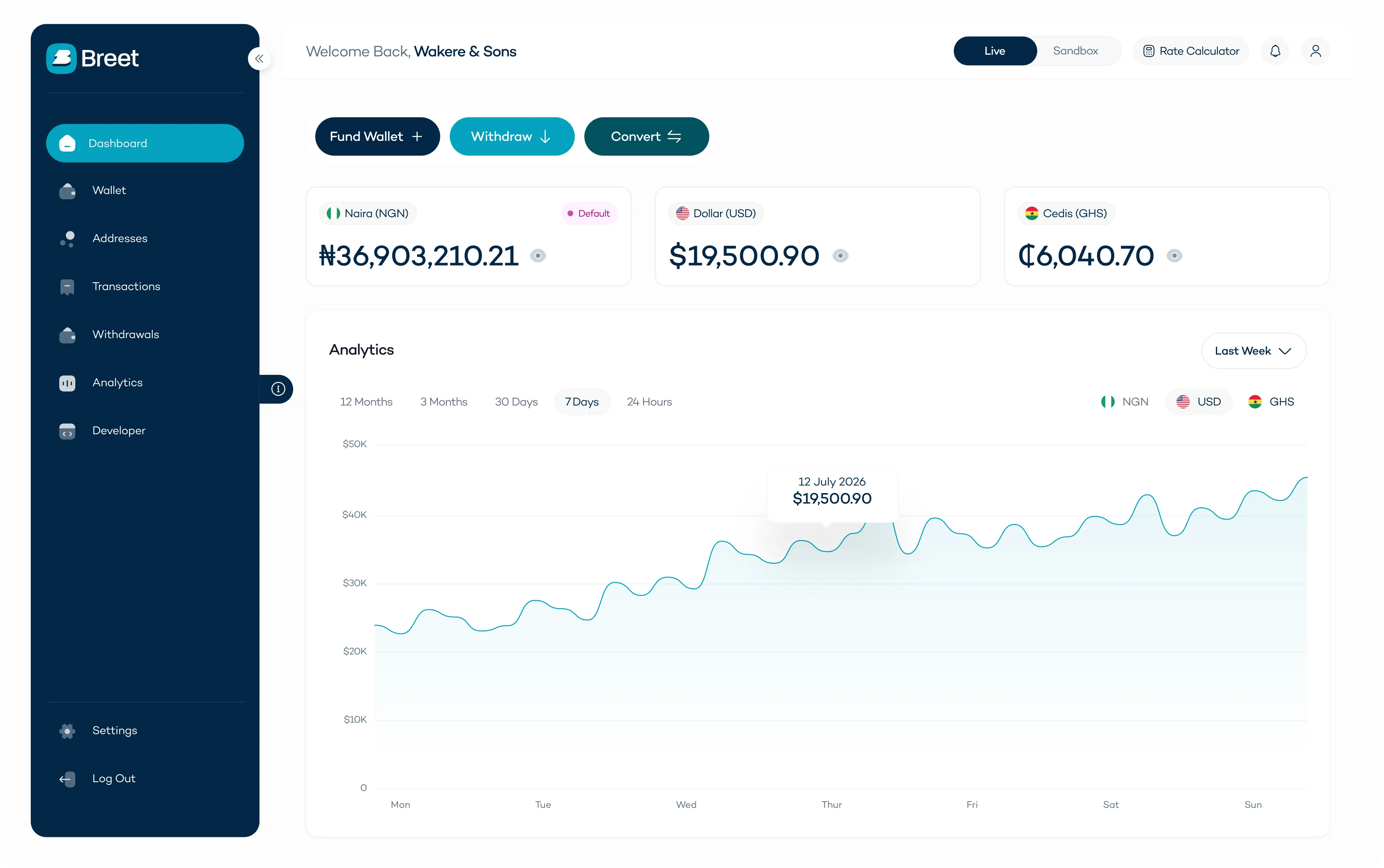
- Withdraw through the API or Breet business dashboard at any time.
- Avoid liquidity management and wallet sweeping.
- Pay one volume-based transaction fee with no separate setup, monthly, or wallet-sweeping fees and no gas fee for receiving crypto.
- Test integrations in a public sandbox with webhooks, live asset discovery, and clear API documentation.
- Get direct integration support through dedicated Slack channel support.
Consider HoneyCoin only when the product requires one or more of these additional capabilities: several African markets beyond Nigeria and Ghana; mobile-money payout methods; fiat collection as well as payout. For a focused crypto acceptance and settlement flow, Breet removes more product decisions and operating work.
Need more detail on HoneyCoin?
Read the HoneyCoin API review for a focused review of its public features, pricing evidence, strengths, and limits. You can also compare other crypto payment APIs.