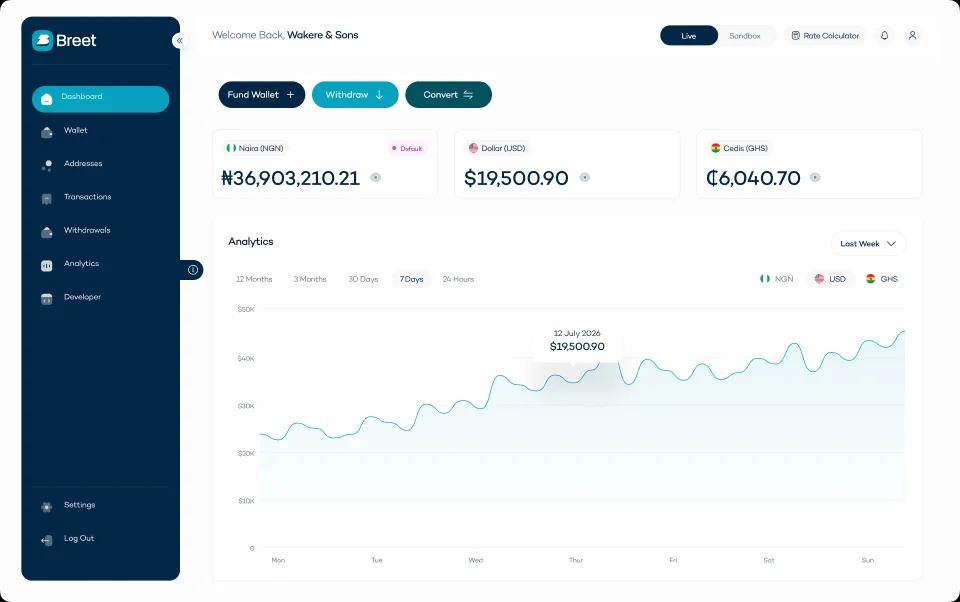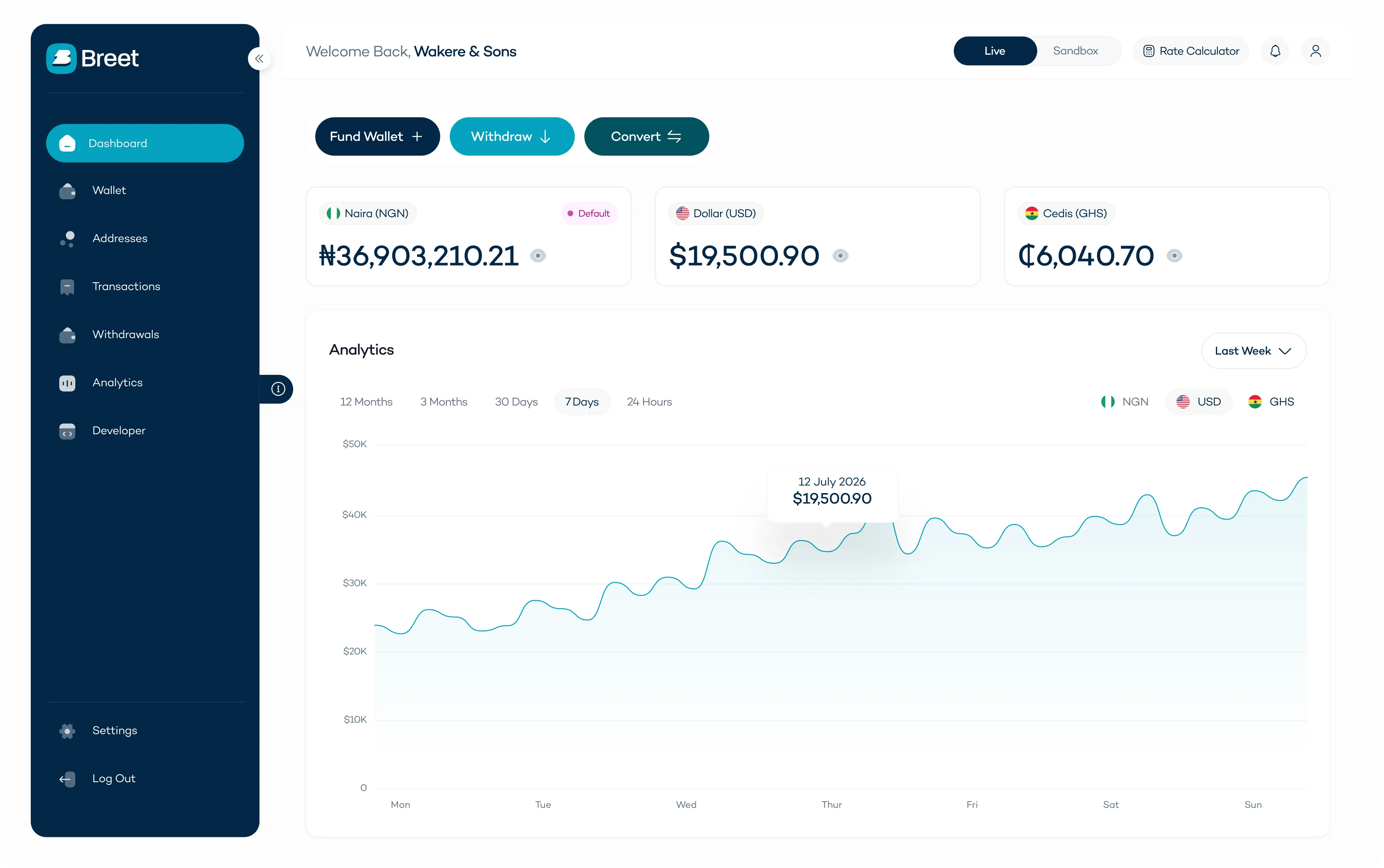

As a crypto API provider, researching what other providers build is part of our job. This comparison gives Fireblocks credit where it is due and states the limits we could verify.
We used public product pages, developer documentation, support pages, and regulator information available on 14 August 2026. We did not test Fireblocks through a production account. Products, prices, and coverage can change.
Overview
Choose Fireblocks when institutional wallet security, policy controls, broad network support, and provider orchestration are core requirements. Choose Breet when the business wants a managed route from customer crypto to stablecoins, USD, NGN, or GHS.
Breet vs Fireblocks at a Glance
| Decision Point | Breet | Fireblocks |
|---|---|---|
| Main job | Accept crypto, convert, and settle locally | Secure and orchestrate digital-asset infrastructure |
| Buyer | African fintechs, PSPs, SaaS, gaming, payroll, and other businesses | Banks, large PSPs, exchanges, fintechs, and institutions |
| Assets | 12+ supported deposit assets | Thousands across dozens of networks |
| Wallet model | Customer deposit addresses managed within the payment flow | MPC vaults, embedded wallets, and policy controls |
| Merchant acceptance | Direct Breet API flow | Fireblocks Flow and connected providers |
| NGN bank settlement | Direct | Partner-dependent |
| GHS bank settlement | Direct | Partner-dependent |
| Pricing model | Volume-based transaction fee; no setup, monthly, or wallet-sweeping fees and no gas fee for receiving crypto | Essentials $999 monthly; custom from $36,000 yearly |
| Volume overage | Main transaction fee covers the normal flow | Essentials 0.20% above $1 million quarterly outbound volume |
| Sandbox | Yes | Yes |
| Regulatory service boundary | Breet and licensed partners supply the product route | Fireblocks says regulated payment services come from partners |
| Best fit | Ready local payment outcome | Custom institutional infrastructure |
Payment Product Versus Infrastructure Platform
Breet is designed around a defined sequence: generate an address, receive crypto, detect the transaction, convert the value, and settle it to a bank or supported balance.
Fireblocks is designed around programmable control. A team chooses wallets, policies, blockchains, providers, compliance services, liquidity, and settlement routes. That flexibility supports many products beyond payments.
The distinction is similar to buying a finished delivery route versus buying the fleet-management system. The second gives more control, but the buyer must still choose vehicles, drivers, destinations, and operating rules.
- Crypto Acceptance
Breet: Breet accepts 12+ supported assets through generated customer addresses. The value can convert automatically and settle to an NGN or GHS bank account. Flow is stronger for a global PSP that wants wallet connectivity and stablecoin merchant settlement. Breet is stronger when the merchant must receive local African fiat without a separate off-ramp integration.
Fireblocks: Fireblocks has improved its acceptance offer through Fireblocks Flow. Flow lets payment service providers accept crypto from many wallets or exchange accounts and settle merchants in a chosen stablecoin. Fireblocks gives examples ranging from USDC to DOGE and says more than 800 wallet types can connect.
Decision: For crypto acceptance, Breet is the better fit when the priority is a focused route from customer crypto to stablecoins, USD, NGN, or GHS. Consider Fireblocks only when its additional product scope is required.
- Wallet Security and Operational Control
Breet: Breet manages the wallet and blockchain work behind a payment service. The partner does not need to operate nodes, handle gas, or manage crypto in the normal conversion flow.
Fireblocks: For businesses that require this capability, Fireblocks's broader scope may be relevant. Its MPC technology, vault accounts, transaction-policy engine, roles, approval workflows, API co-signers, audit logs, and optional cold-wallet functions give institutions detailed control. A bank building its own digital-asset product may need Fireblocks-level control. A SaaS platform adding USDT payment acceptance may prefer not to own those controls at all.
Decision: For wallet security and operational control, Breet is the better fit when the priority is a focused route from customer crypto to stablecoins, USD, NGN, or GHS. Consider Fireblocks only when its additional product scope is required.
- Assets and Networks
Breet: Breet supports fewer assets, but each supported deposit is linked to its conversion and settlement service. Its public list includes major coins and USDT or USDC across several networks. Breet wins when the buyer values a verified local outcome more than the largest asset catalogue.
Fireblocks: Fireblocks supports thousands of assets across dozens of networks. Its live workspace API is the source of truth because asset support can be global, local, or product-specific. For businesses that require this capability, Fireblocks's broader scope may be relevant.
Decision: For assets and networks, Breet is the better fit when the priority is a focused route from customer crypto to stablecoins, USD, NGN, or GHS. Consider Fireblocks only when its additional product scope is required.
- NGN and GHS Settlement
Breet: Breet directly supports automatic bank settlement in Nigeria and Ghana.
Fireblocks: Fireblocks connects customers to payment providers, banks, on/off-ramps, stablecoin issuers, and liquidity partners. Its Network for Payments covers more than 40 providers and over 60 fiat currencies. The Fireblocks payments page also states that Fireblocks provides technology infrastructure only. Partners deliver regulated payment and financial services under their own licences. An NGN or GHS route therefore needs a named provider, separate commercial terms, and route-specific due diligence. Fireblocks makes that provider easier to connect. It does not remove the provider.
Decision: For ngn and ghs settlement, Breet is the better fit when the priority is a focused route from customer crypto to stablecoins, USD, NGN, or GHS. Consider Fireblocks only when its additional product scope is required.
- Pricing and total operating cost
Breet: Breet charges one transaction fee based on transaction volume. The rate is shared during onboarding and is structured to grow with the business. Breet does not charge setup, monthly, gas, wallet-sweeping, or other separate fees.
Fireblocks: Fireblocks publishes infrastructure pricing. Its Essentials offer is listed at $999 per month with included outbound volume and an overage rate, while custom plans start at a higher annual commitment. Connected providers can add conversion, liquidity, compliance, and local-settlement costs.
Decision: The figures do not price the same service. Compare Fireblocks subscription, overage, provider, engineering, and operating costs with Breet's quote for the complete managed route.
- Developer Experience
Breet: Breet has REST documentation, a development environment, webhooks with retries, error guidance, IP restrictions, reporting data, and direct integration support. Its public page states a 99.9% uptime SLA. Breet has fewer concepts to integrate for the specific deposit-to-bank job.
Fireblocks: Fireblocks has a mature REST API, maintained TypeScript and Python SDKs, webhooks, Postman resources, detailed developer guides, and a free Developer Sandbox. The sandbox uses testnet assets and auto-approvals but does not include every production connection. Fireblocks offers greater breadth.
Decision: For developer experience, Breet is the better fit when the priority is a focused route from customer crypto to stablecoins, USD, NGN, or GHS. Consider Fireblocks only when its additional product scope is required.
- Compliance and Legal Responsibility
Breet: Breet's Canadian entity is a Canadian FINTRAC money service business. Its Nigerian entity has a pending SEC ARIP application. Breet also uses licensed partners for some wallet, card, and banking-related services.
Fireblocks: Fireblocks provides compliance tools such as wallet verification, sanctions screening, Travel Rule connections, and policy controls. These tools help the customer operate a compliant product. Fireblocks does not claim to be the regulated provider for every connected payment service. Its partners provide those services under their licences.
Decision: For both products, confirm which legal entity supplies each part of the flow and who owns customer due diligence, transaction screening, record keeping, and regulatory reporting.
When institutional wallet control is essential
These functions matter when they are core product requirements. If the business only needs crypto acceptance and settlement, they can add unnecessary integration work and ongoing operations.
Why Breet removes infrastructure assembly
Breet removes the infrastructure between the customer crypto payment and the chosen crypto or fiat output. The product team can keep the integration focused on the payment result.
Which should you choose?
Choose Breet when the business wants the simplest route from a customer crypto payment to stablecoins, USD, NGN, or GHS. Breet handles the crypto infrastructure and gives the team one focused payment flow.
- Accept 12+ supported crypto assets using permanent or single-use wallet addresses.
- Convert deposits automatically after blockchain confirmation.
- Keep funds in stablecoins or USD, or settle directly to an NGN or GHS bank account.
- Withdraw through the API or Breet business dashboard at any time.
- Avoid liquidity management and wallet sweeping.
- Pay one volume-based transaction fee with no separate setup, monthly, or wallet-sweeping fees and no gas fee for receiving crypto.
- Test integrations in a public sandbox with webhooks, live asset discovery, and clear API documentation.
- Get direct integration support through dedicated Slack channel support.
Consider Fireblocks only when the product requires one or more of these additional capabilities: advanced MPC wallet security; custom transaction policies and approval workflows; thousands of assets and many chains. For a focused crypto acceptance and settlement flow, Breet removes more product decisions and operating work.
Need more detail on Fireblocks?
Read the Fireblocks API review for a focused review of its public features, pricing evidence, strengths, and limits. You can also compare other crypto payment APIs.