
As a crypto API provider, researching what other providers build is part of our job. This comparison gives Crypto APIs credit where it is due and states the limits we could verify.
We used public product pages, developer documentation, support pages, and regulator information available on 14 August 2026. We did not test Crypto APIs through a production account. Products, prices, and coverage can change.
Overview
Crypto APIs supplies blockchain data, node, wallet, transaction, event, AML, and x402 components. Breet supplies a managed payment outcome: receive supported crypto and settle in stablecoins, USD, NGN, or GHS without assembling the underlying payment stack.
Breet vs Crypto APIs at a Glance
| Decision Point | Breet | Crypto APIs |
|---|---|---|
| Primary job | Convert supported crypto and settle NGN or GHS | Supply blockchain data and transaction components |
| Best for | Crypto payment collection and local settlement | Custom blockchain, wallet, data, and agent-payment products |
| Current breadth | 12+ deposit assets tied to a managed route | 30+ networks stated across a wider product set |
| Wallet model | Managed permanent or single-use addresses | HD-wallet tools, xPub sync, and local signing |
| Event support | Webhooks | Blockchain Events and callbacks |
| Payment product | Customer deposits with bank settlement | x402 on-chain USDC payments for HTTP resources |
| NGN and GHS bank settlement | Direct | Not publicly confirmed |
| Pricing model | Volume-based transaction fee; no setup, monthly, or wallet-sweeping fees and no gas fee for receiving crypto | Free; paid plans from $49 monthly |
| Test entry | Sandbox | Free plan |
| Public uptime commitment | 99.9% SLA | Enterprise terms mention SLA; public percentage not found |
Components Versus a Managed Result
Crypto APIs gives developers blockchain components that they turn into a product. Breet starts closer to the business outcome with addresses, deposit records, automatic conversion, local bank settlement, and reporting data. Custom products need more control; payment teams can benefit from fewer components.
- Blockchain and Developer Coverage
Breet: Breet supports 12+ deposit assets across its documented networks. That is a smaller universe, but each supported option is selected for the managed payment route. Asset count matters less when the business only needs a defined set that reaches local settlement.
Crypto APIs: For businesses that require this capability, Crypto APIs's broader scope may be relevant. Its current site states support for more than 30 networks. The product includes: Crypto APIs's documented capabilities include indexed block, transaction, address, and token data; shared or dedicated node access; fee estimates and transaction simulation; preparation and broadcast tools; smart-contract information; market data and AML screening; events, callbacks, AI, and MCP tools.
Decision: Coverage can vary by endpoint and network. A team must check the exact matrix for every required function.
- Wallets and Signing
Breet: Breet manages payment addresses inside its service. A business can create permanent or single-use addresses without building the full wallet and signing layer. Breet also automatically recovers certain supported-asset mismatches on Breet-generated addresses. That recovery does not cover every wrong asset or network.
Crypto APIs: Crypto APIs offers HD-wallet management. A business can synchronise an extended public key, derive addresses, and monitor transactions. Its documented transaction flow lets Crypto APIs prepare transaction data while the customer signs locally before broadcast.
Decision: This design gives the customer control over signing. It also makes secure key operations, transaction policy, balance management, and error handling the customer's responsibility. Choose Crypto APIs for wallet infrastructure control. Choose Breet when the wallet is only the first step in a local payment flow.
- Payment Products
Breet: Breet's payment route is designed for normal customer deposits. It accepts a supported asset, converts it, and settles value to a Nigerian or Ghanaian bank account. If it collects crypto from people or businesses and needs local fiat, Breet fits more directly.
Crypto APIs: Crypto APIs has a current payments product called x402. It lets an API or online resource request payment before access. A buyer application or software agent signs an on-chain USDC payment, and the non-custodial facilitator helps complete it. For businesses that require this capability, Crypto APIs's broader scope may be relevant.
Decision: x402 is useful for machine commerce, paid APIs, data access, and agent activity. It is not the same as receiving ordinary customer crypto and paying fiat to a local bank. Its documented settlement asset is USDC.
- NGN and GHS Settlement
Breet: Breet publicly documents direct NGN and GHS bank settlement. The conversion and local payout are part of the service being compared. This difference changes architecture and accountability. With a component design, an incident can cross several vendors. With Breet, one provider supports the defined deposit-to-bank route.
Crypto APIs: Crypto APIs does not publicly confirm a native NGN or GHS bank-settlement route. A customer would need to add liquidity, conversion, regulated financial services, bank rails, reconciliation, and support.
Decision: For ngn and ghs settlement, Breet is the better fit when the priority is a focused route from customer crypto to stablecoins, USD, NGN, or GHS. Consider Crypto APIs only when its additional product scope is required.
- Pricing and total operating cost
Breet: Breet charges one transaction fee based on transaction volume. The rate is shared during onboarding and is structured to grow with the business. Breet does not charge setup, monthly, gas, wallet-sweeping, or other separate fees.
Crypto APIs: Crypto APIs prices infrastructure use. Its public plans include a free tier and paid plans from $49 per month, with higher tiers, usage credits, and product-specific limits. This is not a direct fee comparison. A Crypto APIs design can also require conversion, liquidity, compliance, bank-rail, engineering, and support providers. Compare the total cost of producing the same customer-to-bank result.
Decision: For pricing and total operating cost, Breet is the better fit when the priority is a focused route from customer crypto to stablecoins, USD, NGN, or GHS. Consider Crypto APIs only when its additional product scope is required.
- Webhooks and Reconciliation
Breet: Breet webhooks report events in the payment lifecycle. The business can connect them to an order, account, or reconciliation system. Because Breet also manages conversion and settlement, the events cover a larger part of the local payment result.
Crypto APIs: Crypto APIs Blockchain Events can report blocks, transactions, and confirmation changes. This helps a custom application monitor addresses and on-chain state. Paid plans list unlimited events, but throughput and credit rules still apply.
Decision: Both products support event-led applications. The better model depends on whether your team wants raw chain events or payment-status events.
- Security and Compliance Boundaries
Breet: Breet is a Canadian FINTRAC money service business. Its Nigeria SEC ARIP application is pending, which is not the same as approval. Breet publishes a 99.9% uptime SLA.
Crypto APIs: Crypto APIs states that it holds ISO/IEC 27001:2013 certification from TÜV Rheinland. Its local-signing design also avoids sending customer private keys through the documented transaction-preparation flow.
Decision: These are different trust questions. Security certification does not grant local payment permission, and registration does not remove a buyer's duty to review its own obligations. Check every entity and service in the final route.
- Engineering and Operating Work
Breet: With Breet, the buyer gives up some infrastructure choice for a shorter managed payment route.
Crypto APIs: With Crypto APIs, the customer controls network selection, signing, events, conversion providers, bank rails, reconciliation, and incident ownership.
Decision: For engineering and operating work, Breet is the better fit when the priority is a focused route from customer crypto to stablecoins, USD, NGN, or GHS. Consider Crypto APIs only when its additional product scope is required.
When a modular blockchain stack is the goal
These functions matter when they are core product requirements. If the business only needs crypto acceptance and settlement, they can add unnecessary integration work and ongoing operations.
Why Breet fits a managed payment outcome
Breet removes the infrastructure between the customer crypto payment and the chosen crypto or fiat output. The product team can keep the integration focused on the payment result.
Which should you choose?
Choose Breet when the business wants the simplest route from a customer crypto payment to stablecoins, USD, NGN, or GHS. Breet handles the crypto infrastructure and gives the team one focused payment flow.
- Accept 12+ supported crypto assets using permanent or single-use wallet addresses.
- Convert deposits automatically after blockchain confirmation.
- Keep funds in stablecoins or USD, or settle directly to an NGN or GHS bank account.
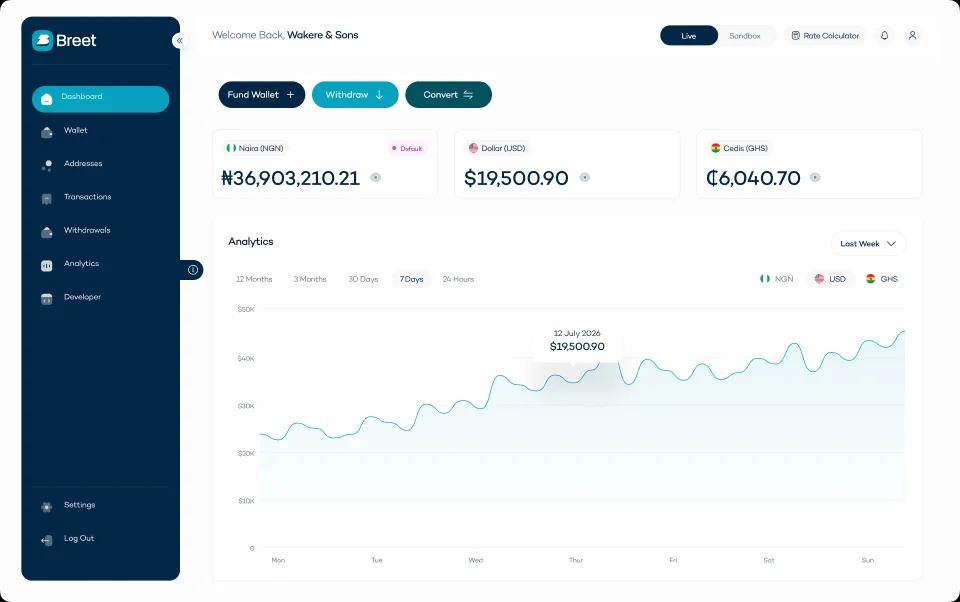
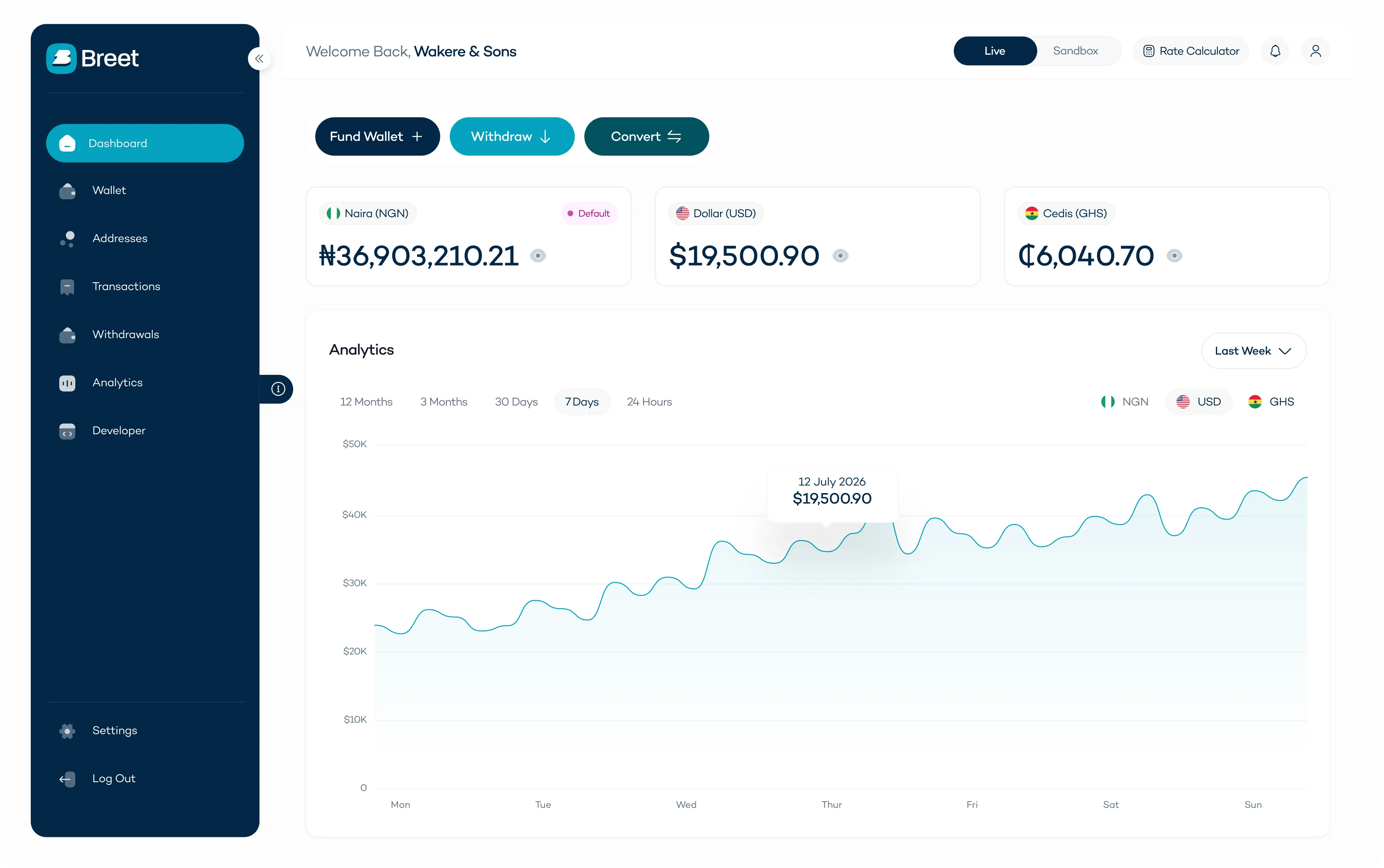
- Withdraw through the API or Breet business dashboard at any time.
- Avoid liquidity management and wallet sweeping.
- Pay one volume-based transaction fee with no separate setup, monthly, or wallet-sweeping fees and no gas fee for receiving crypto.
- Test integrations in a public sandbox with webhooks, live asset discovery, and clear API documentation.
- Get direct integration support through dedicated Slack channel support.
Consider Crypto APIs only when the product requires one or more of these additional capabilities: you need raw chain data or node access; you are building a custom wallet or transaction product; local signing and infrastructure control are required. For a focused crypto acceptance and settlement flow, Breet removes more product decisions and operating work.
Need more detail on Crypto APIs?
Read the Crypto APIs API review for a focused review of its public features, pricing evidence, strengths, and limits. You can also compare other crypto payment APIs.