
As a crypto API provider, researching what other providers build is part of our job. This comparison gives BitPay credit where it is due and states the limits we could verify.
We used public product pages, developer documentation, support pages, and regulator information available on 14 August 2026. We did not test BitPay through a production account. Products, prices, and coverage can change.
Overview
Choose BitPay for mature global commerce tools, broad coin and wallet support, and settlement in its supported fiat currencies. Choose Breet when the payment route must accept customer crypto and end in stablecoins, USD, NGN, or GHS through one managed API.
Breet vs BitPay at a Glance
| Decision Point | Breet | BitPay |
|---|---|---|
| Best for | Direct crypto-to-NGN or GHS bank settlement | Established global crypto commerce and payouts |
| Public crypto coverage | 12+ deposit assets | 100+ coins across six networks |
| Wallet coverage | Addresses on supported networks | 100+ supported wallets |
| Transaction fee | Volume-based transaction fee; no setup, monthly, or wallet-sweeping fees and no gas fee for receiving crypto | 2% + $0.25 to 1% + $0.25 by monthly volume |
| Direct NGN bank settlement | Yes | Not in current published fiat list |
| Direct GHS bank settlement | Yes | Not in current published fiat list |
| Fiat settlement | NGN and GHS | USD, AUD, CAD, GBP, MXN, NZD, CHF, and EUR |
| Commerce tools | Embedded API and business dashboard | Online, e-commerce, email invoices, in-store, donations, and refunds |
| Test environment | Yes | Yes, with stated feature limits |
| Public compliance detail | FINTRAC MSB registration; Nigerian application pending | NYDFS virtual-currency licence statement and NMLS ID |
The Main Product Difference
BitPay covers online, email, and in-store payments, plus donations, refunds, payroll, affiliate settlement, supplier payments, and crypto payouts. Settlement can be in supported fiat, crypto, or a mix.
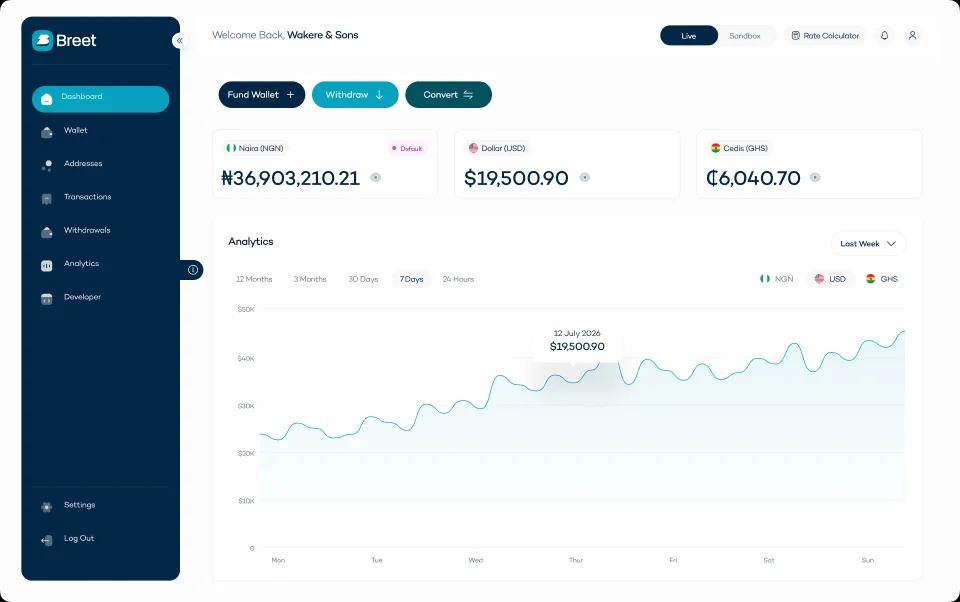
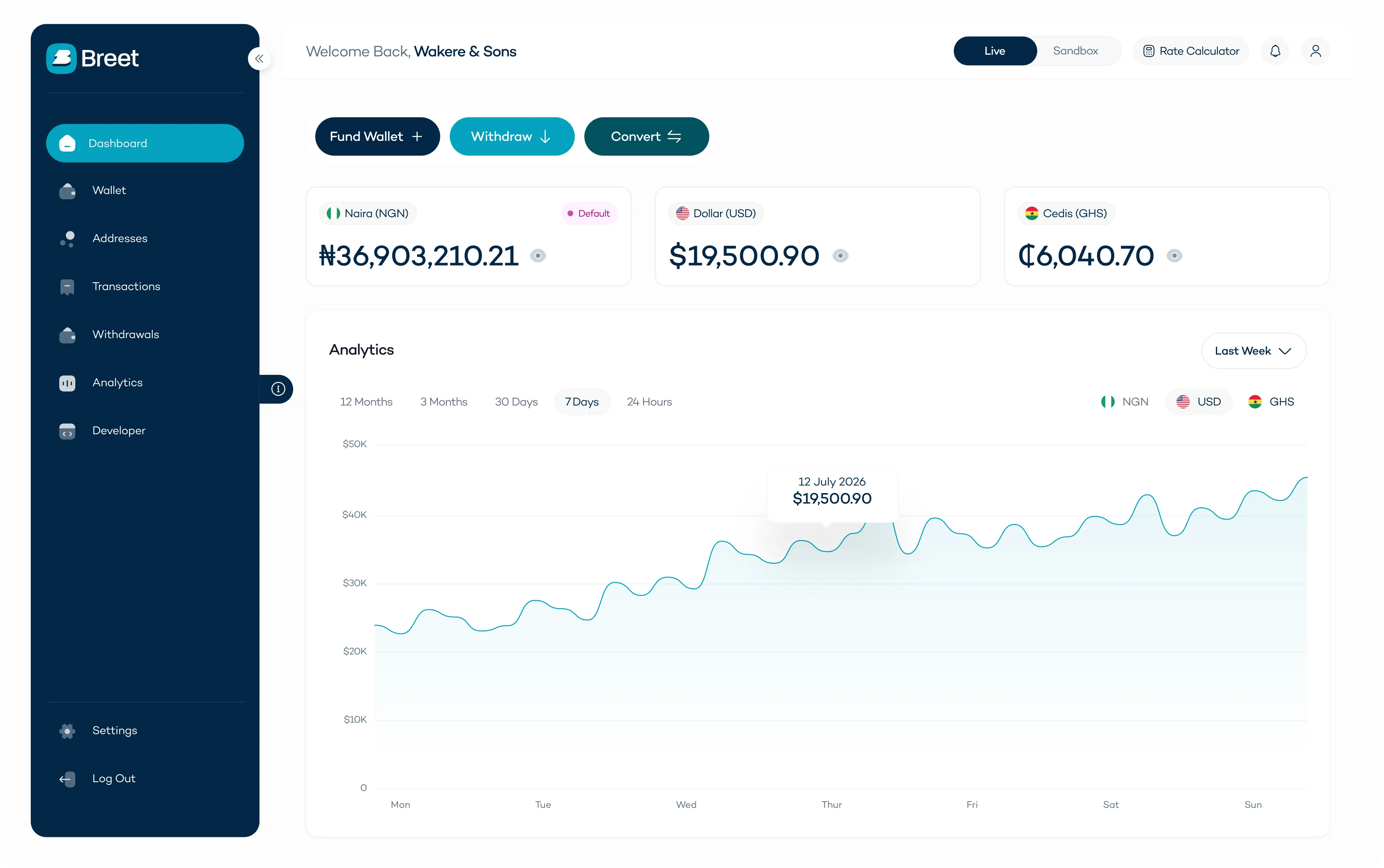
Breet creates a customer address, receives and converts crypto, then settles to an NGN or GHS bank. BitPay serves more commerce channels. Breet serves the local bank result.
- Transaction pricing
Breet: Breet charges one transaction fee based on transaction volume. The rate is shared during onboarding and is structured to grow with the business. Breet does not charge setup, monthly, gas, wallet-sweeping, or other separate fees.
BitPay: BitPay publishes tiered crypto-acceptance pricing. Its listed rate is 2% plus $0.25 below $500,000 in monthly volume, 1.5% plus $0.25 from $500,000 to $999,999, and 1% plus $0.25 at $1 million or more.
Decision: A percentage alone does not show the full cost of an NGN or GHS route. Compare each provider's quote for the same asset, monthly volume, conversion, settlement currency, and final bank amount.
- Crypto Assets and Wallet Support
Breet: Breet publishes 12+ deposit assets across major networks, including BTC, ETH, SOL, TRX, BNB, AVAX, LTC, BCH, DOGE, XRP, USDT, and USDC. The live assets endpoint shows current availability and minimums. Breet can cover the major crypto and stablecoin assets while linking each customer address to an automatic local settlement rule.
BitPay: BitPay's current business page says it supports 100+ coins across six networks and 100+ wallets. Customers can use popular self-custody and exchange-connected wallets. This reduces wallet compatibility work for a global checkout. For businesses that require this capability, BitPay's broader scope may be relevant.
Decision: For crypto assets and wallet support, Breet is the better fit when the priority is a focused route from customer crypto to stablecoins, USD, NGN, or GHS. Consider BitPay only when its additional product scope is required.
- Fiat Settlement and Local Bank Coverage
Breet: Breet directly documents NGN and GHS bank settlement. Auto-settlement can operate at customer-address level or business level. When local bank settlement is the main requirement, Breet avoids an extra provider decision.
BitPay: BitPay states that merchant settlement happens automatically every business day. Its current published fiat bank currencies are USD, AUD, CAD, GBP, MXN, NZD, CHF, and EUR. NGN and GHS are not on that list. This means a business that needs those currencies may need another conversion or banking step after the BitPay settlement. Requirements also differ by fiat currency. For example, USD settlement to a bank outside the United States uses a wire and has a stated $10,000 minimum.
Decision: For fiat settlement and local bank coverage, Breet is the better fit when the priority is a focused route from customer crypto to stablecoins, USD, NGN, or GHS. Consider BitPay only when its additional product scope is required.
- Checkout and Commerce Tools
Breet: Breet's public offer is API-led. It is designed for fintechs, payment processors, gaming operators, wallets, payroll services, and other products that want to embed crypto acceptance and local settlement.
BitPay: For businesses that require this capability, BitPay's broader scope may be relevant. It provides: BitPay's documented capabilities include e-commerce integrations; hosted crypto checkout; email billing; in-store QR payments; donation tools; refunds and payment-exception handling; payroll, affiliate, supplier, and customer payouts.
Decision: Choose BitPay when ready-made global commerce channels matter. Choose Breet when the required function belongs inside a product and must end at an NGN or GHS bank.
- API, Testing, and Payment Events
Breet: Breet provides REST documentation, a development environment, address and settlement controls, webhooks, retries, reporting, IP restrictions, and a public 99.9% uptime SLA. Breet centres on conversion and local settlement.
BitPay: BitPay provides APIs and libraries for invoices, refunds, bills, rates, settlements, and ledgers. Invoice rates lock for 15 minutes. Its test site covers common payment states but not every live wallet, currency, or feature. Verify an IPN before changing an order. BitPay covers more commerce scenarios.
Decision: For api, testing, and payment events, Breet is the better fit when the priority is a focused route from customer crypto to stablecoins, USD, NGN, or GHS. Consider BitPay only when its additional product scope is required.
- Payment Exceptions and Recovery
Breet: Breet automatically recovers certain supported-asset mismatches on Breet-generated addresses. It detects the supported asset that arrived, creates the right address in the integration, applies relevant settlement settings, and sends the normal events.
BitPay: BitPay's transaction pricing page lists automatic payment-exception handling. Its developer guide documents underpaid, overpaid, expired, invalid, and refunded invoices. A buyer should confirm how wrong-asset or wrong-network deposits are handled for the selected checkout.
Decision: Clear asset, network, amount, and expiry instructions remain important with either provider.
- Compliance and Legal Fit
Breet: Breet's Canadian entity is a Canadian FINTRAC money service business. Its Nigerian entity has a pending application to the Nigerian Securities and Exchange Commission's Accelerated Regulatory Incubation Program.
BitPay: BitPay states that payment processing is provided by BitPay Inc. and BitPay B.V. It publishes NMLS ID 1496848 and says it is licensed by the New York State Department of Financial Services for Virtual Currency Business Activity. It also describes KYC, AML, and transaction monitoring.
Decision: Neither statement proves that every product is available in every country. Confirm the contract entity, product permission, restricted markets, data terms, and responsibility split for the exact route.
When BitPay's commerce tools matter
These functions matter when they are core product requirements. If the business only needs crypto acceptance and settlement, they can add unnecessary integration work and ongoing operations.
Why Breet fits NGN and GHS settlement
Breet removes the infrastructure between the customer crypto payment and the chosen crypto or fiat output. The product team can keep the integration focused on the payment result.
Which should you choose?
Choose Breet when the business wants the simplest route from a customer crypto payment to stablecoins, USD, NGN, or GHS. Breet handles the crypto infrastructure and gives the team one focused payment flow.
- Accept 12+ supported crypto assets using permanent or single-use wallet addresses.
- Convert deposits automatically after blockchain confirmation.
- Keep funds in stablecoins or USD, or settle directly to an NGN or GHS bank account.
- Withdraw through the API or Breet business dashboard at any time.
- Avoid liquidity management and wallet sweeping.
- Pay one volume-based transaction fee with no separate setup, monthly, or wallet-sweeping fees and no gas fee for receiving crypto.
- Test integrations in a public sandbox with webhooks, live asset discovery, and clear API documentation.
- Get direct integration support through dedicated Slack channel support.
Consider BitPay only when the product requires one or more of these additional capabilities: a mature global crypto payment brand; 100+ coins and 100+ supported wallets; online, email, in-store, donation, and refund tools. For a focused crypto acceptance and settlement flow, Breet removes more product decisions and operating work.
Need more detail on BitPay?
Read the BitPay API review for a focused review of its public features, pricing evidence, strengths, and limits. You can also compare other crypto payment APIs.