
As a crypto API provider, researching what other providers build is part of our job. This comparison gives Busha credit where it is due and states the limits we could verify.
We used public product pages, developer documentation, support pages, and regulator information available on 14 August 2026. We did not test Busha through a production account. Products, prices, and coverage can change.
Overview
Choose Busha when the product needs many assets, trading, wallets, ramps, hosted tools, or B2B2C onboarding. Choose Breet when the main job is to receive crypto from users and settle in stablecoins, USD, NGN, or GHS through one focused API.
Breet vs Busha API at a glance
| Decision point | Breet | Busha |
|---|---|---|
| Best for | Crypto acceptance, automatic conversion, and direct NGN/GHS bank settlement | Broad crypto products with wallets, trading, ramps, payments, and customer onboarding |
| Direct fiat coverage | NGN and GHS bank settlement | Full fiat payment and payout support documented for Nigeria, Kenya, and the United States |
| Deposit assets | 12+ supported assets across several networks | 80+ supported assets, according to Busha |
| Wallets | Permanent or single-use addresses; normal conversion flow does not require the partner to hold crypto | Multi-currency wallets that can buy, sell, hold, and receive assets |
| Hosted tools | Business dashboard; integration is REST API led | SDKs, widgets, and payment links alongside APIs |
| API fee structure | Volume-based transaction fee; no setup, monthly, or wallet-sweeping fees and no gas fee for receiving crypto | No public like-for-like fee for the complete comparison flow |
| Sandbox and webhooks | Yes | Yes |
| Nigerian regulatory wording | SEC ARIP application pending; Canadian FINTRAC money service business | SEC ARIP participant for a digital-assets exchange |
The main difference
Busha is a broad digital-asset platform. Its developer documentation covers payment collection, wallets, fiat-to-crypto and crypto-to-fiat ramps, quotes, transfers, payouts, customer onboarding, payment links, SDKs, widgets, and webhooks.
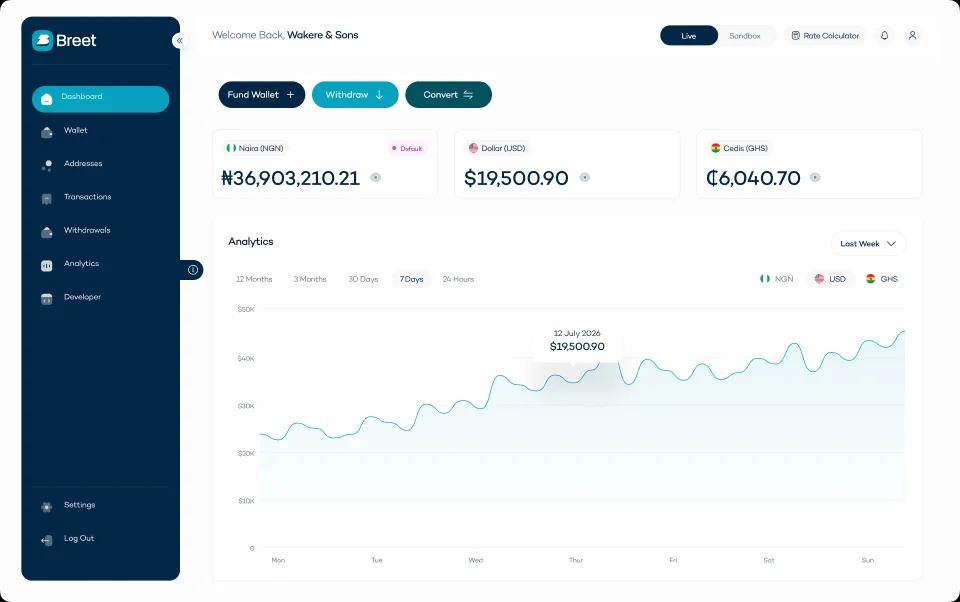
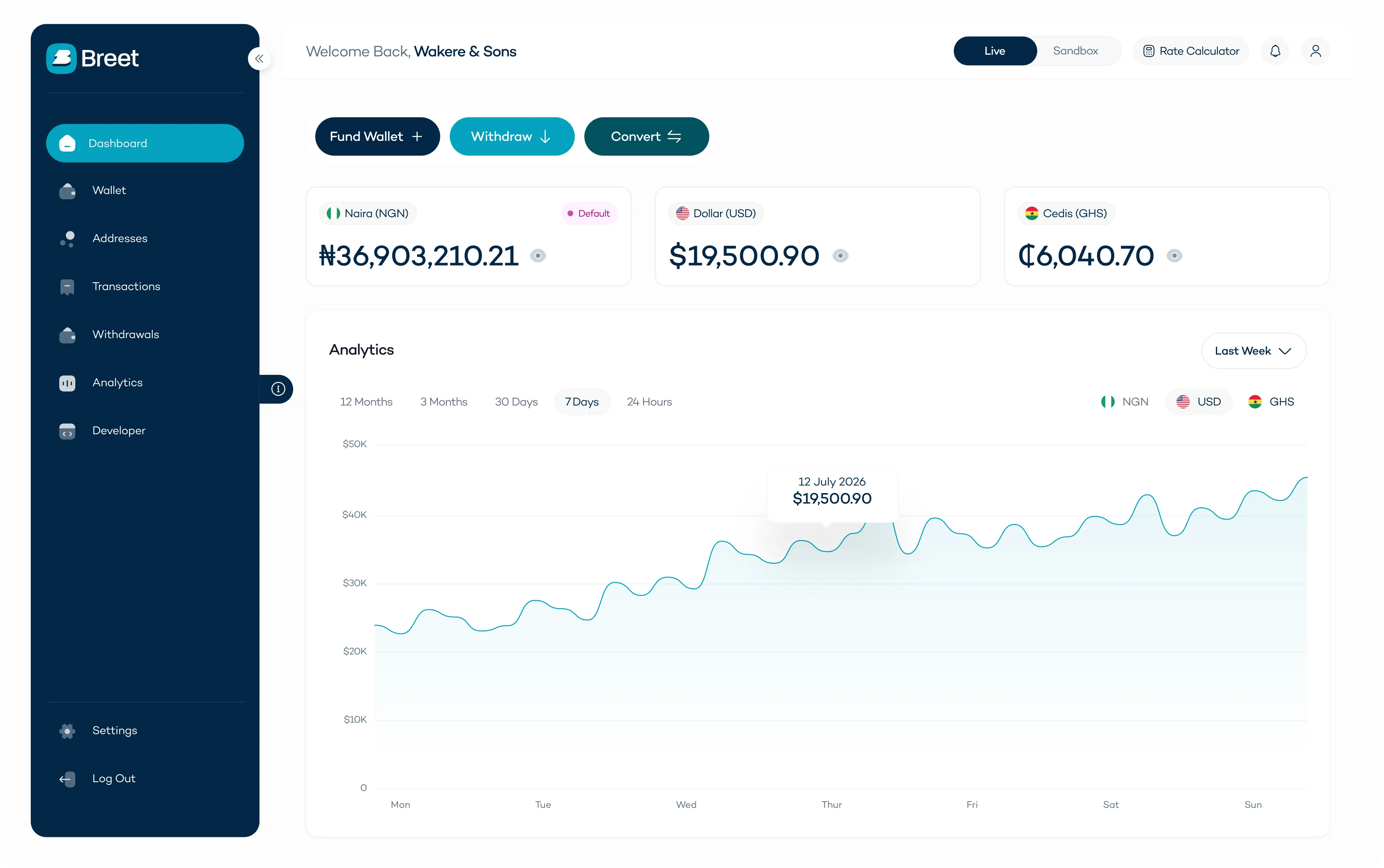
Breet focuses on a shorter route. A business generates customer wallet addresses, receives supported crypto, converts it, and can send NGN or GHS to a linked bank account automatically. The Breet API documentation (opens in new tab) also covers a sandbox, webhooks, reporting data, error handling, and stablecoin payouts.
Busha gives a product team more things to build. Breet gives a payment team fewer things to operate.
- Country and settlement coverage
Breet: Breet's coverage is smaller and more specific. Direct local bank settlement is available in Nigeria and Ghana. A business that needs a confirmed GHS bank outcome has a clearer public answer from Breet.
Busha: Busha says its Business product is available in 65 countries. Its current supported-country guide makes an important distinction: Nigeria, Kenya, and the United States have full fiat payment and payout support. Other listed countries can transact using crypto. For Ghana, this means Busha account availability and crypto support do not prove a direct GHS bank rail. A buyer should request the current route and payment method in writing. A business targeting many countries may prefer Busha.
Decision: For country and settlement coverage, Breet is the better fit when the priority is a focused route from customer crypto to stablecoins, USD, NGN, or GHS. Consider Busha only when its additional product scope is required.
- Assets, wallets, and custody
Breet: Breet's deposit list is smaller at 12+ assets, with current availability supplied by the live assets endpoint. Breet generates permanent or single-use customer wallet addresses. Its normal conversion flow means the partner does not need to manage or hold incoming crypto. Breet wins when the goal is to get from a customer deposit to a local bank without taking on exchange operations.
Busha: Busha publishes support for 80+ assets and multi-currency wallets. Businesses can buy, sell, hold, and receive stablecoins and other assets. This is useful for an exchange, savings product, brokerage, or treasury platform. For businesses that require this capability, Busha's broader scope may be relevant.
Decision: For assets, wallets, and custody, Breet is the better fit when the priority is a focused route from customer crypto to stablecoins, USD, NGN, or GHS. Consider Busha only when its additional product scope is required.
- How API pricing works
Breet: Breet charges one transaction fee based on transaction volume. The rate is shared during onboarding and is structured to grow with the business. Breet does not charge setup, monthly, gas, wallet-sweeping, or other separate fees.
Busha: Busha lists some fiat-account charges and says crypto fees vary by asset and network. It does not publish one price for the complete crypto collection, conversion, and bank-settlement flow covered in this comparison.
Decision: Request a Busha quote for the same deposit asset, network, conversion, settlement currency, destination, and monthly volume. Compare the final amount and the operating work included by each provider.
- Integration and developer tools
Breet: Breet provides REST endpoints, a development environment, customer wallet generation, auto-settlement controls, webhooks with retry behaviour, IP restrictions, error schemas, and direct integration support. Breet's public page displays a 99.9% uptime SLA. Breet's advantage is the narrowness of the implementation when the bank settlement is the product requirement.
Busha: Busha has strong public developer material. It provides a sandbox, code examples, payment links, webhook events, API keys, SDK and widget paths, and step-by-step guides for deposits and payouts. Its B2B2C onboarding can also reuse customer verification data in supported flows. For businesses that require this capability, Busha's broader scope may be relevant.
Decision: For integration and developer tools, Breet is the better fit when the priority is a focused route from customer crypto to stablecoins, USD, NGN, or GHS. Consider Busha only when its additional product scope is required.
- Compliance and regulatory position
Breet: Breet states that its Nigerian entity has a pending ARIP application. Its Canadian entity is a Canadian FINTRAC money service business.
Busha: The Nigeria SEC directory (opens in new tab) lists Busha Digital Limited as an ARIP participant for a digital-assets exchange.
Decision: The labels do not remove procurement work. Confirm the contracting entity, regulated activity, customer-verification duties, transaction-monitoring split, and funds flow for the proposed integration.
When Busha's exchange and ramp tools matter
These functions matter when they are core product requirements. If the business only needs crypto acceptance and settlement, they can add unnecessary integration work and ongoing operations.
Why Breet fits direct crypto-to-bank settlement
Breet removes the infrastructure between the customer crypto payment and the chosen crypto or fiat output. The product team can keep the integration focused on the payment result.
Which should you choose?
Choose Breet when the business wants the simplest route from a customer crypto payment to stablecoins, USD, NGN, or GHS. Breet handles the crypto infrastructure and gives the team one focused payment flow.
- Accept 12+ supported crypto assets using permanent or single-use wallet addresses.
- Convert deposits automatically after blockchain confirmation.
- Keep funds in stablecoins or USD, or settle directly to an NGN or GHS bank account.
- Withdraw through the API or Breet business dashboard at any time.
- Avoid liquidity management and wallet sweeping.
- Pay one volume-based transaction fee with no separate setup, monthly, or wallet-sweeping fees and no gas fee for receiving crypto.
- Test integrations in a public sandbox with webhooks, live asset discovery, and clear API documentation.
- Get direct integration support through dedicated Slack channel support.
Consider Busha only when the product requires one or more of these additional capabilities: 80+ assets; buy, sell, and hold functions; hosted widgets, SDKs, or payment links. For a focused crypto acceptance and settlement flow, Breet removes more product decisions and operating work.
Need more detail on Busha?
Read the Busha API review for a focused review of its public features, pricing evidence, strengths, and limits. You can also compare other crypto payment APIs.