
As a crypto API provider, researching what other providers build is part of our job. This comparison gives Roqqu credit where it is due and states the limits we could verify.
We used public product pages, developer documentation, support pages, and regulator information available on 14 August 2026. We did not test Roqqu through a production account. Products, prices, and coverage can change.
Overview
Choose Roqqu when the product needs wallet, buy, sell, swap, customer-control, or analytics functions. Choose Breet when the main job is to receive customer crypto and settle in stablecoins, USD, NGN, or GHS through one managed route.
Breet vs Roqqu at a Glance
| Decision Point | Breet | Roqqu |
|---|---|---|
| Main product | Managed crypto payment and conversion API | Exchange, wallet, and trading API |
| Deposit assets | 12+ supported assets | Live token list is returned by the API; seven mainnet protocols are listed |
| Customer addresses | Permanent or single-use | Wallet generation and address functions |
| Automatic conversion | Part of the normal payment flow | Buy, sell, and swap endpoints available |
| Direct NGN bank settlement | Yes | Exact automatic API route needs confirmation |
| Direct GHS bank settlement | Yes | Not publicly confirmed |
| API fee structure | Volume-based transaction fee; no setup, monthly, or wallet-sweeping fees and no gas fee for receiving crypto | Not publicly stated |
| Setup or monthly platform fee | None | Not publicly stated for the API |
| Test mode | Yes | Yes |
| Webhooks | Yes | Yes |
| Trading and swaps | Not an exchange | Yes |
| Customer blacklisting/whitelisting | Not the main public product claim | Yes |
| Best for | Customer crypto-to-bank payments | Wallet, exchange, or trading products |
The Main Difference Is the Product Outcome
Roqqu gives a developer many crypto-account components. The business can generate wallets, send crypto, manage transactions, execute trades, control customers, and inspect analytics.
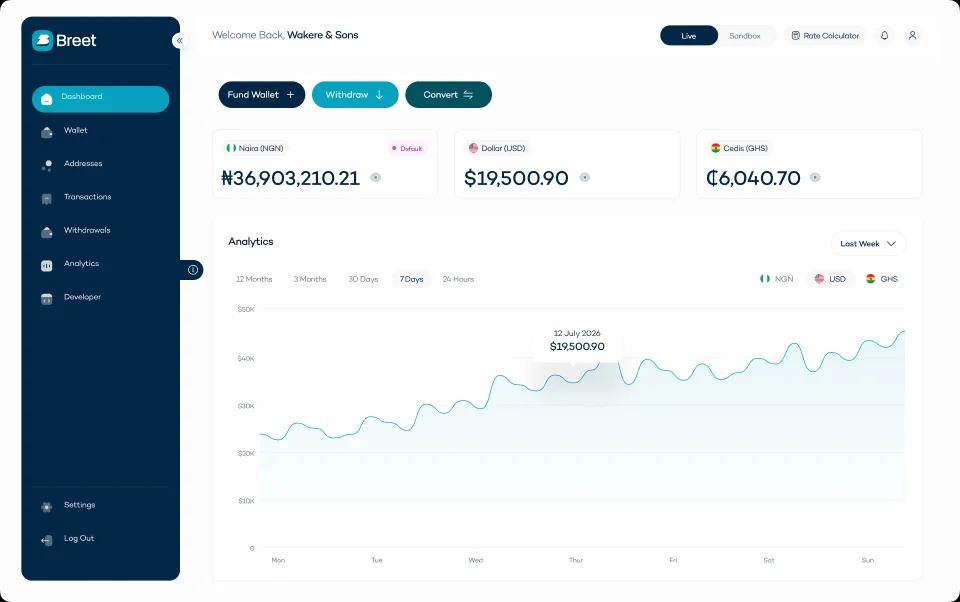
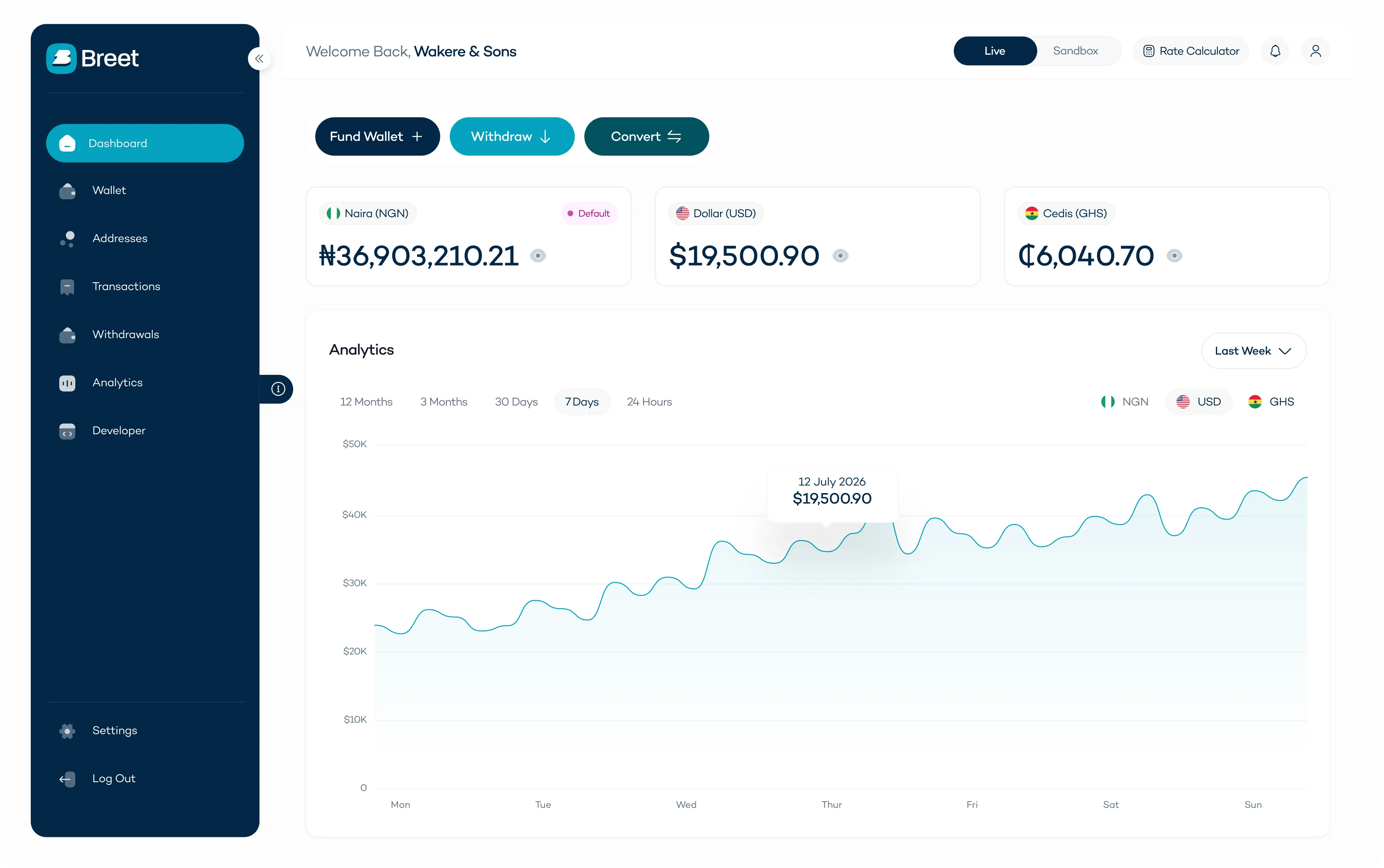
Breet gives a more opinionated payment result. A customer receives an address, sends a supported asset, and Breet handles detection, conversion, and local settlement. The business does not need to build exchange execution or operate blockchain infrastructure for the normal flow.
Think of Roqqu as a larger set of exchange and wallet controls. Think of Breet as a shorter path from crypto receipt to spendable local money.
- Wallets, Assets, and Networks
Breet: Breet supports 12+ deposit assets, including BTC, ETH, SOL, TRX, BNB, AVAX, LTC, BCH, DOGE, TON, XRP, USDT, and USDC across supported networks. The Breet supported-assets page (opens in new tab) tells developers to use the live assets endpoint because availability can change.
Roqqu: Roqqu's current API portal lists Bitcoin, Ethereum, BNB Smart Chain, Tron, Solana, XRP, and Litecoin mainnets. Its token endpoint returns the live token configuration. Wallet endpoints cover generation, address retrieval, sends, deletion, and network identification.
Decision: Neither company should be chosen from a marketing asset count alone. Confirm the exact asset-network pair, minimum deposit, address model, and settlement outcome.
- Trading and Conversion
Breet: Breet does not ask the partner to manage a trade. Conversion happens inside the payment flow. This is useful when the customer experience should end with a confirmed fiat value instead of an exchange balance.
Roqqu: For businesses that require this capability, Roqqu's broader scope may be relevant. Its API has buy, sell, and crypto-to-crypto swap endpoints, plus token prices and fiat rates.
Decision: Choose Roqqu for customer trading, portfolio functions, and crypto swaps. Choose Breet when the product should hide exchange mechanics from the customer and operations team.
- NGN and GHS Settlement
Breet: Breet directly documents automatic bank settlement in Nigeria and Ghana. Auto-settlement can be set at the wallet-address level or business level. Breet has the clearer public answer for a product serving both Nigeria and Ghana.
Roqqu: Roqqu is active in Nigeria, and its wider product supports fiat functions. The current API portal does not document the same direct customer-deposit-to-NGN-bank flow. It also does not confirm direct GHS bank settlement. A buyer should ask Roqqu for a route demonstration and contract language covering the exact endpoint, bank-account rules, settlement timing, reversals, supported customer model, and fee.
Decision: For ngn and ghs settlement, Breet is the better fit when the priority is a focused route from customer crypto to stablecoins, USD, NGN, or GHS. Consider Roqqu only when its additional product scope is required.
- API transaction pricing
Breet: Breet charges one transaction fee based on transaction volume. The rate is shared during onboarding and is structured to grow with the business. Breet does not charge setup, monthly, gas, wallet-sweeping, or other separate fees.
Roqqu: Roqqu does not publish one comparable API price for the complete crypto collection, conversion, and bank-settlement route. Consumer or exchange prices should not be used as a substitute for a business API quote.
Decision: Request written quotes for the same deposit asset, network, conversion, destination, monthly volume, support level, and final bank amount.
- Webhooks, Testing, and Security Controls
Breet: Breet provides a production-mirroring development environment, transaction-state webhooks with retries, IP restrictions, reporting data, and direct integration support. Its public page states a 99.9% uptime SLA. Breet has the more focused payment event and local-settlement model.
Roqqu: Roqqu documents Test and Live API keys, real-time transaction notifications, encrypted webhook bodies, and IP allowlisting. It also has customer-control and analytics endpoints. Roqqu has the wider administrative endpoint set.
Decision: Both products publish a test environment and webhooks.
- Documentation Risk
Breet: Breet maintains one current documentation set with supported assets, use cases, errors, rate limits, webhooks, testing, deposits, withdrawals, and auto-settlement.
Roqqu: Roqqu has two public documentation generations. The older portal remains easy to find and includes pages updated more than five years ago. The newer Roqqu API Service portal documents the current version, Test and Live modes, and a wider feature set. Build against the current portal and ask Roqqu which legacy endpoints remain supported. This prevents an old search result from becoming a production dependency.
Decision: For documentation risk, Breet is the better fit when the priority is a focused route from customer crypto to stablecoins, USD, NGN, or GHS. Consider Roqqu only when its additional product scope is required.
- Legal and Compliance Position
Breet: Breet's Canadian entity is a Canadian FINTRAC money service business. Its Nigerian entity has a pending application for admission to the Nigeria SEC Accelerated Regulatory Incubation Program. Breet does not claim that pending status is a licence.
Roqqu: Roqqu's Nigerian terms identify Roqqu Nigeria Limited. Its website also describes UAB Roqqu Technologies as a Lithuanian VASP.
Decision: Those statements do not prove that every API service or country route is supplied by the same entity. Confirm the contracting entity and regulated scope for your market.
When wallet and exchange functions matter
These functions matter when they are core product requirements. If the business only needs crypto acceptance and settlement, they can add unnecessary integration work and ongoing operations.
Why Breet fits the deposit-to-bank route
Breet removes the infrastructure between the customer crypto payment and the chosen crypto or fiat output. The product team can keep the integration focused on the payment result.
Which should you choose?
Choose Breet when the business wants the simplest route from a customer crypto payment to stablecoins, USD, NGN, or GHS. Breet handles the crypto infrastructure and gives the team one focused payment flow.
- Accept 12+ supported crypto assets using permanent or single-use wallet addresses.
- Convert deposits automatically after blockchain confirmation.
- Keep funds in stablecoins or USD, or settle directly to an NGN or GHS bank account.
- Withdraw through the API or Breet business dashboard at any time.
- Avoid liquidity management and wallet sweeping.
- Pay one volume-based transaction fee with no separate setup, monthly, or wallet-sweeping fees and no gas fee for receiving crypto.
- Test integrations in a public sandbox with webhooks, live asset discovery, and clear API documentation.
- Get direct integration support through dedicated Slack channel support.
Consider Roqqu only when the product requires one or more of these additional capabilities: buy, sell, and crypto swap endpoints; exchange or broker functions; wallet balances and transfers. For a focused crypto acceptance and settlement flow, Breet removes more product decisions and operating work.
Need more detail on Roqqu?
Read the Roqqu API review for a focused review of its public features, pricing evidence, strengths, and limits. You can also compare other crypto payment APIs.