
As a crypto API provider, researching what other providers build is part of our job. This comparison gives CoinPayments credit where it is due and states the limits we could verify.
We used public product pages, developer documentation, support pages, and regulator information available on 14 August 2026. We did not test CoinPayments through a production account. Products, prices, and coverage can change.
Overview
Choose CoinPayments for hosted invoices, plugins, custom wallet flows, and broad payment-asset support. Choose Breet when the business wants customer crypto converted and settled in stablecoins, USD, NGN, or GHS without operating the wallet and liquidity layers.
Breet vs CoinPayments at a Glance
| Decision Point | Breet | CoinPayments |
|---|---|---|
| Best for | Automatic conversion and direct NGN/GHS bank settlement | Global crypto checkout with hosted and custom integration paths |
| Public asset coverage | 12+ deposit assets | 40+ payment cryptocurrencies |
| Transaction fee | Volume-based transaction fee; no setup, monthly, or wallet-sweeping fees and no gas fee for receiving crypto | 0.5% for coins; 1% for tokens |
| Direct NGN bank settlement | Yes | Not confirmed in current public sources |
| Direct GHS bank settlement | Yes | Not confirmed in current public sources |
| Payment model | Customer addresses, conversion, balance, and bank settlement | Hosted invoices or API wallets and addresses |
| Customer addresses | Permanent or single-use | Permanent or temporary, subject to chain rules |
| Merchant tools | API and business dashboard | Plugins, buttons, invoice builder, API, and SDKs |
| Eligible asset recovery | Certain supported-asset mismatches | Same-chain recovery for merchant addresses |
| Sandbox and webhooks | Yes | Yes |
The Main Product Difference
CoinPayments offers hosted invoices or a custom wallet-and-address flow, with plugins, buttons, SDKs, and an invoice builder.
Breet focuses on one result: create a customer address, accept and convert crypto, then settle to an NGN or GHS bank. CoinPayments is broader at checkout. Breet is clearer at local settlement.
- Transaction pricing
Breet: Breet charges one transaction fee based on transaction volume. The rate is shared during onboarding and is structured to grow with the business. Breet does not charge setup, monthly, gas, wallet-sweeping, or other separate fees.
CoinPayments: CoinPayments publishes a 0.5% fee for coins that run on their own blockchain and a 1% fee for tokens built on another blockchain. It says higher fees can apply to high-risk industries.
Decision: These rates do not by themselves price the same settlement result. Ask for matched quotes that include the asset type, conversion, destination currency, bank route, exception handling, and final amount received.
- Payment Assets
Breet: Breet publishes 12+ major assets, with live availability and minimums in its endpoint.
CoinPayments: CoinPayments accepts 40+ payment cryptocurrencies. Its live endpoint returns the assets enabled for an account, their status, confirmations, and payout settings. For businesses that require this capability, CoinPayments's broader scope may be relevant. Check customer demand before making that decisive.
Decision: For payment assets, Breet is the better fit when the priority is a focused route from customer crypto to stablecoins, USD, NGN, or GHS. Consider CoinPayments only when its additional product scope is required.
- Checkout, Wallets, and Customer Addresses
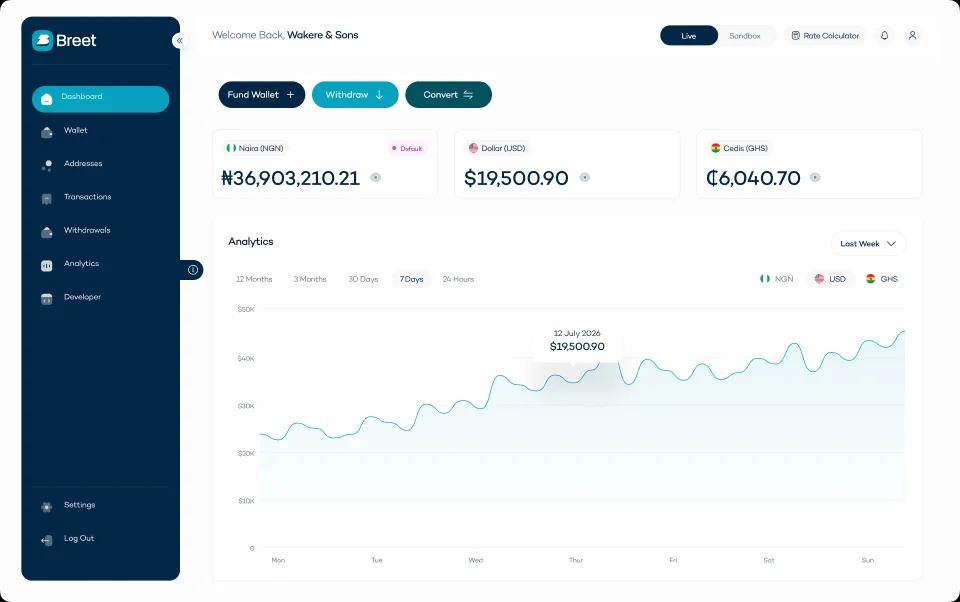
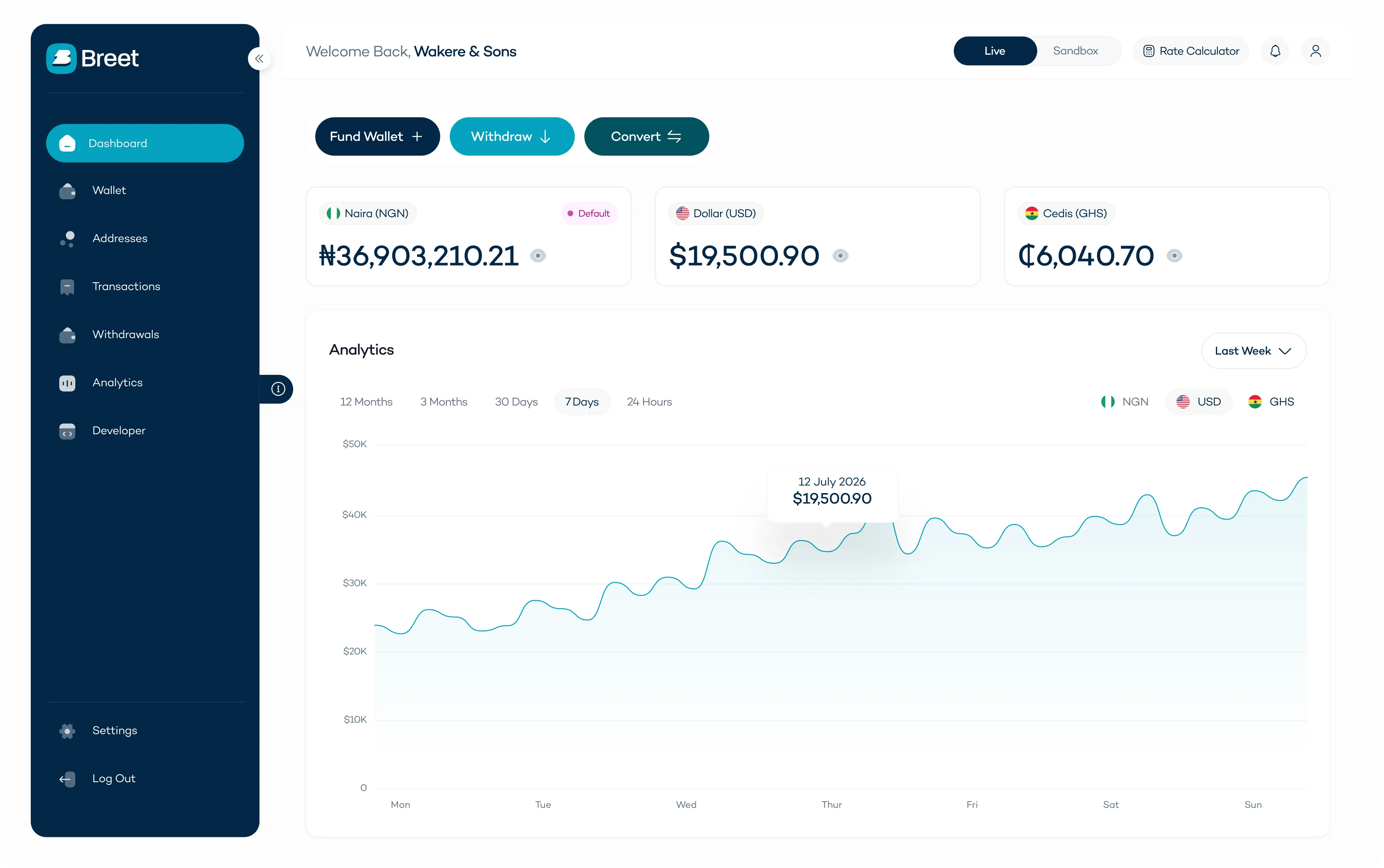
Breet: Breet uses customer addresses as the start of its flow. An address can be permanent or single-use. The business can link the address to a customer and bank account, then enable automatic settlement.
CoinPayments: For businesses that require this capability, CoinPayments's broader scope may be relevant. The hosted invoice path lets the merchant create a bill while CoinPayments handles the payment page and invoice events. The wallets and addresses path lets the merchant control the interface, receive arbitrary deposits, and assign a permanent or temporary address to a customer.
Decision: Choose CoinPayments when you want a hosted crypto checkout or a custom crypto wallet flow. Choose Breet when the address must lead to automatic conversion and local bank settlement.
- Fiat Settlement and African Bank Coverage
Breet: Breet directly documents NGN and GHS bank settlement. With auto-settlement enabled, the system can detect a deposit, convert it, and pay the linked bank account without a manual settlement action. For a business that requires a Nigerian or Ghanaian bank outcome, Breet has the clearer public product.
CoinPayments: CoinPayments' current homepage says merchants can convert crypto to fiat for bank payout where supported. The same page states that fiat settlement can depend on third-party partners, technical feasibility, applicable fees, and jurisdiction. The New platform integration guide lists fiat settlement as “TBD.” We found no current public source that confirms direct NGN or GHS bank settlement. This is not proof that an account can never receive such a route. It is a procurement gap that CoinPayments must answer in writing.
Decision: For fiat settlement and african bank coverage, Breet is the better fit when the priority is a focused route from customer crypto to stablecoins, USD, NGN, or GHS. Consider CoinPayments only when its additional product scope is required.
- APIs, SDKs, and Testing
Breet: Breet provides REST documentation, a development environment, address creation, auto-settlement controls, webhooks, retry behaviour, reporting data, error schemas, IP restrictions, and direct integration support. Its public API page states a 99.9% uptime SLA. Breet gives developers a narrower workflow with fewer local settlement components to assemble.
CoinPayments: CoinPayments provides a REST API, a sandbox, Postman material, current integration guides, and official SDKs for Python, JavaScript, Node.js, TypeScript, and PHP. Authenticated calls and webhook events use HMAC SHA-256 signatures. CoinPayments gives developers more official language packages.
Decision: The SDKs are a meaningful advantage. They handle request signing, path and query encoding, response decoding, and webhook verification.
- Recovery and Payment Exceptions
Breet: Breet automatically recovers certain supported-asset mismatches on Breet-generated addresses. It creates the suitable address inside the integration, carries over relevant settlement settings, and reports the resulting events through webhooks.
CoinPayments: CoinPayments provides automatic or manual recovery for eligible assets sent to the wrong merchant address on the same blockchain. The rule applies only to deposits to merchant addresses. The current homepage also describes fund-recovery support for eligible same-chain cases.
Decision: Both functions reduce support work. Neither is a promise to recover every token, network, or incorrect address. Test the supported cases and show clear payment instructions to users.
- Compliance and Legal Fit
Breet: Breet's Canadian entity is a Canadian FINTRAC money service business; its Nigerian SEC programme application is pending. Confirm the contract entity, custody, fiat partner, and duties.
CoinPayments: CoinPayments states that it has ISO 27001 certification and AML/KYC controls. Its footer names several possible service entities or partners.
Decision: For compliance and legal fit, Breet is the better fit when the priority is a focused route from customer crypto to stablecoins, USD, NGN, or GHS. Consider CoinPayments only when its additional product scope is required.
When hosted checkout and plugins matter
These functions matter when they are core product requirements. If the business only needs crypto acceptance and settlement, they can add unnecessary integration work and ongoing operations.
Why Breet fits local bank settlement
Breet removes the infrastructure between the customer crypto payment and the chosen crypto or fiat output. The product team can keep the integration focused on the payment result.
Which should you choose?
Choose Breet when the business wants the simplest route from a customer crypto payment to stablecoins, USD, NGN, or GHS. Breet handles the crypto infrastructure and gives the team one focused payment flow.
- Accept 12+ supported crypto assets using permanent or single-use wallet addresses.
- Convert deposits automatically after blockchain confirmation.
- Keep funds in stablecoins or USD, or settle directly to an NGN or GHS bank account.
- Withdraw through the API or Breet business dashboard at any time.
- Avoid liquidity management and wallet sweeping.
- Pay one volume-based transaction fee with no separate setup, monthly, or wallet-sweeping fees and no gas fee for receiving crypto.
- Test integrations in a public sandbox with webhooks, live asset discovery, and clear API documentation.
- Get direct integration support through dedicated Slack channel support.
Consider CoinPayments only when the product requires one or more of these additional capabilities: hosted crypto invoices; custom wallets and customer addresses; 40+ payment cryptocurrencies. For a focused crypto acceptance and settlement flow, Breet removes more product decisions and operating work.
Need more detail on CoinPayments?
Read the CoinPayments API review for a focused review of its public features, pricing evidence, strengths, and limits. You can also compare other crypto payment APIs.