- The cross-border problem African businesses are actually solving
- How SWIFT works, and what it really costs
- How stablecoin rails work, and what they really cost
- SWIFT vs. stablecoin rails, side by side
- Where stablecoin rails win, and where SWIFT still does
- What about PAPSS and instant payment systems?
- How African businesses actually move onto the stablecoin rail
- Is using stablecoin rails instead of SWIFT legal in Africa?
- How to decide: route by corridor, not by loyalty
- Frequently asked questions
A Nigerian importer sending $10,000 to an overseas supplier today has two very different payment rails available: SWIFT and stablecoin rails. SWIFT costs $25 to $50 in fees, adds a 2% to 5% FX spread, and can take days to settle.
Stablecoin rails can settle the same payment in minutes for less than a dollar.
The honest answer isn’t that stablecoins always win. SWIFT still has real advantages in some corridors; stablecoin rails are cheaper and faster in others.
For African businesses, there’s a third factor many comparisons ignore: correspondent banking is shrinking, making some cross-border payments slower and more expensive every year.
In this guide, we compare SWIFT vs. stablecoin rails on cost, speed, compliance, and practicality, look at where PAPSS fits into the picture, and explain how a business actually moves money on and off stablecoin rails in a compliant way.
The cross-border problem African businesses are actually solving
Before comparing SWIFT vs. stablecoin rails, it helps to be clear on the problem African businesses are trying to solve.
Moving money into or out of Africa is often slow, expensive, and difficult, whether you’re paying an overseas supplier or receiving funds from international customers.
The friction usually comes from the payment infrastructure itself, and the costs add up quickly:
- SWIFT transfers carry explicit fees of around $25 to $50 per transaction.
- FX spreads can add another 2% to 5% to the total cost.
- Research shows FX markups account for 60% to 97% of total cross-border payment costs.
- End-to-end transfers average roughly 27 hours and can take 3 to 5 business days on many emerging-market corridors.
There’s another challenge most global payment guides overlook: correspondent banking is shrinking.
Over the last decade, international banks have reduced correspondent relationships with African institutions as part of broader de-risking efforts.
Payments are increasingly routed through fewer intermediaries, which creates more points of failure along the way.
How SWIFT works, and what it really costs
SWIFT is a messaging network that instructs a chain of correspondent banks to move funds, and every intermediary in that chain adds cost, delay, and complexity.
How SWIFT works
- SWIFT sends standardized payment messages between banks rather than moving funds itself.
- The actual money travels through a network of correspondent and intermediary banks, each deducting a fee, often $10 to $25 per hop.
- Settlement depends on banking hours, liquidity pre-positioning, and how efficient the correspondent chain happens to be.
What it really costs
On paper, a SWIFT transfer looks like a simple bank fee. In reality, the cost is layered:
- Explicit transfer fees: typically $25 to $50 per transaction.
- FX spread: often 2% to 5%, depending on the corridor and the bank.
- End-to-end settlement time: 27 hours on average, with many emerging-market corridors taking 3 to 5 business days.
SWIFT gpi has improved visibility and tracking across major corridors. Swift’s own data shows nearly 50% of gpi payments are credited to the end beneficiary within 30 minutes, and almost 100% within 24 hours.
That tracking improvement doesn’t change the underlying cost structure. Final settlement still depends on the full correspondent chain completing every step.
Where SWIFT still performs well
Despite its inefficiencies, SWIFT remains deeply embedded in global finance for good reason:
- It offers near-universal reach across almost every bank and currency in the world.
- It remains the default system for high-value institutional transfers and major currency corridors where alternatives are limited.
- It’s fiat-native, so there’s no need to convert into digital assets or alternative settlement instruments.
- It operates within a mature regulatory framework that compliance teams, auditors, and regulators already understand.
How stablecoin rails work, and what they really cost
Stablecoin rails move dollar-pegged value directly over blockchain networks, without correspondent banks. That’s why they’re significantly faster and cheaper than traditional cross-border payment systems.
How stablecoin rails work
- Value moves directly from wallet to wallet over blockchain networks such as Tron or Solana.
- Transactions are validated and settled on-chain in seconds to minutes, depending on network congestion.
- Payments run 24/7/365, with no dependence on banking hours, settlement windows, or intermediary banks.
At the core of this system are stablecoins such as USDT and USDC, designed to maintain a 1:1 peg with the US dollar and enable digital dollar settlement across borders.
What they really cost
Compared to traditional banking rails, stablecoin transactions run on a low-fee rail:
- Transaction fees: typically $0.01 to $1.00, depending on the network.
- Settlement time: usually under three minutes from send to confirmation.
- FX impact: minimal between wallet transfers, since value stays in dollar-pegged form throughout settlement.
That gap in cost and speed runs 100 to 1,000 times more efficient than SWIFT for similar payment sizes.
Where stablecoin rails fall short
Despite their advantages, stablecoin rails aren’t a perfect replacement for traditional banking infrastructure:
- Transactions are irreversible, so there are no chargebacks once funds are sent.
- Businesses depend on the stability of the underlying issuer and the peg mechanism of the stablecoin.
- Most importantly, funds stay on-chain until converted into local fiat, so a business still needs a reliable on/off-ramp to make the money usable in real-world operations.
SWIFT vs. stablecoin rails, side by side
SWIFT and stablecoin rails are built for fundamentally different strengths. Speed determines how quickly funds arrive, cost affects margins at scale, FX determines hidden leakage, and availability determines whether payments can move outside banking hours.
Compliance, reversibility, and on/off-ramp capability determine whether a rail is usable in real operations at all.
SWIFT vs. stablecoin rails (comparison table)
| Dimension | SWIFT | Stablecoin rails | Note |
| Settlement speed | 27 hours average (1 to 5 days in many corridors) | Under 3 minutes | Stablecoin rails settle near-instantly on-chain |
| Explicit cost | $25 to $50 per transfer | $0.01 to $1.00 per transaction | Depends on network and congestion |
| FX spread | 2% to 5% | Minimal, provider-dependent | Stablecoins maintain their dollar peg during transfer |
| Availability | Banking hours only | 24/7/365 | No dependency on banking windows |
| Reach and ubiquity | Near-universal bank connectivity | Limited to recipients with wallet access | SWIFT still wins on global coverage |
| Transparency | Improving via SWIFT gpi tracking | Fully transparent on-chain | Blockchain provides real-time visibility |
| Reversibility | Limited recall once processed | Irreversible | No chargebacks in stablecoin transfers |
| Compliance/AML | Mature, bank-led compliance framework | Handled via licensed providers | Depends on the platform used |
| Volatility | None (fiat-based) | None (if the stablecoin is dollar-pegged) | Stability depends on issuer trust |
| On/off-ramp to fiat | Native banking rails | Requires a provider | This is the key operational gap for stablecoin usage |
How to read this table
It’s not a scorecard for one universal winner. Stablecoin rails win on speed, cost, and availability. SWIFT wins on reach and fiat-native settlement, especially where a counterparty can’t or won’t touch digital assets.
Everything else is a trade-off that depends on the corridor, the regulation involved, and how much risk the business can carry.
Where stablecoin rails win, and where SWIFT still does
The right approach for most businesses choosing between SWIFT and stablecoin rails is routing payments based on the corridor, the cost, and the settlement requirement.
Where stablecoin rails win
Stablecoin rails tend to outperform SWIFT where cost, speed, and frequency matter most:
- High-cost, emerging-market corridors: especially African inbound and outbound routes where FX spreads and intermediary fees run high.
- Frequent, lower-value payments: contractor payouts, supplier settlements, and operational disbursements.
- 24/7 settlement needs: payments that can’t wait for banking hours or multi-day clearing cycles.
- Corridors affected by correspondent banking de-risking: where delays, rejections, or routing inefficiencies are common.
- Dollar value preservation: businesses that want to hold or move USD-equivalent value without immediate FX conversion.
Where SWIFT still wins
Despite its inefficiencies, SWIFT remains essential in specific contexts:
- High-value institutional transfers on major G7 corridors, especially where SWIFT gpi provides reliable tracking and settlement.
- Exotic currency corridors with limited or no stablecoin liquidity or off-ramp support.
- Counterparties restricted to traditional banking rails, who can only receive fiat through bank accounts.
- Scenarios requiring reversibility or recall, where dispute resolution matters in case of error or fraud.
For most African SMEs, the majority of real-world payments land naturally on the stablecoin side of that ledger.
The exceptions where SWIFT still wins are real, just narrower than the traditional payment narrative suggests.
What about PAPSS and instant payment systems?
SWIFT isn’t the only incumbent in cross-border payments. The Pan-African Payment and Settlement System (PAPSS) connects participating African countries and enables cross-border payments in local currencies, changing how intra-African payments get structured.
PAPSS lets money move across African borders without relying on correspondent banking relationships or external currencies, with settlement in minutes to hours. It isn’t a replacement for SWIFT or stablecoin rails; it solves a different part of the problem:
- Strong for intra-African, local-currency payments, especially where both sender and receiver operate within PAPSS-enabled countries.
- Reduces reliance on USD settlement, helping businesses avoid unnecessary dollar conversion in regional trade.
- Works best within connected African corridors where adoption and banking integration already exist.
The real framing: three rails, not one winner
The most accurate way to think about modern cross-border payments isn’t as a single-choice system, but as routing infrastructure.
PAPSS handles African-to-African local currency flows. Stablecoin rails handle dollar-based and global cross-border payments. SWIFT stays necessary for institutional and global banking corridors the other two don’t yet reach.
Most businesses won’t choose one system; they’ll use all three, depending on where the payment is going and what currency needs to land on the other side.
How African businesses actually move onto the stablecoin rail
Stablecoin rails only outperform SWIFT when a business can reliably move between crypto and local fiat in a compliant way. That on/off-ramp layer determines whether the rail is usable at scale, and building it internally is often too complex, capital-intensive, and regulatory-heavy for most teams.
If the comparison points your corridors toward the stablecoin rail, the only question left is the one SWIFT never makes you ask: how do you get local money on and off it?
The on/off-ramp layer
- Converts between stablecoins, or other crypto assets, and local fiat currencies.
- Handles custody, compliance checks, transaction monitoring, and settlement into bank accounts or wallets.
This layer is what turns a crypto transfer into a usable business payment.
How Breet fits into the stablecoin rail
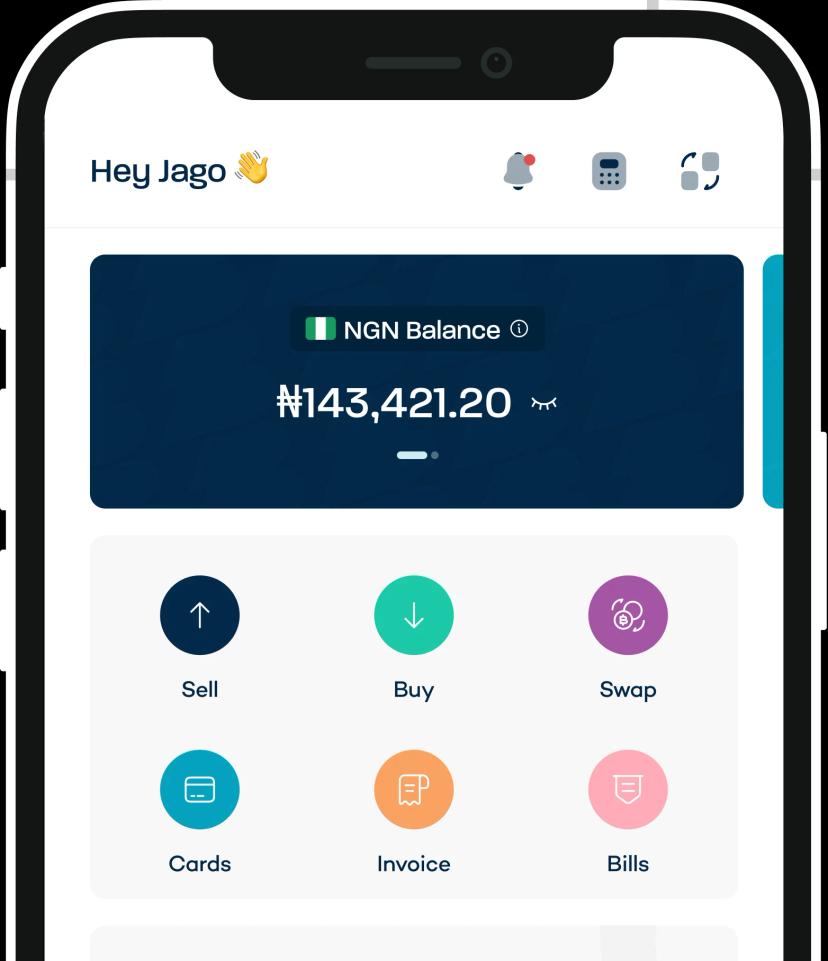
Breet Business’ crypto and stablecoin API connects blockchain settlement to real-world business operations. Instead of a business building wallets, liquidity systems, and compliance pipelines itself, the process is abstracted through an API.
Core mechanism:
- API-generated wallet addresses: Breet creates a unique wallet address per transaction or use case, handling wallet infrastructure, transaction monitoring, and key security.
- Automated settlement flow: an incoming payment triggers an instant webhook, funds convert automatically to USDT, USDC, naira, or cedis, then settle into a bank account, mobile money wallet, or stablecoin wallet.
- Multi-chain support: BTC, ETH, USDT, USDC, SOL, TRX, including low-fee USDT via Tron, and other major networks.
- Built-in compliance: full KYC/AML and PCI DSS alignment, so a business operates within regulated frameworks without building compliance infrastructure internally.
- Transparent pricing: flat fee of 0.5% per transaction, with no setup fees, monthly charges, or hidden FX spreads, against SWIFT’s $25 to $50 plus 2% to 5% FX cost structure.
Important operational context
Breet currently supports direct local fiat settlement in Nigeria (NGN) and Ghana (GHS), along with USD-stablecoin settlement globally.
For other African markets where direct fiat off-ramping isn’t yet available, businesses typically combine Breet’s infrastructure with local rails or systems like PAPSS to complete settlement.
Proof of use case
PIL, a B2B spend management platform, integrated Breet for wallet generation, webhook-based payment detection, USDC funding, and periodic USD withdrawals. As the team described it: “Breet fit in cleanly and let us stay focused on our core product.”
High-volume treasury use
For larger flows, like supplier settlements or treasury conversions, Breet’s VIP OTC Desk is built to handle higher transaction volumes without the pricing inefficiencies or slippage typically associated with retail conversion routes.
If your payment corridors consistently point toward stablecoin rails, book a demo to see how Breet replaces the SWIFT leg for your corridors.
Is using stablecoin rails instead of SWIFT legal in Africa?
In most major African markets, using stablecoin rails for cross-border payments is legal when done through regulated providers. The regulatory direction isn’t a ban on the rail itself, but increasing formalization of how it must be used, as of June 2026.
Regulatory position across key markets
Across Africa, regulation is evolving toward supervision rather than restriction:
- Nigeria: the Securities and Exchange Commission has established a digital asset framework bringing virtual asset service providers under regulatory oversight.
- Kenya: the Virtual Asset Service Providers (VASP) Act (2025) provides a legal framework for crypto-related services under the Central Bank of Kenya and Capital Markets Authority.
- South Africa: crypto assets are regulated under the Financial Sector Conduct Authority, treated as financial products within a formal compliance structure.
- Ghana: the Bank of Ghana is progressing virtual asset regulations, with ongoing steps toward formal market supervision.
Implementation differs by country, but the direction is consistent: regulation is being formalized.
What this means in practice
For a business, legality is less about the technology itself and more about how it’s accessed. Using a KYC/AML-compliant provider keeps transactions within regulated financial frameworks, and a business still has to consider counterparty jurisdictions to stay compliant on both the sending and receiving side.
Companies aren’t required to avoid stablecoin rails. They’re required to use them through properly regulated channels.
This section is general informational context, not legal advice.
How to decide: route by corridor, not by loyalty
The goal isn’t to replace SWIFT entirely. It’s to route each payment through the rail that delivers the best combination of cost, speed, and settlement certainty.
- Expensive, emerging-market, or high-frequency dollar payments → stablecoin rails. Best for contractor payouts, supplier payments, and cross-border flows where cost and speed matter most, especially in corridors hit by high FX spreads or correspondent banking delays.
- Local-currency intra-African payments → PAPSS, where available. Ideal for regional trade where both sides operate within African banking systems and there’s no need for dollar settlement.
- High-value, exotic-currency, or fully fiat-native institutional transfers → SWIFT. Still necessary where global bank connectivity, currency coverage, or institutional settlement standards are required.
The businesses that consistently optimize cross-border payments are the ones that understand where each system performs best, and route payments accordingly.
As correspondent banking keeps contracting and alternative rails expand across Africa, a SWIFT-only model gets less practical for day-to-day operations every year.
If you’re exploring how to replace SWIFT with stablecoin settlement, Breet’s crypto and stablecoin API can help you move from comparison to implementation. Book a demo to get started.
Frequently asked questions
Is SWIFT cheaper than stablecoin rails?
No. SWIFT typically costs $25 to $50 per transfer plus a 2% to 5% FX spread. Stablecoin rails usually cost under $1 per transaction with minimal FX impact.
Are stablecoin payments legal in Africa?
In most major African markets, stablecoin usage is legal when processed through regulated providers.
What is the main difference between SWIFT and stablecoin rails?
SWIFT is a messaging network that relies on correspondent banks to move money. Stablecoin rails move value directly on blockchain networks without intermediaries, enabling faster and cheaper settlement.
Is SWIFT being replaced by stablecoins?
Not entirely. SWIFT is still widely used for global banking connectivity and certain institutional transfers.
Can businesses convert stablecoins into local currency?
Yes. This requires an on/off-ramp provider that converts stablecoins into fiat currencies like NGN or GHS.