Most “best crypto payment processors” roundups show you familiar names: BitPay, CoinGate, Coinbase Commerce, all promising to simplify how your business accepts crypto.
Those processors work well enough for a US or EU company. For a business in Lagos or Accra, they fall short because:
- They settle to a US or EU bank account, or leave the funds sitting as a USDC balance you still have to off-ramp yourself.
- Most custody your crypto before paying out, holding funds in their own wallet instead of converting and releasing them directly.
- None of them answer the basics: whether you need a processor or a gateway, who holds your money while it’s in transit, or whether accepting crypto is even legal for your business here.
This guide compares the 5 crypto payment processors that actually work for a business in Nigeria or Ghana, then shows how to start receiving crypto payments in under a day.
The 5 top crypto payment processors for businesses in Africa (2026)
| Processor | Coins | Settlement currency & rails | Custody | Fees | Compliance / region | Best for |
| Breet Business | BTC, ETH, USDT, USDC + more | NGN/GHS/USD to bank, mobile money, or stablecoin address | Non-custodial (direct conversion) | Talk to sales | KYC/AML, PCI-DSS, NDPC/NDPA aligned; Nigeria & Ghana | Businesses that need local settlement without custody risk |
| Ivorypay | USDT, USDC | Settles to preferred local currency (verify per market) | Not publicly documented, confirm before onboarding | Not publicly disclosed | Positions across 54 African countries | Pan-African merchants accepting stablecoins |
| TransFi | NGN plus major crypto/stablecoins | NGN or stablecoin, near-instant conversion | Hybrid regulated model, confirm custody terms | Not publicly disclosed | Regulated across multiple markets, confirm NG specifics | Businesses wanting fiat and crypto on one rail |
| Busha Business | BTC, ETH, USDT and other exchange-listed assets | Stablecoin or NGN settlement | Custodial (exchange model) | Not publicly disclosed | Nigeria-focused, established exchange | Nigerian merchants wanting a simple stablecoin/naira settlement choice |
| Quidax Collections | USDT, USDC and other Quidax-listed crypto | NGN payout via payment link or QR code | Custodial (exchange-held) | Not publicly disclosed | Nigeria-native exchange | No-code payment links and QR checkout |
1. Breet Business: Best for African businesses that must settle in naira or cedis without custody
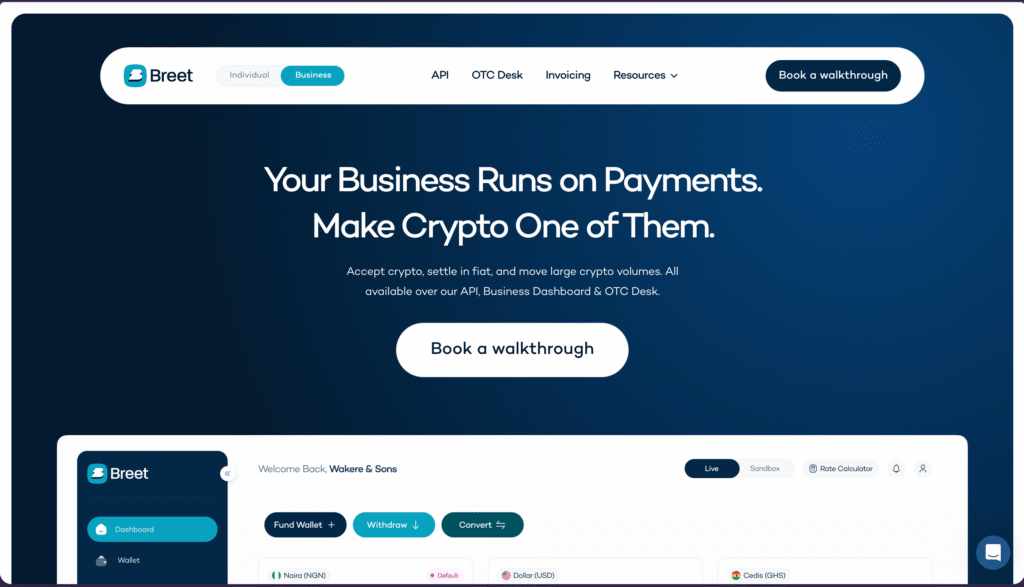
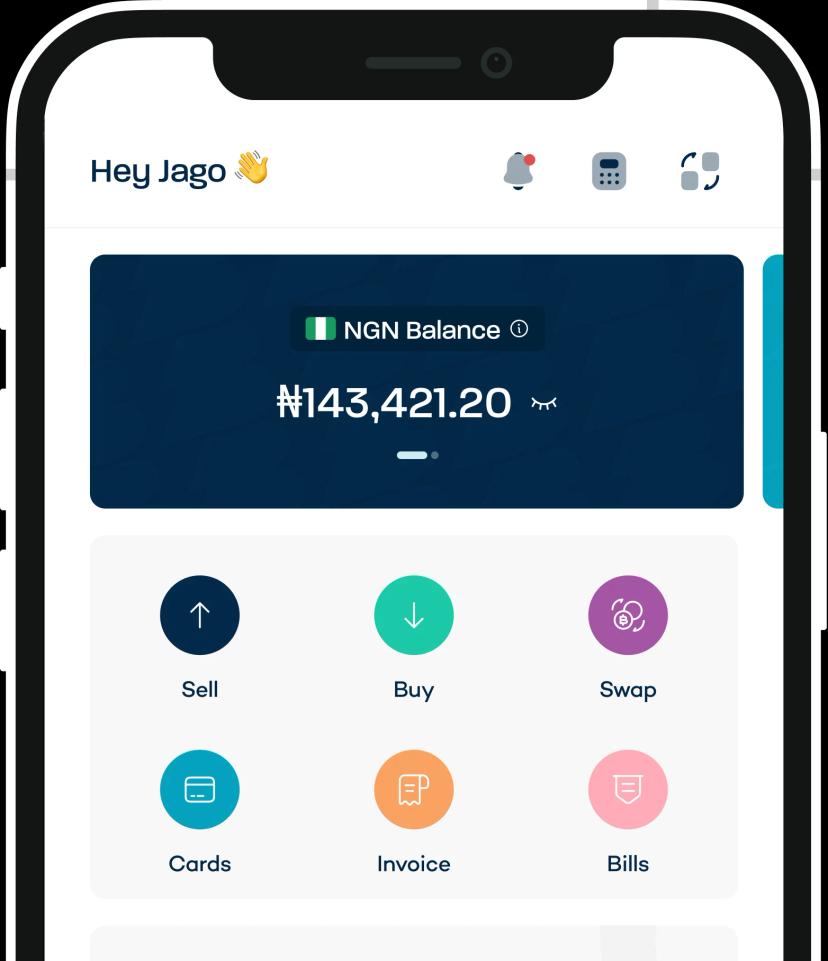
Breet Business is Africa-built crypto payment infrastructure, operated by Inbreetic Technologies, that accepts crypto from a customer and settles automatically to NGN, GHS, or USD, whether that’s a bank account, a mobile money wallet, or a stablecoin address.
AML screening and reconciliation run in the background, and Breet does not custody the crypto passing through: it converts directly rather than parking funds in a platform wallet.
The platform has processed transactions for 100+ verified African businesses, settled 3M+ transactions programmatically, holds 99.9% uptime, and typically gets a new business live in under a day, as detailed on the Breet Business page.
Coins supported: BTC, ETH, USDT, USDC, and other major assets, with stablecoins covering the bulk of business volume.
Settlement: NGN or GHS to a bank account or mobile money wallet, USD available, and stablecoin payout for businesses that want to hold value in USDT or USDC instead of converting immediately.
Custody: Non-custodial by design. Crypto converts on confirmation; it isn’t held in a Breet-controlled wallet awaiting a withdrawal request.
Compliance/region: KYC and AML checks run on every transaction, with PCI-DSS handling for payment data and alignment with Nigeria’s NDPC and Ghana’s Data Protection Act (NDPA) frameworks. Live in Nigeria and Ghana.
Breet Business isn’t one product but three surfaces, each built for a different buyer inside the same company.
Add crypto checkout to your product in under a day
Breet’s payment API puts on-ramp, off-ramp, and wallet infrastructure behind one integration, handling wallet generation, on-chain confirmation, automatic fiat conversion, AML screening, and webhook notifications.
A dev team plugs crypto checkout into an existing product without building any blockchain infrastructure, and sign-up to first live transaction takes under a day. The API documentation has the endpoints.
Invoice clients anywhere, receive naira or cedis the same day
Finance teams create a crypto invoice in minutes, the client anywhere in the world pays in BTC or USDT, and the business receives the fiat equivalent directly.
There’s no volatility exposure and no manual reconciliation, because immediate conversion is the default rather than a nightly chore.
Accounts receivable looks exactly as it did before, except the payment can now come from a crypto wallet.
Move large volumes at a locked rate, settled within the hour
For big positions, the OTC desk converts crypto to naira or cedis at an institutional rate locked before execution, with settlement in the bank account the same hour.
No counterparty, no order-book slippage, and the rate is visible upfront, which is the structural opposite of screening P2P buyers or watching an order fill in pieces.
Where a processor imposes a $1,000 minimum fiat withdrawal, there’s no equivalent enterprise gate here.
Pros:
- The only option on this list purpose-built for Nigerian and Ghanaian local settlement, including mobile money, not just a USD/stablecoin balance
- Non-custodial by design: funds convert directly instead of sitting in a platform wallet, which removes a layer of counterparty risk
- Compliance is built into the transaction flow (PCI-DSS, NDPC/NDPA alignment), not bolted on after
- One platform serves developers (API), finance teams (invoicing), and high-volume desks (OTC), so a growing business doesn’t have to re-platform as its needs change
- Onboarding is measured in hours, not integration quarters; see the Cardtonic case study for a real go-live timeline
Cons:
- Built for Nigeria and Ghana by design. A business that needs a single processor to settle in dozens of currencies worldwide will need to pair this with (or choose) a global processor instead.
Ready to see it live? Book a walkthrough and get a straight answer on whether Breet Business fits your stack.
2. Ivorypay: Best for crypto-native merchants accepting pan-African stablecoin payments
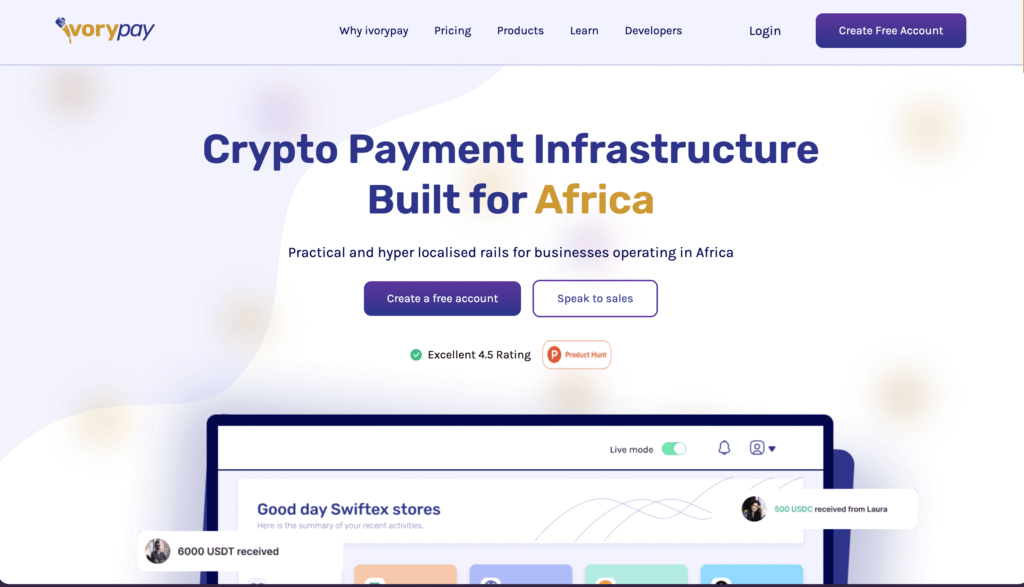
Ivorypay positions itself as crypto payment infrastructure built for Africa, built to accept USDT and USDC from customers across 54 countries and settle to a merchant’s preferred currency.
It’s aimed at merchants who already think in stablecoins and want reach across African markets beyond a single country.
Coins supported: USDT and USDC, per public positioning.
Settlement: Settles to a merchant’s preferred currency; specific rails and turnaround per market aren’t fully documented publicly.
Custody: Not clearly documented in public materials; confirm directly before committing volume.
Fees: Not publicly disclosed at the time of writing.
Compliance/region: Markets itself around pan-African coverage rather than a single-country compliance regime.
Pros:
- Broad multi-country reach for merchants selling across Africa, not just one market
- Merchant-facing tools aimed at stablecoin-first businesses
Cons:
- Public documentation on fees, exact settlement timing, and custody model is thinner than a business handling real volume needs; verify these directly with Ivorypay before integrating.
3. TransFi: Best for accepting naira and crypto on one rail
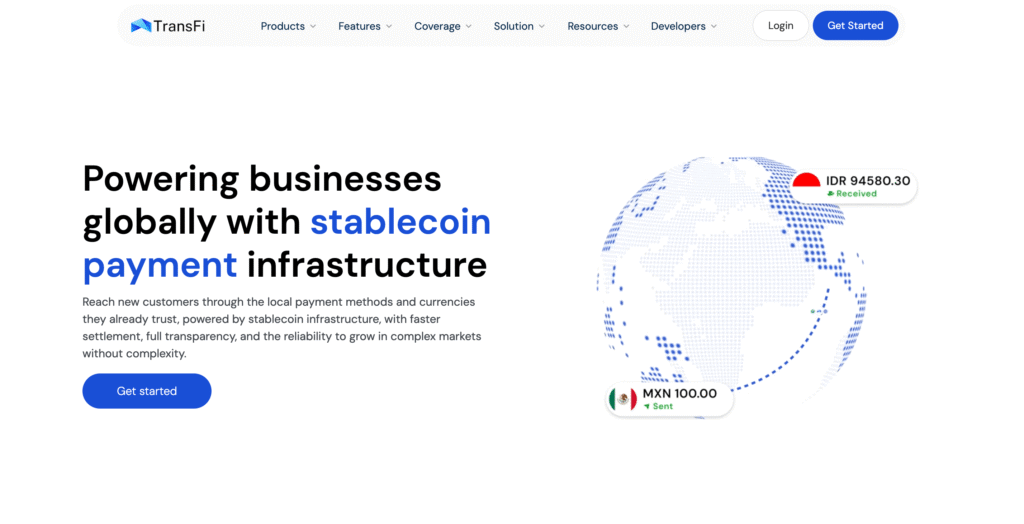
TransFi operates as a regulated hybrid payments platform that accepts both NGN and crypto, converting instantly to naira or to stablecoins depending on what the business needs.
It suits a business that wants a single rail for card-like fiat flows and crypto, rather than running two separate providers.
Coins supported: Major crypto assets and stablecoins alongside NGN as a native currency.
Settlement: NGN or stablecoin, with conversion described as near-instant.
Custody: Operates under a regulated model; confirm exact custody terms for NG-specific flows before onboarding.
Fees: Not publicly disclosed at the time of writing.
Compliance/region: Regulated across the markets it serves; Nigeria-specific payout mechanics are worth confirming directly with the TransFi team.
Pros:
- Fiat and crypto handled on one platform, useful for a business that doesn’t want to stitch together two providers
- Operates as a regulated entity rather than an unregulated pass-through
Cons:
- Its focus spans broader payments beyond crypto, so it carries less crypto-developer depth than a dedicated crypto payment API; confirm Nigeria payout specifics directly before relying on it for local settlement.
4. Busha Business: Best for Nigerian merchants wanting stablecoin or naira settlement
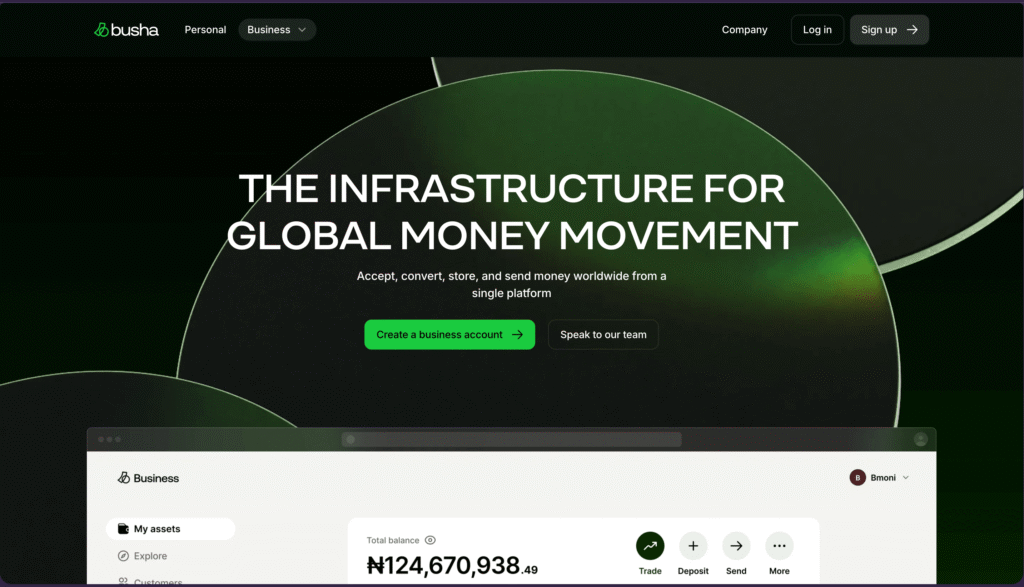
Busha Business is the merchant-facing arm of Busha, an established Nigerian exchange, offering stablecoin settlement with no chargeback risk. A merchant chooses upfront whether to settle in stablecoin or local currency, which keeps the decision simple for a business that doesn’t want to manage volatility exposure.
Coins supported: BTC, ETH, USDT, and other assets available on the underlying exchange.
Settlement: Stablecoin or NGN, selected by the merchant.
Custody: Custodial, funds move through Busha’s exchange infrastructure before payout.
Fees: Not publicly disclosed at the time of writing.
Compliance/region: Nigeria-focused, backed by an exchange with an established local brand.
Pros:
- Recognized Nigerian brand with exchange infrastructure already in place
- Straightforward settlement choice between stablecoin and naira, with no chargeback exposure
Cons:
- Custodial by nature of the exchange model, and less programmable than a purpose-built API for a business that wants deep integration control.
5. Quidax Collections: Best for no-code payment links and QR codes
Quidax Collections is a payments feature inside the Quidax exchange, letting a business generate a payment link or QR code, have a customer pay in USDT, USDC, or other supported crypto, and receive naira on the other end.
It’s built for merchants who want to start collecting crypto payments today without touching code.
Coins supported: USDT, USDC, and other assets listed on Quidax.
Settlement: NGN payout, collected via a payment link or QR code.
Custody: Custodial; funds are held within the exchange before settlement.
Fees: Not publicly disclosed at the time of writing.
Compliance/region: Nigeria-native, operating under Quidax’s existing exchange compliance setup.
Pros:
- Fast, no-code setup for a small business or solo merchant
- Nigeria-native and familiar to anyone who already uses Quidax
Cons:
- It’s a collections feature bolted onto an exchange rather than dedicated payment infrastructure, custodial by default, and less suited to a business that wants to integrate deeply via API.
How to choose a crypto payment processor in Africa (6 criteria)
Fees are the number every landing page leads with, but five other criteria decide whether a processor actually works for a business operating in Nigeria or Ghana. Score every provider on all six before signing anything.
Local fiat settlement
Does the processor pay out NGN or GHS to a bank account, a mobile money wallet, and a stablecoin address, or does it stop at a USD balance?
This is the single biggest differentiator on this list; see how fiat settlement actually works in a crypto payment flow.
Custody model
Does the processor hold your crypto before paying out (custodial), or convert directly without parking funds in a platform wallet (non-custodial)?
A custodial setup adds a layer of platform risk on top of market risk; the difference between custodial vs. non-custodial models is worth understanding before volume gets meaningful.
Compliance and legality
A serious processor runs KYC and AML checks on every transaction, handles payment data under PCI-DSS, and aligns with data protection rules like Nigeria’s NDPC and Ghana’s NDPA.
In Nigeria specifically, digital asset activity now sits under the SEC’s Investments and Securities Act (ISA) 2025 licensing regime, which is a reason to favor a provider working through a licensed or compliant partner model rather than an unregulated pass-through.
This is general regulatory context, not legal advice; confirm current requirements with counsel before making a compliance decision.
Fees and settlement speed
The headline percentage is only part of the cost. Add network fees, FX spread on conversion, and any payout fee, then check how fast value actually lands in the account; same-hour and next-day are very different promises.
Coins supported and reliability
Confirm BTC, ETH, USDT, and USDC coverage at minimum, and ask what the uptime looks like during a volume spike, not just on an average day.
Time-to-live and audience fit
An API suits a developer team that wants to build the flow into a product. No-code invoicing or a dashboard suits a finance team or merchant who wants to start today.
An OTC desk suits a high-volume business moving large positions. The right fit is measured in days to integrate, not a quarter of engineering time.
Fees are the least important number on this list
For a business in Nigeria or Ghana, the best crypto payment processor is the one that settles to local rails, doesn’t hold your crypto while it sits there, clears compliance under the current regulatory regime, and goes live without eating an engineering quarter.
Run that filter first, and the list of real options gets short fast.
Crypto acceptance has stopped being a novelty feature and become a baseline customer expectation.
The businesses that win from here aren’t the ones chasing the lowest advertised fee; they’re the ones that treated local settlement, custody, and compliance as the deciding criteria from the start.
If naira or cedis settlement, non-custodial conversion, and a same-day go-live matter to your business, book a walkthrough and see Breet Business against your actual stack.
Frequently asked questions
What’s the difference between a crypto payment processor and a gateway?
A gateway is the customer-facing checkout, the screen where someone chooses to pay in crypto. A processor is the infrastructure behind it: confirming the on-chain transaction, running AML checks, converting to fiat, and settling the payout. A business usually needs both, but the processor is where custody, compliance, and settlement currency actually get decided.
Can my customers pay in crypto and I get paid in naira?
Yes, with a processor that auto-converts crypto to fiat and settles directly to a Nigerian bank account or mobile money wallet, rather than leaving the balance in crypto or a foreign currency.
Is it legal for a Nigerian business to accept crypto?
Digital asset activity in Nigeria now falls under the SEC’s Investments and Securities Act (ISA) 2025 licensing regime. The practical approach is choosing a processor that runs KYC/AML on every transaction and operates through a licensed or compliant partner model. This is general information, not legal advice; confirm specifics with a qualified adviser for your situation.
How much do crypto payment processors charge?
Published rates generally run from roughly 0.5% to 2% per transaction, but the percentage alone doesn’t tell the full story. Weigh total cost, including network fees, FX spread on conversion, and any separate payout fee, before comparing two providers on price.
Does the processor hold my crypto?
It depends on the custody model. Custodial processors hold crypto in a platform-controlled wallet before paying out; non-custodial processors convert directly without parking funds anywhere in between, which removes that layer of platform risk.
Do I need to build wallet infrastructure?
No. A crypto payment API handles wallet generation, on-chain monitoring, AML screening, and webhook notifications, so a development team integrates a payment flow instead of building exchange-grade infrastructure from scratch.