Getting into crypto can feel exciting and a bit confusing at first.
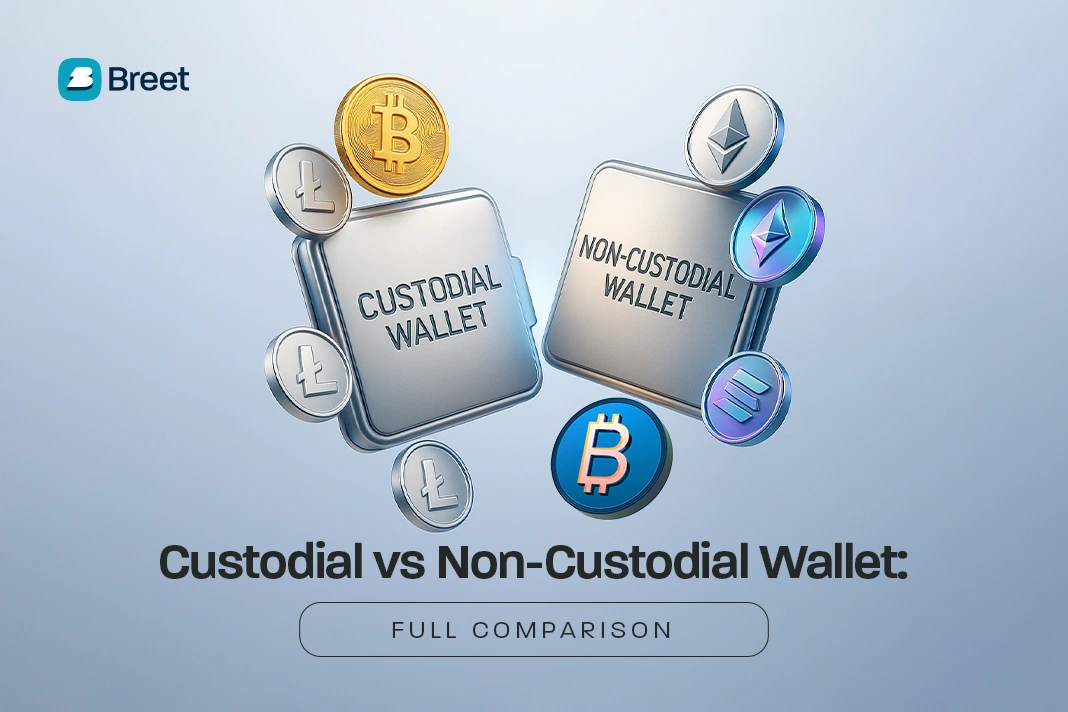
One of the first choices you’ll make is where to keep your cryptocurrency safe. Should you trust a platform to hold it for you or should you keep full control yourself? This brings us to the custodial vs non-custodial wallet debate.
In this guide, we’ll explain everything about custodial vs non-custodial wallets in simple terms, so you can understand how they work and choose what’s right for you.
What is a custodial wallet?
A custodial wallet means a third party, the custodian, holds your private keys for you, and you access your funds by logging in, the same way you’d log into a bank app. The platform, an exchange, or a service like Breet generates and stores the key on its own servers, and you authenticate with a username, password, and usually identity verification.
Binance Wallet, Coinbase Wallet, and Breet Wallet are all examples of this model. The upside is easy account recovery if you forget your login.
Pros of custodial wallets
- Easy to Use: Custodial wallets are simple and perfect for beginners. You don’t need to worry about handling private keys.
- Password Recovery: If you forget your password, you can easily reset it through your email or phone.
- Customer Support: You can always reach out to the support team if you run into any problems.
- Familiar Feel: They work just like your online bank app; you log in, check your balance, and make transactions.
Cons of custodial wallets
- No Control Over Keys: The platform keeps your private keys, so you don’t fully own your crypto.
- Platform Risk: If the exchange gets hacked, shuts down, or locks your account, you could lose access to your money.
- Privacy Issues: Most custodial wallets ask for ID verification, which means your personal details are connected to your account.
What is a non-custodial wallet?
A non-custodial wallet means you alone hold the private key and the seed phrase, and no third party can access or freeze your funds, ever. The wallet generates a 12-to-24-word seed phrase when you set it up, and if you lose it, there’s no password reset and no support line to call.
MetaMask, Trust Wallet, Ledger, Trezor, and Phantom are the names you’ll see most often here. The upside is total control: nobody can lock you out.
Pros of non-custodial wallets
- Full Control: You are in control of your cryptocurrency.
- Privacy: You can use them anonymously, as most of them don’t require personal information.
- Protection from Platform Failures: If an exchange collapses, your funds remain safe.
- No Restrictions: You can send and receive crypto anytime without needing approval from a third party.
Cons of Non-Custodial Wallets
- You Handle Security: You’re fully in charge of keeping your wallet safe. If you lose your seed phrase, your funds are gone for good.
- No Password Reset: There’s no way to reset your password or recover your wallet if you lose your seed phrase.
- Takes Time to Learn: You need to understand how to store your seed phrase safely, confirm transactions, and stay alert to scams.
Custodial vs non-custodial: how they actually compare
Three everyday questions decide most of this, the same ones you’d ask about any financial account: can you always get to it, what happens if something goes wrong, and how do you know you can trust the platform holding it?
Here’s each one, compared plainly.
| What matters | Custodial wallet | Non-custodial wallet |
| Who holds the key | The platform | You, alone |
| Getting locked out | Possible if the platform loses access or gets restricted | Possible if you lose your seed phrase, permanently |
| Account recovery | Password reset, ID verification, a support line | None; nobody can restore a lost seed phrase |
| Regulatory exposure | Depends on the platform’s licensing status in your country | None; there’s no company for a regulator to act against |
| Ease of use | Familiar login, easy for beginners | Requires managing your own backup carefully |
| Cashing out | Usually built in | Not on its own; needs a separate conversion step |
Can you always get to your money?
With a custodial wallet, your access depends on the platform staying reachable, not just on it staying secure. You need to be able to reach the platform and log in before you can access your account.
With a non-custodial wallet, nobody outside can block your access, ever, because there’s no company or regulator in the loop to cut you off. The trade-off, covered next, is that there’s also nobody there to help you if you lock yourself out.
What happens if something goes wrong?
On a custodial platform, if you forget your password, you reset it by email or an ID check, the same way you’d recover a bank login. There’s a person, or at least a support system, on the other end.
On a non-custodial wallet, if you forget or lose your seed phrase, there’s no reset button and nobody to call. Ledger’s own analysts estimate that somewhere between 2.3 and 3.7 million Bitcoin are permanently lost as of early 2025, almost entirely for this exact reason, and the FBI logged over $9.3 billion in crypto fraud losses in 2024 alone, with the majority of victims over the age of 60.
If you’re going the non-custodial route, back up your seed phrase offline, in more than one physical place, before this becomes a live problem rather than after.
How do you know you can trust it?
This is where “which platform” starts to matter specifically in Nigeria. Under the Investments and Securities Act 2025, Nigeria’s SEC now has to approve any exchange or custodian operating here.
For a reader choosing a custodial platform today, checking how far along it actually is in that process is now a real, practical filter, not a box-ticking formality.
With a non-custodial wallet, there’s no platform to license in the first place, since no company holds your funds, so trust here is about the wallet software or hardware itself rather than a regulator’s approval.
7 key differences between a custodial and non-custodial wallet
Now that we understand what each wallet type is, let’s compare them side by side to help you make an informed decision.
1. Control and Ownership
Custodial Wallet: The platform controls your private keys, and you access your funds through them. It’s convenient but means you’re trusting a third party.
Non-Custodial Wallet: You control your private keys. You have complete ownership and authority over your funds.
2. Security
Custodial Wallet: Security depends on the platform’s systems. If they get hacked or go bankrupt, your funds are at risk. However, reputable platforms invest heavily in security measures.
Non-Custodial Wallet: Security depends entirely on you. Your funds are safe from platform hacks, but vulnerable if you lose your seed phrase or fall for scams.
3. Privacy
Custodial Wallet: It usually requires identity verification (KYC). Your personal information and transaction history are linked to your account.
Non-Custodial Wallet: It is often anonymous. Many don’t require any personal information. You can use crypto without revealing your identity.
4. Ease of Use
Custodial Wallet: They are beginner-friendly, familiar, offer password recovery, and have customer support ready to help.
Non-Custodial Wallet: They require more responsibility and knowledge. You need to understand seed phrases, transaction fees, and blockchain basics.
5. Recovery Options
Custodial Wallet: If you forget your password, you can reset it via email or SMS. Customer support can help you regain access.
Non-Custodial Wallet: Recovery is only possible if you have your seed phrase.
6. Transaction Speed and Fees
Custodial Wallet: Transactions can be faster on the platform (if both parties use the same exchange), but withdrawals to external wallets may have delays and higher fees.
Non-Custodial Wallet: You interact directly with the blockchain. Transaction speed depends on network congestion, and you pay standard network fees.
7. Regulatory Compliance
Custodial Wallet: They are fully compliant with regulations. Platforms follow KYC/AML rules, which can be reassuring for some users.
Non-Custodial Wallet: They operate outside traditional financial regulations. This offers freedom but less legal protection.
Which one fits what you’re holding
The right answer here depends on three concrete things: how much you’re holding, how long you’re planning to hold it, and whether you need it to become naira or cedis in a bank account. It’s rarely a permanent, either-or choice.
Small, everyday amounts tolerate custodial convenience just fine. Larger, savings-scale balances, especially relevant with naira inflation, carry more real cost if a seed phrase gets lost, and more real cost if a platform access issue hits at exactly the wrong moment. Match the wallet type to the size of what’s actually at stake.
Short-term or actively-used funds favor a custodial wallet’s speed and recoverability. Long-term storage favors a non-custodial or hardware wallet, where the one-time effort of guarding a seed phrase properly pays off over years instead of days.
None of the non-custodial wallets named earlier: MetaMask, Trust Wallet, Ledger, Phantom, convert crypto to a Nigerian or Ghanaian bank account on their own. That’s a custodial-side job by definition, which reframes the whole question as “which one, or both, for which job” rather than a side you pick once and defend forever.
Most people who think this through end up using both: custodial for spending and cashing out, non-custodial or hardware for long-term storage.
Need a wallet that gets your crypto into naira or cedis? Create a Breet account and keep the cash-out option open.
Frequently Asked Questions
Which wallet is safer to use?
Non-custodial wallets are safer if you can manage your keys properly. Custodial wallets are easier for beginners but require trust in the platform.
Can I switch from a custodial wallet to a non-custodial wallet?
Yes. You can transfer your crypto from one type of wallet to another using the right wallet address.
Which wallet type is best for beginners?
Custodial wallets are better for beginners since the platform handles security and recovery.
Can I lose my crypto in a custodial wallet?
Yes, if the platform is hacked or shuts down. Use trusted options like Breet for better safety.