If you’re comparing stablecoin payment gateways, you’re probably trying to:
- Get naira or cedis landing in your bank account, not a stablecoin balance you have to convert and off-ramp yourself.
- Accept stablecoins like USDT and USDC without building wallet infrastructure, on-chain monitoring, and AML checks from scratch.
- Clear a compliance review without gambling on whether your provider is even licensed to operate where you do business.
Stripe, BitPay, and BVNK don’t solve any of that. Stripe settles USDC to SEPA or ACH only, and BitPay and BVNK clear to USD or EUR, so none of the three pays into a Nigerian bank account, a Ghanaian mobile money wallet, or a local stablecoin address.
This guide compares the 4 stablecoin payment gateways that actually settle for an African business, judged on local settlement, compliance, on- and off-ramp depth, fees, and how quickly you can go live.
The 4 top stablecoin payment gateways in Africa
| Provider | Coins | Settlement currency & rails | Fees | Compliance | Region focus | Best for |
| Breet Business | USDT, USDC, BTC, and other major crypto | NGN/GHS/USD via bank transfer, mobile money, or stablecoin address | Talk to sales | PCI-DSS, NDPC-aligned, AML/KYC built in | Nigeria, Ghana | Businesses that must settle in naira or cedis |
| Yellow Card | USDT, USDC | Local bank and mobile money in 20+ countries | Not fully published; verify per corridor | Licensed on/off-ramp operator in its markets | Pan-African (20+ countries) | Multi-country African coverage |
| Ivorypay | USDT, USDC | Stablecoin and card/merchant payout; confirm local bank/mobile money reach directly | Published on request; not broken out publicly by corridor | Merchant-facing KYC | Africa-focused | Crypto-native merchants accepting global stablecoin payments |
| Paychant | USDT, USDC | Bank and mobile money, via API (cash-to-stablecoin and back) | Usage-based, quoted per integration | KYC on connected payment networks | Africa-focused | Embedding on/off-ramps into an existing app via API |
1. Breet Business: best for businesses that must settle in naira or cedis
Breet Business is crypto and stablecoin payment infrastructure built specifically for Nigeria and Ghana.
A customer or partner pays in crypto, and it settles automatically to NGN, GHS, or USD, in a bank account, a mobile money wallet, or a stablecoin address, with AML screening and reconciliation handled on the backend rather than left to your finance team.
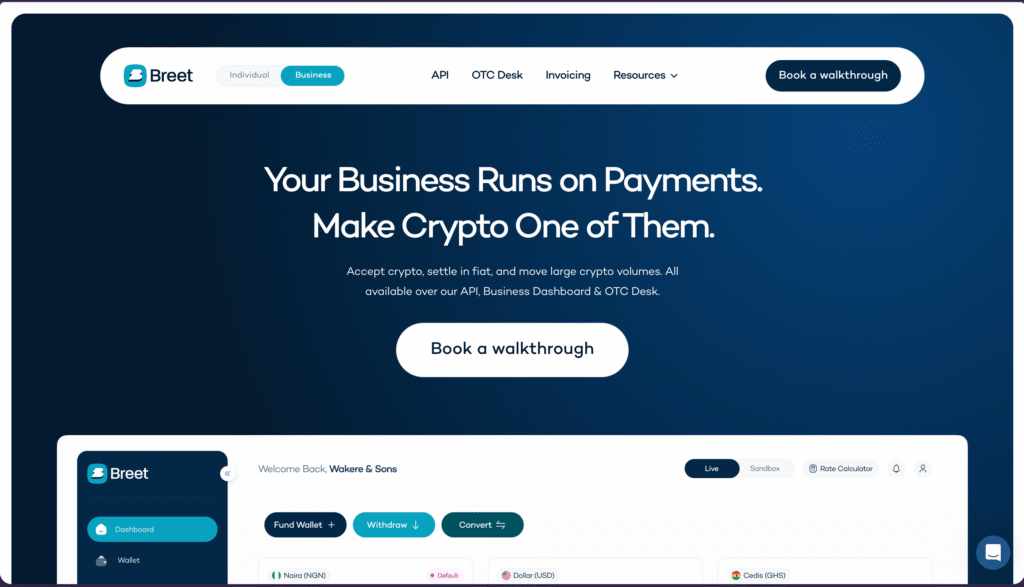
It’s already running at real scale: over 100 verified African businesses use it, more than 3 million transactions have settled programmatically through it, uptime sits at 99.9%, and a new business can be live in under a day.
What separates Breet from a single tool is that it ships three surfaces, each built for a different buyer inside the business, not one generic dashboard stretched across every use case.
An API that removes wallet infrastructure from the roadmap (for developers)
A development team that wants to accept stablecoins has to solve wallet generation, on-chain confirmation monitoring, fiat conversion, AML screening, and payment webhooks before a single dollar can be accepted safely.
Breet’s crypto & stablecoin payment API does all five: it generates deposit addresses per customer, confirms on-chain activity, converts to fiat automatically, screens against AML lists, and fires a webhook when funds land.
Full parameters and integration steps are in the API documentation.
Invoicing that removes manual reconciliation (for finance teams)
A finance team that doesn’t want to touch code needs a different fix: crypto invoicing.
You create the invoice, the client pays in crypto, and you receive fiat, with no exposure to price swings between invoice and payout and no spreadsheet reconciling wallet addresses by hand.
The crypto invoicing product is no-code end-to-end.
An OTC desk that removes slippage on large positions (for high-volume treasury)
A business holding a large crypto position (treasury proceeds, a bulk client payment, an exchange payout) has a different problem: price movement and counterparty risk during execution.
Breet’s OTC desk locks a rate before execution at institutional pricing, then settles to a Nigerian or Ghanaian bank account the same hour, so a large trade doesn’t slip against you mid-execution.
Pros:
- The only option on this list purpose-built for NG/GH local settlement, including mobile money payout, not just bank transfer
- Compliance handled at the infrastructure layer (PCI-DSS, NDPC-aligned), not bolted on after the fact
- Serves developers, finance teams, and high-volume treasury on one platform (API, invoicing, and OTC), instead of forcing a business to stitch together separate vendors
- Go-live in under a day, backed by 99.9% uptime and 3M+ transactions already settled; see the Cardtonic case study for how one business put it to work
Cons:
- Built for Nigeria and Ghana by design. A business that needs one gateway to settle everywhere globally, from Southeast Asia to Latin America, will need a global processor alongside or instead of Breet.
Ready to see it running against your own volumes? Book a walkthrough and get a live demo of the settlement flow.
2. Yellow Card: best for multi-country African coverage
Yellow Card is one of the largest and earliest licensed stablecoin on/off-ramps on the continent, operating across 20-plus African countries with bank and mobile money payout in most of them.
Pros:
- Broadest country footprint of any Africa-native provider on this list
- Licensed operator status across its markets, which matters for regulated payout corridors
Cons:
- Less developer and invoicing depth than a dedicated payment infrastructure API; a team wanting programmatic wallet generation or no-code invoicing out of the box may need to build more around it
- Fee specifics for Nigeria and Ghana corridors aren’t fully broken out publicly; confirm directly before committing volume
3. Ivorypay: best for crypto-native merchants accepting global stablecoin payments
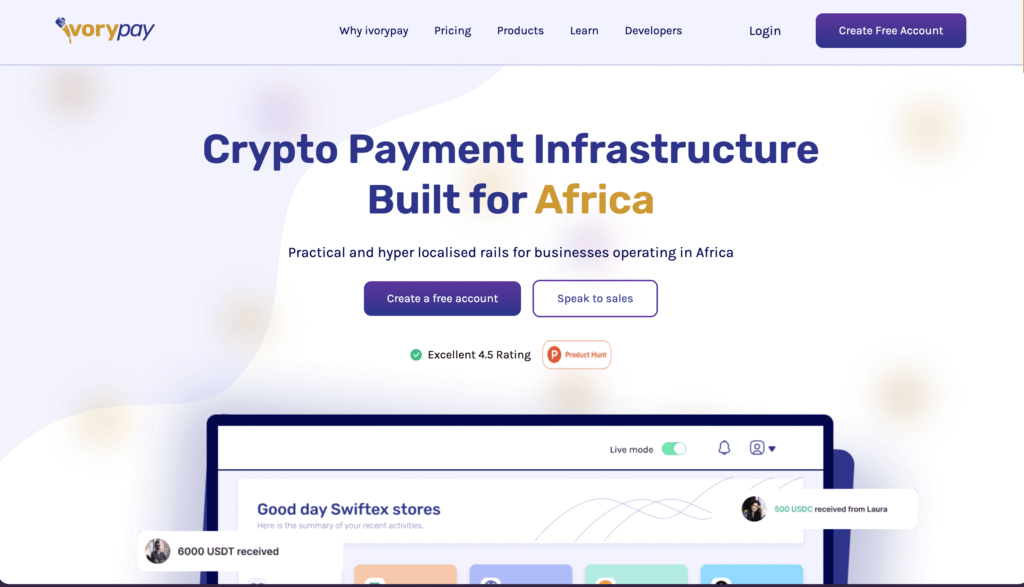
Ivorypay positions itself as one of Africa’s leading stablecoin payment gateways, built around accepting USDT and USDC from customers anywhere and giving merchants tools to manage those payments.
Pros:
- Africa-focused positioning with merchant-facing tools built for e-commerce and betting/gaming use cases
- Straightforward setup for a merchant whose primary need is accepting global stablecoin payments
Cons:
- Public comparison data on fees and settlement times is thinner than what’s published for the other providers here; request specifics directly before evaluating against a fee-sensitive workflow
4. Paychant: best for embedding African on/off-ramps via API
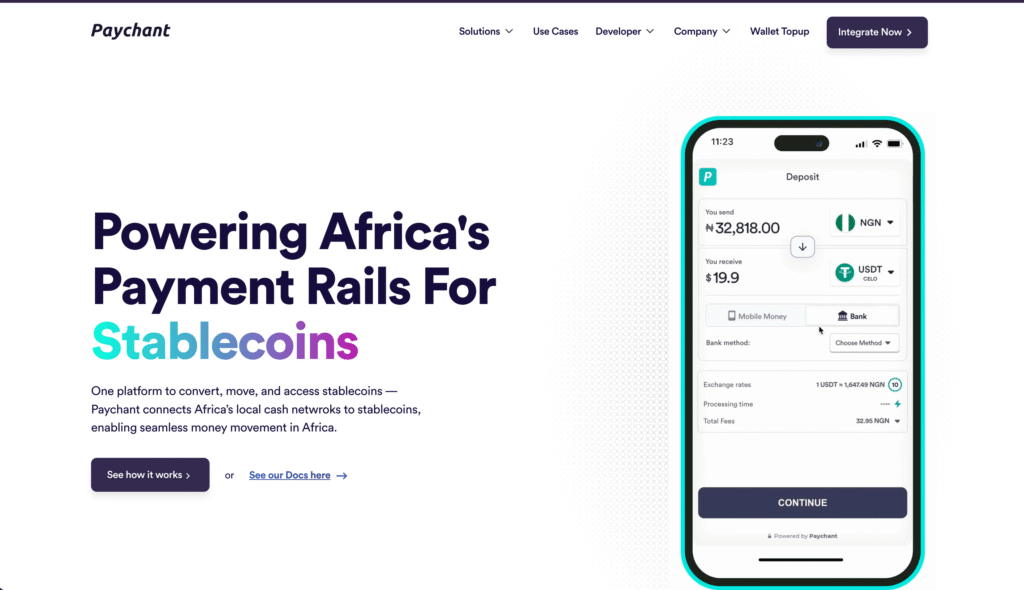
Paychant connects apps to local payment networks, bank transfer, and mobile money, so a product can move cash to stablecoin and back without building that rail itself.
Pros:
- Purpose-built on/off-ramp API, useful for a product embedding stablecoin conversion into an existing app rather than running it as a standalone gateway
Cons:
- It’s an infrastructure layer, not a ready dashboard, so a finance team that wants to log in and see invoices or settlement history without engineering support will find it less turnkey than a product built for that audience directly
How to start accepting stablecoin payments
Match the integration path to whichever team owns the problem, developers, finance, or treasury, and a business can be live within a day.
If a developer owns the integration: wire up the crypto & stablecoin payment API. Generate a deposit wallet address per customer, receive a webhook the moment on-chain confirmation lands, and let fiat conversion happen automatically on the backend. The API documentation covers authentication, endpoints, and webhook payloads in full, so there’s no guesswork about what a production integration looks like before you start.
If finance owns it and nobody wants to write code: send a crypto invoice instead. Create the invoice, share it with the client, and receive fiat once they pay in crypto. No engineering ticket required, and no manual reconciliation once the payment clears.
If the business is moving high volume: onboard to the OTC desk. A rate gets locked before execution, and settlement to a Nigerian or Ghanaian bank account happens the same hour, which matters when a position is large enough that even small slippage adds up fast.
Across all three paths, the numbers stay the same: go-live in under a day, and 99.9% uptime once integrated. Talk to sales or book a walkthrough to see which path fits your team, and how quickly it can be running.
The gateway that wins is the one built for where your money actually lands
For an African business, the best stablecoin payment gateway isn’t the one with the most recognizable logo. It’s the one that settles to your local rails, clears your compliance review, and goes live without eating an engineering quarter, and that filter narrows the field fast once you apply it honestly.
Stablecoin acceptance stopped being a differentiator the moment 79% of Africa’s crypto-active users started holding stablecoins as a matter of course.
The businesses that win from here are the ones treating local settlement and compliance as the deciding criteria, not the headline fee on a pricing page.
Ready to stop losing time to wallet infrastructure and manual reconciliation? Book a walkthrough with Breet Business and see how fast your first settlement can clear.
Frequently asked questions
What is the best stablecoin payment gateway in Africa?
It depends on where the money needs to land. For a business settling in Nigeria or Ghana, that needs naira or cedis in a bank account or mobile money wallet, Breet is built specifically for that corridor. For a business spanning many African countries at once, broader-coverage providers like Yellow Card are worth evaluating alongside it.
Can I accept USDT and USDC and get paid in naira?
Yes. A gateway that auto-converts on receipt and settles to a Nigerian bank account or mobile money wallet handles the conversion and payout without you touching an exchange yourself.
Are stablecoin payments legal for businesses in Nigeria?
Regulatory treatment of stablecoins and crypto payments in Nigeria continues to evolve, and this isn’t legal advice. The practical step is choosing a provider that runs KYC and AML checks and operates through a licensed-partner compliance model, rather than assuming any gateway clears that bar by default.
How much do stablecoin payment gateways charge?
Rates typically range from around 0.5% at enterprise volume up to about 2% for smaller volumes. Compare total cost, not just the headline percentage: FX spread and payout fees can add up separately from the processing fee itself.
How fast is settlement?
Once a payment gets on-chain confirmation, auto-conversion to fiat kicks in immediately. With a provider built for local settlement, funds can land in a bank account or mobile money wallet within minutes to an hour.
Do I need to build wallet infrastructure?
No. A dedicated payment API handles wallet address generation, on-chain monitoring, AML screening, and webhook notifications, so a business integrates against an API rather than building and securing wallet infrastructure from scratch.