When cryptocurrency in Africa is being discussed, Kenya is always mentioned. The country is a global leader in digital finance with most of its household relying on its services.
Kenya is leaning towards the use of cryptocurrency and stablecoins for daily transfers and global trade. However, to facilitate the accelerated stablecoin adoption, there is need for a crypto and stablecoin API in Kenya.
Kenya’s economy is uniquely positioned for a crypto-led revolution. Here are the several reasons why:
- Mobile Money Maturity: The heavy reliance on systems like M-Pesa makes the transition to digital assets intuitive for the average user.
- Cross-Border Friction: Traditional banking faces a lot of delays and high fees for international trade.
- Stablecoin Utility: USDT and USDC are increasingly used as a hedge against inflation and a tool for instant global settlement.
Related:
Top 7 Crypto & Stablecoins API Providers in Kenya
The right crypto and stablecoin API ensures seamless transfers during international and business transactions. Here are the top 7 crypto and stablecoin APIs in Kenya:
- Breet
- Kotani Pay
- Binance Pay
- Paychant API
- Yellowcard API
- Ivorypay API
- HoneyCoin
1. Breet API
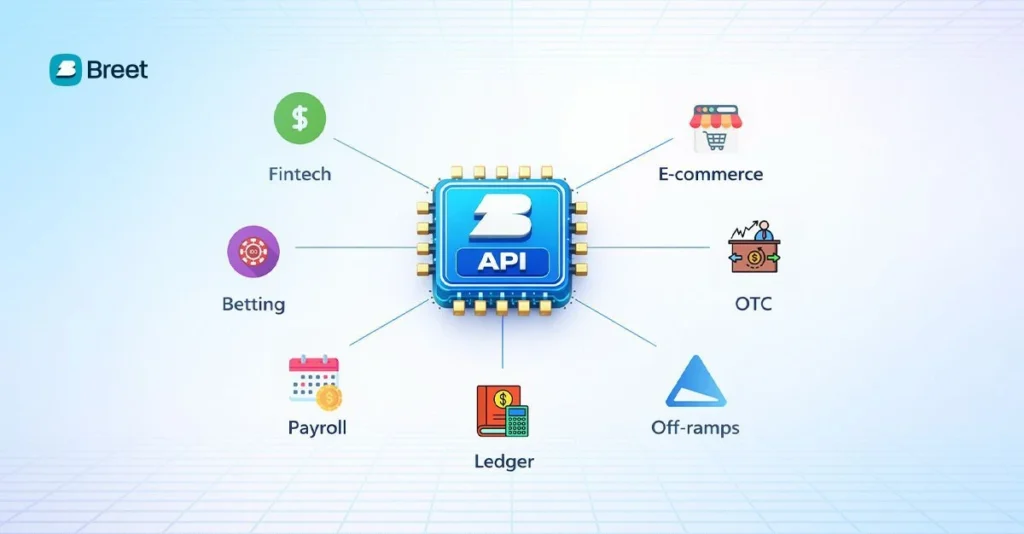
Breet’s API remains the best stablecoin API in Kenya for businesses wanting to avoid crypto volatility. It allows you to accept stablecoins and settle instantly into KES or your crypto wallet. Its integration with local payment rails makes it a highly frictionless stablecoin API in Africa.
Pros:
- Instant settlement into KES eliminates volatility risk entirely. Hence, merchants receive the exact local currency value at the point of transaction; there are no price swings between payment receipt and conversion.
- Deep integration with local payment rails enables businesses to go live faster without building custom middleware to bridge crypto and Kenyan banking infrastructure.
- Purpose-built for African merchants. This offers edge cases that would silently break a global API. There are no network interruptions, M-Pesa reconciliation quirks, and local compliance requirements. They have already been handled at the infrastructure level.
- Breet supports both stablecoin acceptance and crypto wallet settlement. Merchants have the flexibility to choose their preferred payout format depending on their treasury or operational needs.
- As a crypto-native platform designed around the African market, Breet offers compliance coverage that aligns with CBK regulatory expectations. This means reduced legal legwork businesses would otherwise have to do independently.
2. Kotani Pay API
Kotani Pay API was created specifically for the African market. The platform provides excellent on/off-ramp infrastructure. Their API seamlessly connects blockchain protocols directly to local mobile money networks like M-Pesa. Hence, Kotani Pay is a powerful tool for Web3 platforms looking to build accessible fiat gateways.
Pros:
- Offers direct blockchain-to-mobile-money bridging.
- M-Pesa integration is a primary design focus.
Cons:
- Businesses needing full merchant payment infrastructure will need to build around it.
- A smaller developer community means fewer third-party resources.
Related:
3. Binance Pay
Binance Pay is a massive global crypto infrastructure platform. Its vast liquidity makes it great for businesses targeting a global audience. Customers using the platform benefit from trust in the Binance ecosystem. The downside for Kenyan users is the reliance on P2P markets for final KES settlement.
Pros:
- Has unmatched liquidity depth for large trading volumes.
- Brand recognition reduces trust friction for existing crypto users.
Cons:
- KES settlement depends on P2P markets.
- Regulatory exposure in several African markets creates potential compliance risk.
4. Paychant API
Paychant provides seamless stablecoin API in Kenya powered by local payment networks. It helps platforms empower their users with stablecoin access easily, especially USDT and USDC. The company handles the fiat rails and liquidity so developers can focus on their core product.
Pros:
- Focuses heavily on African local payment channels.
- Provides an easy-to-use gateway for Web3 onboarding.
Cons:
- Exchange rates can sometimes be less competitive.
- Online documentation and third-party tutorials are somewhat limited.
5. Yellow Card API
Yellow Card offers comprehensive digital asset infrastructure for emerging markets. It supports instant cross-border payments and treasury management. Some of its unique features is the ability to settle international invoices easily.
Its Stablecoin API in Kenya handles the complexity of moving money between fiat and digital currencies. Plus, users can enjoy the platform’s broad fiat coverage as it supports payout in over 50 emerging market currencies.
Pros:
- Provides robust and compliant access to local fiat rails
- Supports over 50 local currencies and multiple blockchains.
Cons:
- The extensive feature set might overwhelm simple use cases.
- Integration requires more technical overhead than simpler widgets.
Read Also:
- 5 Best Stablecoin Infrastructure API for African Businesses
- The Best Crypto to Fiat API in Nigeria for Developers
6. Ivorypay API
Ivorypay is a specialized crypto payment gateway tailored for the African market. It empowers businesses to conduct bankless transactions using stablecoins.
The platform connects directly with local bank accounts for easy fiat conversion. Ivorypay API also supports customizable payment links and QR codes for easy checkout experiences.
Pros:
- Offers features like storefronts and invoicing alongside the API.
- Reduces payment volatility by focusing on stable cryptocurrencies.
Cons:
- Service availability is restricted to a few key African countries.
- The platform has a smaller market footprint compared to global giants.
7. HoneyCoin API
HoneyCoin offers Crypto payment API in Kenyan focused on African and emerging-market money movement, including cross-border payments, local collections, payouts, FX, and stablecoin on/off-ramps.
Its public API materials state that businesses can convert between local fiat and USDC/USDT, with support for KES and other African currencies, mobile money, bank transfers, and card rails where available. HoneyCoin’s docs also show Kenya-specific payout examples for KES, including mobile money, bank account, M-Pesa Paybill, and M-Pesa Till destinations.
Pros:
- Offers Africa-focused stablecoin infrastructure, including USDC/USDT on-ramps and off-ramps across African markets.
- Provides developer-facing APIs, sandbox environments, webhooks, FX-rate endpoints, and documentation for integrations.
Cons
- Less globally established, so enterprise buyers may need to do more diligence on uptime history, SLAs, compliance coverage, and support capacity.
- Pricing should be confirmed directly with HoneyCoin before integration. Public help-center material states a 0.5% minting fee for on-ramp/off-ramp minting, while third-party reporting says enterprise API integration can cost up to $2,500 monthly.
Compare the Top Crypto API Providers in Kenya
| Crypto & Stablecoin API | KES & M-Pesa Support | Settlement Speed | Best For |
| Breet | Native & Instant | Instant | Automated Merchant Payouts |
| Kotani Pay | Native | Fast | Blockchain to Mobile Money |
| Binance Pay | P2P based | Moderate | Global Retail Reach |
| Paychant | Native | Fast | Web3 Onboarding via Local Rails |
| Yellow Card | Native | Fast | Cross border Treasury & B2B |
| Ivorypay | Native | Fast | African Bankless Storefronts |
| HoneyCoin | Native | Fast | B2B Stablecoin Rails |
Related:
- How to Generate Free Bitcoin Invoices in Minutes
- USDT Invoice Generator: Create Free USDT Invoices
Key Features to Look for in a Crypto API in Kenya
Choosing the right crypto API in Kenya requires a checklist tailored to the local environment:
- Native KES & M-Pesa Support: Avoid double-conversion fees by ensuring the API settles directly to Kenyan Shillings.
- Multi-Chain Compatibility: To keep gas fees low, look for support for Tron (TRC-20) or Polygon, which are significantly cheaper than Ethereum.
- Compliance & Security: Ensure the provider follows AML/KYC standards relevant to the Kenyan regulatory landscape.
- Developer Experience: Look for comprehensive SDKs, webhooks, and sandbox environments to speed up deployment.
Real-World Use Cases of Stablecoin API in Kenya
Here are real-world use cases of the crypto/stablecoin APIs for Kenyan Businesses,:
- Global Freelancing: Receive payments from international clients in USDT and withdraw to M-Pesa in minutes.
- Import/Export Settlement: Pay suppliers globally without waiting 3–5 days for a SWIFT transfer.
- Treasury Management: Businesses can hold reserves in USD-pegged stablecoins to protect against local currency fluctuations.
- Remote Payroll: Efficiently pay remote teams across different countries using a single stablecoin rail.
Key Takeaway
The demand for a reliable crypto and stablecoin API in Kenya is surging as businesses outgrow the limitations of traditional banking. While crypto APIs offer the necessary, it is some of the crypto options more than others.
The African-based platform provides all the necessary support Kenyan business needs for faster international and local payments at reduced costs.
Don’t Miss:
Frequently Asked Questions on Crypto & StableCoin API in Kenya
Is It Legal To Use Crypto APIs For My Business In Kenya?
While the Central Bank of Kenya (CBK) provides cautionary guidance, using crypto for business transactions is not illegal. Most businesses use reputable APIs that comply with international KYC/AML standards to stay protected.
How Do I Convert Stablecoins to M-Pesa Using An API?
Platforms like Breet provide dedicated API endpoints that automatically convert incoming stablecoins (like USDT) into KES and send them directly to a linked M-Pesa number.
Which Stablecoin Is Most Popular In Kenya?
USDT (Tether) on the Tron (TRC-20) network is the most popular due to its high liquidity and extremely low transaction fees compared to the Ethereum network.
What Are The Typical Transaction Fees?
Fees generally range between 0.5% and 2%, depending on the provider. This is significantly cheaper than international bank transfers or credit card processors.
How Long Does Settlement Take?
While on-chain transactions take a few minutes, settlement to M-Pesa or a local bank account via Breet is usually instant once the blockchain confirmation is received.