- The State of Crypto & Stablecoin Infrastructure in Uganda
- What a Crypto & Stablecoin API Enables for Businesses in Uganda
- The 7 Best Crypto and Stablecoin APIs in Uganda
- Compare the Best Stablecoin API Providers in Uganda
- Key Features to Look for in a Crypto API in Uganda
- Conclusion
- Frequently Asked Questions on Crypto API in Uganda
Uganda’s digital economy is moving fast. Mobile money has already rewired how millions of Ugandans send, save, and spend, and now crypto infrastructure is building on top of that foundation.
However, the challenge most builders face of accepting crypto or processing stablecoin payments remains. You need wallet infrastructure, on-chain confirmations, FX conversion, local currency settlement, compliance, and a reliable API layer to bring it all together. That is exactly where crypto and stablecoin APIs come in.
In this guide, we break down the 7 best crypto and stablecoin APIs available for businesses building in Uganda in 2026, what they offer, how they compare, and which one is built to actually work for the African market.
Related:
The State of Crypto & Stablecoin Infrastructure in Uganda
Uganda sits at an interesting crossroads. Crypto is not legal tender, the Bank of Uganda has not issued a formal licensing framework for virtual asset service providers, and the regulatory environment remains cautious. Yet, despite all of that, adoption is accelerating at scale.
Uganda is one of East Africa’s largest recipients of diaspora remittances. For those using stablecoins, cross-border payments that previously took days can now be completed in minutes, improving cash flow and reducing the cost of moving money across borders.
Across Uganda’s fintech and e-commerce ecosystem, businesses that previously relied entirely on bank transfers and mobile money are now exploring stablecoin-powered settlement as an alternative, particularly for cross-border transactions where the shilling’s volatility adds FX risk to every transaction.
Until recently, integrating crypto into a product meant building an enormous amount of infrastructure in-house. For most Ugandan startups and fintechs, that was simply not feasible.
Crypto and stablecoin APIs have changed that equation completely. A business can now integrate a single API and instantly gain access to crypto deposit addresses, automatic conversion, and local currency settlement, without writing a single line of blockchain code.
Infrastructure providers are building the essential rails, on/off-ramps, liquidity engines, FX orchestration, KYC/AML layers, and developer APIs, that are accelerating adoption further across the continent.
What a Crypto & Stablecoin API Enables for Businesses in Uganda
Before you evaluate which API to pick, it helps to understand exactly what you are buying. A crypto or stablecoin API in Uganda is not just a gateway for accepting Bitcoin. Here is what a well-built API actually unlocks for a business operating in Uganda and the most important use cases.
1. Crypto to Fiat Conversions
When a customer sends USDT to your platform, you need that value converted and accessible, ideally in local currency, without you manually touching a single transaction.
With Breet, every incoming crypto deposit is automatically converted to USD at the current market rate. From there, auto-settlement converts it further to local currency and pushes it directly to a linked bank account.
Breet’s on-ramp capability lets businesses with a USD balance purchase USDT or USDC and send them to any external wallet address on networks including TRC20, ERC20, Solana, BNB Smart Chain, and TON, turning local currency revenue into on-chain stablecoins in minutes.
2. Wallet Infrastructure and Custody
Every user or transaction in your product that needs to receive crypto needs a wallet address. The right API generates these with no manual setup. With Breet, the generate-address endpoint creates a permanent, unique wallet address for each user.
This eliminates one of the most complex and expensive parts of building a crypto product: managing wallet infrastructure.
3. Cross-Border Payouts and Collections
This is where stablecoin APIs in Uganda deliver the most immediate value for businesses. Instead of routing international payments through correspondent banks that offer 3–5 day settlement windows, opaque fees, and frequent failures, you route through stablecoin rails that settle in minutes.
With Breet’s withdrawal infrastructure, a business can call the withdraw-to-bank endpoint and send a USD-denominated payout directly to a recipient’s bank account. Breet converts the stablecoin to local currency and processes the bank transfer.
For payroll, supplier payments, or collections from international clients, this replaces the entire correspondent banking chain with a single API call.
4. Automated Treasury and FX Management
For businesses holding balances across multiple currencies and markets, manual treasury management is a significant operational burden. A stablecoin API in Uganda solves this by letting businesses hold value in USD-denominated stablecoins and convert or disburse on their own schedule.
Breet supports two levels of auto-settlement: per-address settlement, which routes each wallet address to its own linked bank account, and business-wide settlement, which funnels all incoming deposits to a single destination, either a bank account or a stablecoin address.
Businesses can configure a markup percentage (up to 10%) on each settlement, turning the API into a revenue-generating layer on top of treasury operations.
5. Integration with Local Payment Rails
The businesses that will win in Uganda are those that can bridge crypto and local financial rails seamlessly, accepting USDT from an international client and settling UGX to a mobile money wallet or bank account on the other end, without friction.
Breet’s settlement infrastructure handles the bank payout side of this bridge. Every withdrawal confirmed through the API fires a webhook, giving your product real-time visibility into settlement status, and the ability to automate downstream actions like crediting user balances, confirming orders, or triggering payroll confirmations.
Related Posts:
The 7 Best Crypto and Stablecoin APIs in Uganda
- Breet
- Yellow Card
- Transfi
- Binance Pay API
- Kotani Pay
- Bitget API
- Transak
1. Breet: Best Overall Crypto API in Uganda
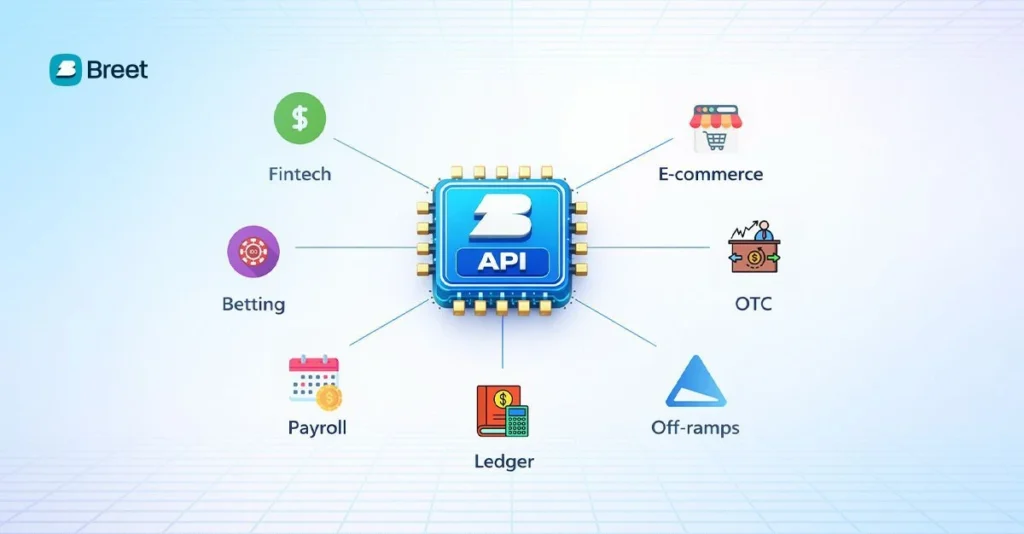
Best for: Fintechs, e-commerce, and any builder wanting a simple, Africa-first crypto-to-bank settlement API.
Breet API is built for exactly the problem Ugandan businesses face: accepting crypto or stablecoin payments from anywhere in the world and settling in local currency to a bank account, without building complex blockchain infrastructure.
What Breet offers:
- Breet generates unique, permanent wallet addresses for each user or transaction via a single API call
- Supported deposit assets include Bitcoin, Ethereum, Solana, Tron, BNB, Avalanche, Litecoin, Bitcoin Cash, Dogecoin, TON, and XRP, USDT, and USDC
- On the withdrawal side, businesses can send USDT or USDC to any external wallet, or initiate fiat bank payouts in local currency
- Auto-settlement works at two levels: per-address or business-wide
- Every onboarded API partner gets a dedicated support group on WhatsApp or Slack
Why Breet wins for Uganda: No other Crypto API in Uganda on this list combines Africa-native bank settlement, a genuinely simple integration model, multi-chain stablecoin support, and dedicated partner support in one package.
2. Yellow Card
Best for: Businesses operating across multiple African markets that need a single API to handle local fiat rails.
The Yellow Card API supports payments across 50+ local currencies through a single connection, with transparent exchange rates, settlement in hours, and integration with local payment methods like bank transfers and mobile money across 20+ African countries.
3. TransFi
Best for: Businesses in Uganda needing a stablecoin API with broad global reach, cross-border collections, and B2B payment orchestration across emerging markets.
For businesses searching for a crypto API in Uganda that goes beyond Africa, TransFi is one of the most capable global options. TransFi operates across 70+ countries and integrates 250+ local payment methods, supporting 40+ fiat currencies and 100+ digital assets.
4. Binance Pay API
Best for: Businesses serving a crypto-native customer base that already holds funds on Binance.
Binance Pay allows instant transactions across over 100 cryptocurrencies including USDT and USDC with no gas or processing fees, and merchants can accept payments via QR code or integrate directly through APIs.
5. Kotani Pay
Best for: Web3 platforms, DeFi apps, and fintechs in Uganda that need to bridge crypto and mobile money — including reaching users without smartphones or internet access.
Kotani Pay is one of the few crypto API providers to have made a direct, deliberate move into Uganda. Kotani Pay has officially expanded into Uganda, enabling local fintechs and Web3 companies to integrate its crypto-fiat payments gateway, giving users in Uganda seamless access to the Ugandan Shilling through an easy-to-integrate API that accepts payments in both crypto and local currency while Kotani Pay facilitates the conversion
6. Bitget API
Best for: Exchanges, trading platforms, and developer teams in Uganda building products that need deep liquidity, advanced order types, and multi-chain wallet infrastructure at scale.
Bitget is primarily known as a global crypto exchange, but its API and wallet infrastructure have grown into a serious option for developers building trading adjacent products. The Bitget API is recognised for its high-performance trading engine and support for 1,300+ coins, with its Universal Exchange architecture integrating Model Context Protocol with REST and WebSocket APIs, creating an environment where AI agents can monitor market sentiment and execute strategies via natural language instructions.
7. Transak
Best for: Web3 apps and DeFi products that need to let users buy crypto with local fiat through an embeddable widget.
Transak specialises in fiat-to-crypto on-ramp widgets that can be embedded into any app or website. Stablecoin infrastructure including on/off-ramps, liquidity engines, FX orchestration, and developer APIs can accelerate adoption further across Africa, and Transak sits squarely in the on-ramp segment of that stack.
Compare the Best Stablecoin API Providers in Uganda
| Platform | Best for | Supported Countries | Local currency settlement | Stablecoin Networks | Ease of Integration |
| Breet | Fintechs, e-commerce, payroll & OTC desks in Africa | All African countries | Auto crypto → local currency → bank account | TRC20, ERC20, SOL, BNB, TON, Polygon | Self-serve, API key in minutes, sandbox included, AI-powered docs |
| Yellow Card | Large fintechs expanding across multiple African markets | 20+ African countries | Local fiat via bank & mobile money | TRC20, ERC20, SOL, 30+ chains | Sales-led onboarding, enterprise setup required |
| Coinbase Commerce | Global e-commerce accepting crypto from international buyers | Global (limited Africa fiat rails) | No African bank or mobile money payout | ERC20, Base, BTC, ETH | Self-serve, well-documented, Shopify & WooCommerce plugins |
| Binance Pay API | High-volume crypto-native merchants with Binance users | Global (where Binance operates) | No local bank settlement for Uganda | BNB, TRC20, ERC20, 100+ coins | API + QR code, requires Binance merchant account |
| Flutterwave | Businesses needing crypto + traditional African payments together | 34 African countries | Strong local rails, crypto settlement still maturing | USDT, USDC via Polygon | Self-serve for fiat; crypto integration needs additional setup |
| Fireblocks | Banks & institutions needing enterprise custody infrastructure | Global | No African fiat settlement | ERC20, TRC20, SOL, 50+ chains | Complex, enterprise onboarding, months-long setup |
| Transak | Web3 apps needing an embeddable fiat-to-crypto on-ramp widget | 150+ countries (on-ramp only) | On-ramp only, no crypto → bank settlement | ERC20, SOL, Polygon, BNB | Easy embed widget, developer-friendly SDK |
Related:
- How to Build a Crypto Wallet/Exchange With APIs
- The Best Crypto to Fiat API in Nigeria for Developers
Key Features to Look for in a Crypto API in Uganda
Before you commit to an integration, here are the features that actually matter for businesses operating in the Ugandan market.
1. Support for Local Currency Settlement and Bank Payouts
Look for an API that handles the full settlement chain natively. Breet’s auto-settlement does this end to end: crypto arrives, gets converted to USD, converts again to local currency at the current settlement rate, and lands in a linked bank account automatically.
2. Reliable Fiat On/Off-Ramp Infrastructure
For Ugandan businesses, the on-ramp and the off-ramp need to work reliably, at competitive rates, and without multi-day delays.
Breet’s off-ramp is built directly into the API. Every completed deposit triggers conversion and bank payout. The on-ramp side is handled through the dashboard, allowing businesses to fund their stablecoin position and use Breet’s endpoint to send USDT or USDC to any external wallet.
3. Compliance With Local Regulations
Look for APIs that have transaction monitoring built in, that operate within the legal frameworks of African markets, and that have a track record of working with regulators rather than against them. When regulators in Uganda eventually formalise a virtual asset framework, businesses that built on compliant infrastructure from the start will be far better positioned than those who did not.
4. Multi-Chain Support
Stablecoins do not operate on one blockchain. USDT alone runs on six different networks: Tron (TRC20), Ethereum (ERC20), Solana, BNB Smart Chain, Polygon, and TON. Your customers and partners will send from whichever network they use, and if your API only supports one or two, you will miss transactions or force users through unnecessary steps.
A wide multi-chain deposit surface means your business can serve more customers without limiting which wallets or networks they use.
5. Real-Time Settlement and Reporting
Users need to know the moment a transaction is confirmed and settled. Waiting hours for a status update is not acceptable in a market where trust in new financial infrastructure is still being built.
Conclusion
Uganda’s crypto and stablecoin ecosystem is growing, and businesses are using stablecoins to pay suppliers, receive remittances, run payroll, and protect savings from currency volatility.
The right crypto API in Uganda is not the one with the longest feature list or the biggest global name. It is the one that understands what it actually means to do business in Africa.
That is the standard Breet was built to meet.
From a fintech letting users fund wallets with USDT, to a merchant auto-settling crypto payments to a bank account, to a remote-first company running payroll across Uganda and beyond, Breet’s API handles the entire crypto-to-bank settlement chain in a single integration.
The other six APIs on this list all have their strengths. However, for a business building in Uganda, or anywhere in Africa, that needs a reliable, Africa-native stablecoin infrastructure partner to grow with, Breet is the clear starting point.
Don’t Miss:
- USDT Invoice Generator: Create Free USDT Invoices
- How to Generate Free Bitcoin Invoices in Minutes
Frequently Asked Questions on Crypto API in Uganda
Is Crypto Legal in Uganda?
Crypto is not legal tender in Uganda, and the Bank of Uganda has not issued a formal licensing framework for virtual asset service providers.
Can a Ugandan Business accept USDT and Receive Local Currency in their Bank Account?
Yes, and this is precisely what Breet’s API is built for. A Ugandan business integrating Breet can accept USDT or USDC from any wallet on any supported network, and Breet automatically converts the deposit to USD and then to local currency, depositing the settled amount directly into a linked bank account.
Which Stablecoin Networks does Breet support?
Breet supports USDT across six networks: Tron (TRC20), Ethereum (ERC20), Solana, BNB Smart Chain, Polygon, and TON, and USDC across five networks: Ethereum, Solana, Arbitrum, Base, and Polygon. For native coin deposits, Breet supports Bitcoin, Ethereum, Solana, Tron, BNB, Avalanche, Litecoin, Bitcoin Cash, Dogecoin, TON, and XRP.
How Long does Settlement Take with Breet?
Under 287 seconds. Once a crypto deposit is confirmed on-chain and auto-settlement is enabled, Breet converts the deposit and initiates the bank payout automatically. The exact timing depends on the blockchain network used for the deposit and local bank processing times.
Does Breet support Businesses Outside Nigeria and Ghana?
Breet’s core settlement infrastructure currently supports African Businesses. Businesses can use Breet to accept crypto deposits and manage stablecoin treasury operations, with local currency settlement available as Breet’s market coverage expands.
How do I Get Started with the Breet API?
Book a demo to get started with Breet API. Once Breet understands your business needs, integration is done without setup fees.