- The Feature That Sat on the Roadmap for 18 Months
- The Real Reason the Launch Kept Getting Delayed
- What 18 Months of Waiting Actually Cost
- The Hidden Opportunity Cost Most Fintech Leaders Ignore
- How to Evaluate the Build vs Partner Decision
- Speed Is Becoming the New Competitive Advantage in Fintech
- Conclusion
The hardest part of fintech product development is rarely deciding what to build. Most fintech companies already know what their customers want. Based on our work with fintech teams across Africa, the pattern is consistent: product teams spend months, sometimes years, building the infrastructure around a feature they identified on day one. By the time everything is ready, customer expectations have grown, and competitors have moved ahead.
This is the story of one such feature, and the real cost of letting it sit on the roadmap.
The Feature That Sat on the Roadmap for 18 Months
Let’s call the company PayStart. PayStart is not a single company with a single outcome. It is a composite drawn from patterns we have seen across multiple fintech teams building savings, payments, and cross-border products in similar environments, where infrastructure complexity repeatedly slows down features teams already know they need.
In mid-2024, PayStart launched a feature that let users save Naira on the platform while earning interest. Customers wanted more. They continuously asked for ways to protect the value of their savings from currency fluctuations, specifically a stablecoin savings feature.
The product team jumped on it as a way to increase retention while meeting a clear user need. They explored user journeys, assessed market demand, and mapped out the rollout. But once they worked through the requirements, they realised they were not just building a savings feature. They were preparing to build an entire layer of infrastructure to support it.
The Real Reason the Launch Kept Getting Delayed
At first glance, the stablecoin savings feature looked like a quick win. There was no need for a new user interface; the backend concept was understood, and user demand was clear. The problem was that the infrastructure underneath it was absent.
The feature was not a standalone product update. It required infrastructure the company did not yet have: a secure way to manage digital assets, review compliance processes, and transaction monitoring systems built for a different type of asset flow. Then came reporting requirements, settlements, and operational risk.
Every quarter, the same tradeoff surfaced in planning. The team could commit two to three engineers to a four-to-six-month infrastructure sprint to build the stablecoin rails properly, or divert that capacity to ship two to three customer-facing features with immediate revenue impact, like onboarding improvements, faster transactions, or new payment corridors.
Like many fintechs, PayStart chose to build the infrastructure, and the project stalled for 18 months. The feature stayed on the roadmap because users still wanted it, and the business case held.
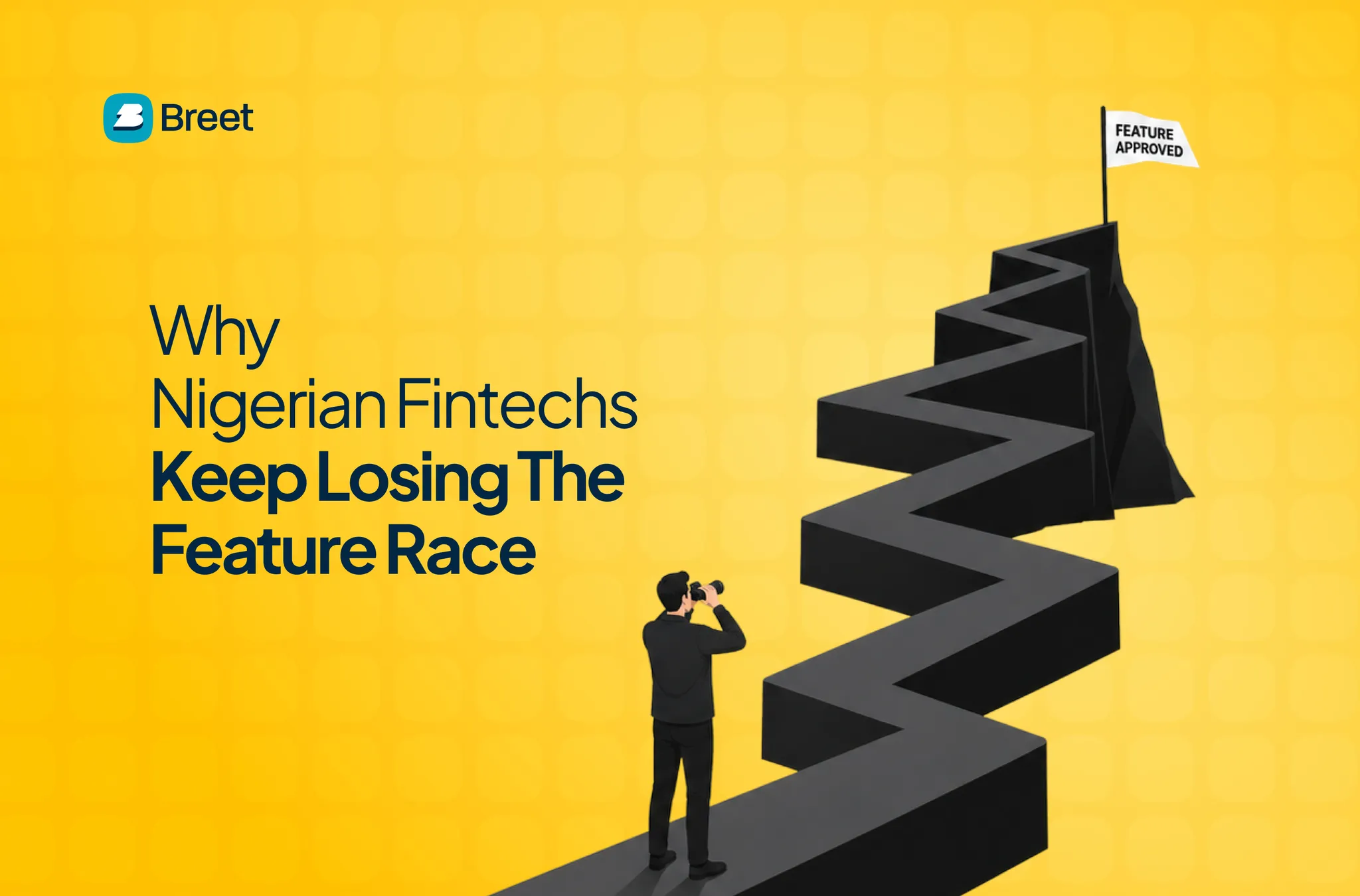
This is one of the most common challenges in fintech product development: teams are forced to choose between building customer-facing experiences and building the infrastructure to support them. The result is that features everyone agrees are valuable can wait months or years for the right conditions to move forward.
What 18 Months of Waiting Actually Cost
For PayStart, the 18-month wait carried consequences that reached far beyond the product itself.
1. Lost Market Position
The most visible cost was market positioning. When the stablecoin savings feature was first identified, PayStart had something fintech teams rarely get: early alignment between customer demand and internal awareness. Users were already asking for it, competitors had not yet standardised it, and the opportunity window was open.
While internal teams worked through infrastructure planning, the market moved. Within the 18-month delay:
- Competing fintechs began launching basic versions of stablecoin savings products
- User expectations shifted from “this would be nice” to “this already exists elsewhere”
- Early adopters migrated to platforms that offered immediate access
- The feature category itself became less novel and more commoditised
By the time PayStart revisited the rollout, the advantage was no longer about being early. It was about catching up. In fast-paced sectors like digital banking, timing matters as much as execution, and a strong product launched late often struggles to match the impact of an average product launched early.
2. Lost Internal Momentum
The less visible but more damaging cost was internal momentum. Unlike user churn or competitive pressure, this loss does not show up in dashboards. It shows up in how teams operate over time.
Inside PayStart, the stablecoin savings feature shifted from a “priority initiative” to a long-running infrastructure programme. Engineers cycled through sprint planning sessions without shipping anything customer-facing.
Product managers kept extending roadmaps into the next quarter. Stakeholders asked the same question in different forms: when is it launching?
Over time, this creates a specific organisational effect. Teams stop thinking in releases and start thinking in phases. Instead of shipping, they spend more time:
- Refining requirements that are already understood
- Revalidating decisions that were previously agreed upon
- Reworking infrastructure dependencies that were already partially built
- Aligning across functions that are all waiting on the same underlying system
The result is not inactivity. It is continuous work without visible output. For engineering teams, that breeds fatigue, not because the work is unimportant but because progress is not externally visible. For product teams, it creates a constant need to re-justify moving timelines. For business teams, it opens a gap between what was promised and what is delivered. Morale does not drop suddenly; it degrades slowly as a feature stays “almost ready” for multiple quarters.
By the time PayStart approached readiness, the team had already absorbed the psychological cost of the delay. The feature was no longer just a product milestone. It had become a reference point for how long infrastructure-heavy initiatives take, and that perception often dampens future ambition.
The Hidden Opportunity Cost Most Fintech Leaders Ignore
For fintech leaders, the question should not only be “What will it cost us to launch this feature?” It should also be “What will it cost us if we don’t?”
For PayStart, the 18-month delay was not just an infrastructure expense. It was a missed opportunity to gain and retain users who were actively looking for stablecoin savings. It was time spent watching competitors strengthen their position. It was 18 months during which valuable customer feedback, usage data, and product insight could have been collected and used to improve the offering.
This matters most in markets where customer behaviour changes rapidly. User expectations do not wait while teams finish infrastructure projects, and competitors do not delay their launches because another company is still preparing its systems. The market keeps moving, whether individual businesses are ready or not. That shift in thinking can fundamentally change how organisations approach fintech product development and infrastructure investment.
How to Evaluate the Build vs Partner Decision
At some point in every fintech product cycle, the question stops being “what should we build?” and becomes “should we even be building this ourselves?” For infrastructure-heavy features like stablecoin savings, cross-border settlement, or payment rails, the decision is rarely about technical capability. It is about whether building internally creates a competitive advantage or just delays execution. A few practical criteria tend to separate the two.
1. Time-to-Market vs Strategic Differentiation
The first question is simple: does building this in-house create differentiation or just delay delivery? If a feature is core to your product experience, something users directly perceive as value, internal investment may be justified.
But if the feature is infrastructure-heavy, like settlement layers, stablecoin flows, or compliance, the advantage usually comes from shipping first, not owning the underlying systems. In those cases, every extra month of build time is lost market positioning.
2. Internal Engineering Opportunity Cost
The second factor is what the same engineering capacity could otherwise deliver, and most teams underestimate this tradeoff. A single infrastructure build that takes three to five engineers over six to nine months often competes directly with multiple revenue-impacting releases, such as onboarding optimisation, faster transactions, new payment corridors, or retention features.
The real question is what the business loses by tying up senior engineering capacity on a long, non-user-facing build. If the answer includes delayed revenue or stalled product velocity, the build decision gets harder to justify.
3. Infrastructure Reusability and Maintenance Burden
The third factor is long-term ownership cost. Building infrastructure internally does not end at launch. It introduces ongoing responsibilities:
- Maintaining settlement logic across corridors
- Updating compliance flows as regulations evolve
- Handling uptime, reconciliation, and edge-case failures
- Scaling across markets with different regulatory expectations
If the system is not central to your differentiation, this becomes a permanent operational load rather than a one-time build. In many cases, the real cost of “building once” is “owning forever.”
The Decision Filter
Combine these three factors, and a clear pattern emerges:
- If it is core user experience, build it.
- If it is infrastructure that supports user experience, consider partnering.
- If it is infrastructure that must evolve across jurisdictions, almost always partner.
The goal is not to avoid building. It is to ensure engineering time goes to what moves the product forward fastest. That distinction is what separates teams that ship features in months from teams that spend years building the foundation for them.
Speed Is Becoming the New Competitive Advantage in Fintech
For years, fintech success was defined by access. Access to core banking infrastructure is no longer the defining constraint for most Nigerian fintech teams. Today, the constraint is speed.
The companies making moves are usually the ones that can go from idea to execution faster than everyone else. That does not mean cutting corners or ignoring compliance. It means shrinking the time between identifying customer demand and delivering a solution. The most successful teams understand that speed is no longer just an operational metric. It is a strategic advantage.
The PayStart story shows why. The company did not lose time because it misunderstood its customers or lacked a clear product vision. It lost time because the infrastructure required to support the feature became a project of its own.
Rather than building every component from scratch, more companies are now leaning on existing infrastructure that lets them launch faster, test demand earlier, and put more of their resources into customer experience and innovation.
This is where infrastructure partners are starting to play a larger role. At Breet, we have seen how quickly product timelines expand when teams are forced to build the infrastructure themselves. Instead of building stablecoin rails, settlement infrastructure, and compliance workflows from scratch, Breet provides a ready-to-use settlement layer that handles those underlying flows, so fintech teams can launch features in weeks rather than spending 12 to 18 months building and coordinating the infrastructure themselves.
As customer expectations keep growing, the ability to move quickly will increasingly separate market leaders from followers. The fintech companies that win will not necessarily be the ones building the most infrastructure. They will be the ones finding smarter ways to access it, so they can focus on creating products customers actually want to use.
Conclusion
Looking back at PayStart’s 18-month journey, the problem was never that the feature was unimportant. It was. But in fintech product development, importance does not automatically translate into speed. The real challenge came from everything underneath the feature: infrastructure decisions, compliance requirements, system dependencies, and competing priorities.
By the time the stablecoin savings feature finally became “ready,” the company had already paid the full cost of the delay. Users had moved to competitors who offered imperfect but available features. PayStart entered a market it had helped create, but no longer led.
This is exactly the gap Breet helps fintech teams close. Instead of spending months building the underlying infrastructure for stablecoin flows, conversions, and settlement layers, fintech companies can plug into systems that already handle that complexity.
If you are building in fintech and keep getting slowed down by infrastructure bottlenecks, it may be time to rethink your approach. Start with Breet to see how you can launch faster, reduce build time, and get your products into users’ hands while demand is still high.