
Yellow Card has moved from a personal crypto buying and selling app into a crypto payment gateway for businesses. The platform has processed over $10 billion in transactions and has formed banking partnerships in more than 60 countries. It now provides infrastructure services to banks, telecommunications companies, and global corporations.
Currently, Yellow Card focuses on three main areas: digital asset infrastructure, fiat payments infrastructure, and an API suite for developers.
This is particularly relevant for small and medium-sized businesses (SMBs), e-commerce sellers, or agencies in Nigeria or Ghana that wish to accept crypto payments through a gateway. However, before opting for an alternative to Yellow Card, consider the following four key factors:
- How quickly you can get verified and complete your first transaction
- Whether the gateway settles payments in Naira or Cedis, or if you will only hold crypto
- If compliance is integrated into the product or if it becomes your responsibility
- Whether settlement occurs automatically or requires a manual trigger
If these considerations resonate with you, one of the seven alternatives in this guide may be a better choice.
Top 7 Yellow Card Alternatives in 2026
| Gateway | Self-serve sign-up | Settles to NGN/GHS | Best for |
| Breet | Yes | Yes | A business that wants to be live the same day it signs up |
| Busha | Yes | Yes (USD or local) | A business that wants a licensed stablecoin gateway with a Tether partnership |
| Quidax | Yes | Yes (Naira) | A business that wants exchange, custody, and payment gateway under one SEC license |
| Bitnob | Yes (API docs public) | Yes (NGN, GHS, KES, 40+ currencies) | A fintech or wallet provider wanting wallets-as-a-service plus stablecoin settlement |
| Paychant | Yes | Yes (via mobile money/bank) | A wallet or remittance app wanting a lightweight multi-country on/off-ramp widget |
| NowPayments | Yes | No native NGN/GHS | A business wanting the widest coin selection at a low published fee |
| CoinGate | Yes | No (EUR/GBP/USD only) | A business selling into Europe needing a fast licensed plugin install |
1. Breet: best for a business that wants to accept crypto and settle directly to local currency
Breet is a crypto payment platform built to fill the gap left by Yellow Card: it provides a solution for any African business that wants to accept cryptocurrency immediately, without waiting for a lengthy sales cycle.
Simply sign up, complete the verification process, and start transacting without having to coordinate a call around someone else’s schedule.
Go live the same day you sign up with a 24-hour KYB check
Breet’s Know Your Business (KYB) process completes within 24 hours. Once verified, a business can access the API, use the OTC desk, or start invoicing on the same day it registers.
Over 100 verified businesses across Africa are already utilizing Breet’s platform, and Cardtonic, a gift card marketplace, moved from the sandbox to full production in just two days.
Skip the developer build just to see pricing, with free no-code invoicing
A business can create and send its first crypto invoice on Breet for free. There are no percentage cuts and no transaction limits.
In contrast, both Paychant and Bitnob require a developer integration before you can access any pricing information. Breet’s invoicing allows you to see the amount without needing to write any code.
Know your exact fee before you integrate, with data returned in every webhook
Breet offers transparent transaction fees with no setup or monthly fees. For each completed trade, a webhook payload is provided, detailing the exact fee percentage and the fee amount.
Businesses can apply their own markup, ranging from 0% to 10%, which is reflected in the payload as the settled amount.
This approach replaces the traditional model that often relies on enterprise quotes. Additionally, building in-house solutions for wallet generation, on-chain monitoring, AML screening, and reconciliation can take up to 18 months, time that a business signing up today simply does not have.
Stop touching wallet addresses with automatic settlement to naira, cedis, or USD
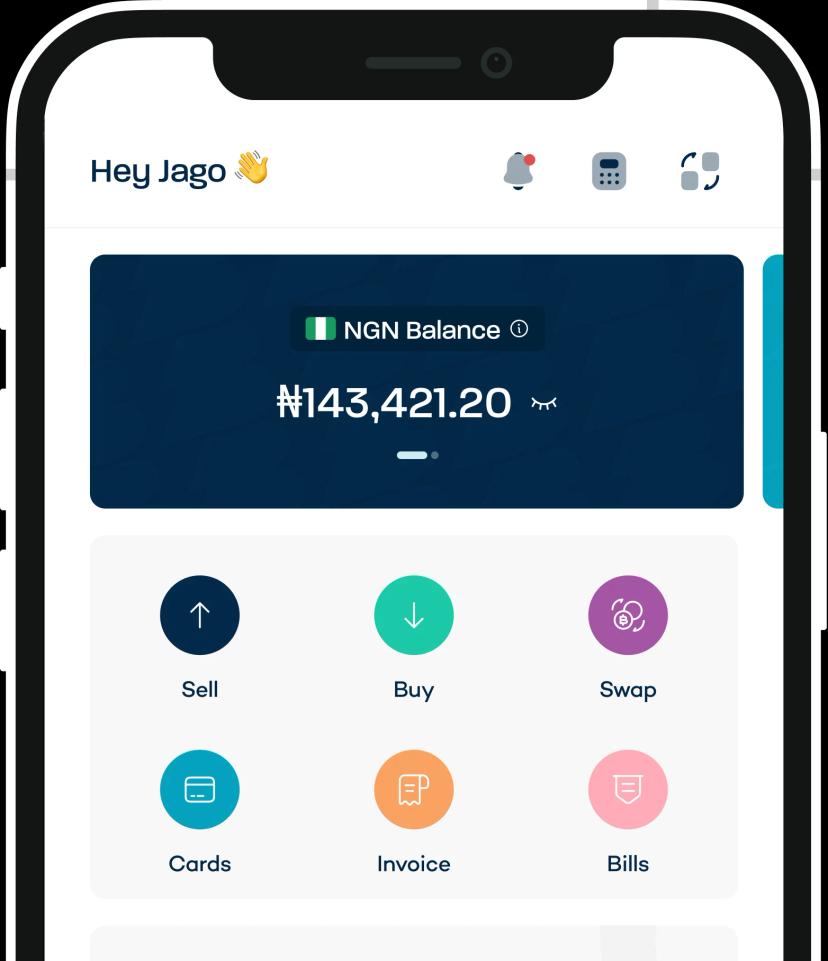
When someone makes a payment in cryptocurrency, your accounting systems receive the equivalent amount in naira, cedis, or USD, rather than the actual coins. This conversion occurs automatically, so no one on your team needs to handle a wallet address.
Breet ensures 99.9% uptime based on its Service Level Agreement (SLA) and has successfully processed over 3 million transactions programmatically. You will receive real-time webhook confirmations as soon as a payment is completed, eliminating the need for polling.
If your business is already handling large volumes and requires a negotiated rate or dedicated support for integration, you can use the API or OTC desk instead of opting for self-service invoicing.
Are you a business that’s overwhelmed by enterprise features? Book a demo with us to see how Breet can help.
2. Busha: best for a business that wants a licensed stablecoin gateway backed by a fresh Tether partnership
Busha was among the first companies to obtain Nigeria’s initial set of SEC approvals for digital asset platforms in August 2024. In July 2026, a partnership with Tether further strengthened Busha’s stablecoin infrastructure.
Busha Pay allows transactions using USDT and USDC through three methods: payment links, checkout, or API, with the option to settle in USD or local currency.
The platform received its SEC approval-in-principle on the same day as Quidax, in August 2024. Founded in 2019, Busha operates in Nigeria and Kenya.
Pros
- Fully licensed by the SEC
- Direct Tether backing
- Payment links that work without a full API build.
Cons
- The fee structure is not disclosed
- Only operates in Nigeria and Kenya
3. Quidax: best for a business that wants an exchange, custody, and payment gateway bundled
Quidax presents a compelling pitch by offering exchange, custody, and payment gateway services all under one SEC license.
Its payment gateway, Basqet, allows users to make payments using USDT or USDC through payment links or QR codes, with settlements made in Naira. Quidax received its SEC approval-in-principle in August 2024, coinciding with Busha’s approval on the same day.
The platform boasts an average API response time of about 100 milliseconds and maintains an impressive uptime of 99.9%. It also comes equipped with built-in KYC (Know Your Customer) and AML (Anti-Money Laundering) tools as standard features.
Pros
- Exchange, custody, and payments in one SEC-licensed product
- Around 100ms API response time with 99.9% uptime
- Built-in KYC and AML tooling
Cons
- Fee structure is not publicly listed
- Settlement centers on Naira, so businesses needing Cedis look elsewhere
4. Bitnob: best for a fintech or wallet provider that wants wallets-as-a-service plus stablecoin settlement
For a fintech or wallet provider seeking a comprehensive solution that includes wallets-as-a-service and stablecoin settlement, Bitnob is an ideal choice.
Bitnob Business offers APIs for stablecoin transactions and cross-border payments, along with card programs. The company reports that it has processed over $4.5 billion through its infrastructure.
Businesses can send and receive USDT while settling in their local currency, with payouts available in NGN, KES, GHS, and more than 40 other currencies. Bitnob was founded in 2020 and publicly launched in 2021.
Pros
- Settlements in NGN, KES, GHS, and 40+ other currencies
- Stablecoin settlement, cross-border payments, and card programs in one stack
- Over $4.5 billion moved through the infrastructure
Cons
- Built for fintechs integrating infrastructure, not a business sending one invoice
- No self-serve invoicing product
- Needs developer resources and a higher volume threshold
5. Paychant: best for a wallet or remittance app that wants a lightweight, multi-country on/off-ramp widget
TechCabal recognized Paychant as the first Bitcoin payment processor in Africa when it launched in 2020, initially supporting Bitcoin and Ethereum before transitioning to stablecoins. Today, Paychant operates as a fiat-to-stablecoin widget in Nigeria, Ghana, Kenya, Uganda, and Zambia, and can be integrated in under 30 minutes. The platform was founded in 2019.
Cash-in and cash-out transactions can be conducted via bank transfer and mobile money services, including MTN MoMo, AirtelTigo, and Vodafone Cash. Paychant supports three stablecoins: USDT, USDC, and cUSD.
Pros
- Integrates in under 30 minutes
- Live across Nigeria, Ghana, Kenya, Uganda, and Zambia
- Mobile money support via MTN MoMo, AirtelTigo, and Vodafone Cash
- Published 1% to 2.5% fee range
Cons
- A widget for wallets and remittance apps, not a full e-commerce gateway
- Checkout pages or invoicing mean building on top
- Fees vary between buying and selling, adding a step to margin math
6. NowPayments: best for a business that wants the widest coin selection at a low, published fee
Supported by over 350 cryptocurrencies and 30 stablecoins, fees begin at just 0.5% for standard volume transactions.
Multi-currency or fixed-rate transactions incur a fee of 1%. There are no setup or monthly fees.
Pros
- 350+ cryptocurrencies and 30+ stablecoins supported
- Fees as low as 0.5% on standard volume, no setup or monthly fees
- Payment links, invoices, and mass payouts via API or CSV
Cons
- G2 reviewers flag conversion fees as high and note the lack of a mobile app
- No direct native Naira or Cedi bank settlement, so local payouts need an off-ramp
7. CoinGate: best for a business selling into Europe that needs a fast, licensed plugin install
CoinGate provides a quick installation of its licensed plugin. It received MiCA authorization from the Bank of Lithuania in December 2025.
The platform offers ready-to-use integrations for WooCommerce, PrestaShop, and WHMCS. It charges a fee of 1% per transaction, along with an additional 2% to 4% on fiat withdrawals.
Pros
- MiCA-authorized by the Bank of Lithuania
- Plugin-ready for WooCommerce, PrestaShop, and WHMCS
- Instant EUR, GBP, or USD settlement with rate locked at payment
Cons
- Full KYC required past EUR 1,000/month or EUR 5,000 total
- Settlement is EUR, GBP, or USD only; no Naira or Cedi payout
Yellow Card didn’t get worse; it just stopped building for you
Yellow Card works. It just doesn’t work for a single African business that doesn’t need enterprise features to receive crypto payments.
Every gateway on this list can move crypto. Only one still treats a single African business signing up today as the point of the product, not a segment beneath a bank.
With Breet, that means:
- Live the same day you sign up, no sales call required.
- Invoicing that costs nothing to create or send.
- API pricing that shows up as a number in a webhook payload, not a quote you have to request.
Still, before booking a call with any provider that won’t show you a price first, check whether it will even let a business your size sign up. If you’re moving large crypto volumes instead of individual invoices, the OTC desk is worth a separate conversation.
Ready to accept crypto payments? Book a demo to see how Breet Business can help.
Frequently Asked Questions
Is Yellow Card shutting down?
No. Yellow Card shut down its consumer retail app on January 1, 2026, and shifted to enterprise-only stablecoin infrastructure for banks, fintechs, and large corporates.
Can my business accept crypto payments without a crypto license?
You don’t need a license. In Nigeria, the SEC licensing requirement applies to Virtual Asset Service Providers, which handle trading and custody of assets. If your business accepts payments through a licensed provider, you are covered by their compliance framework and benefit from their license protection.
How fast can I start accepting crypto payments?
Breet completes KYB verification within 24 hours, enabling businesses to start using the API, OTC desk, or invoicing the same day they register.
Which gateway settles to Naira or Cedis?
Breet automatically converts payments to Naira, Cedis, or a USD balance. Quidax settles in Naira, while Bitnob offers payouts in NGN, KES, GHS, and more than 40 other currencies. NowPayments and CoinGate do not support direct settlement in Naira or Cedis, requiring off-ramping for those payments.
Is it safe to accept crypto payments in Nigeria?
Yes, this is possible through a licensed and regulated provider. Breet is PCI DSS compliant, automatically conducts KYC and AML screenings on transactions, and follows the Nigeria Data Protection Act 2023. Compliance is built into the platform, so you don’t need to manage it.