- Withdrawals Are the Moment Users Decide to Trust You
- Operational Complexity Hides in Five Places, Not One
- Building the Payout Machine In-House Solves the Wrong Problem
- Automation Lets Volume Grow While Headcount Stays Flat
- Reliable Payouts Are a Growth Lever, Not a Cost Line
- Five Questions That Separate Real Infrastructure From the Rest
- Final thoughts
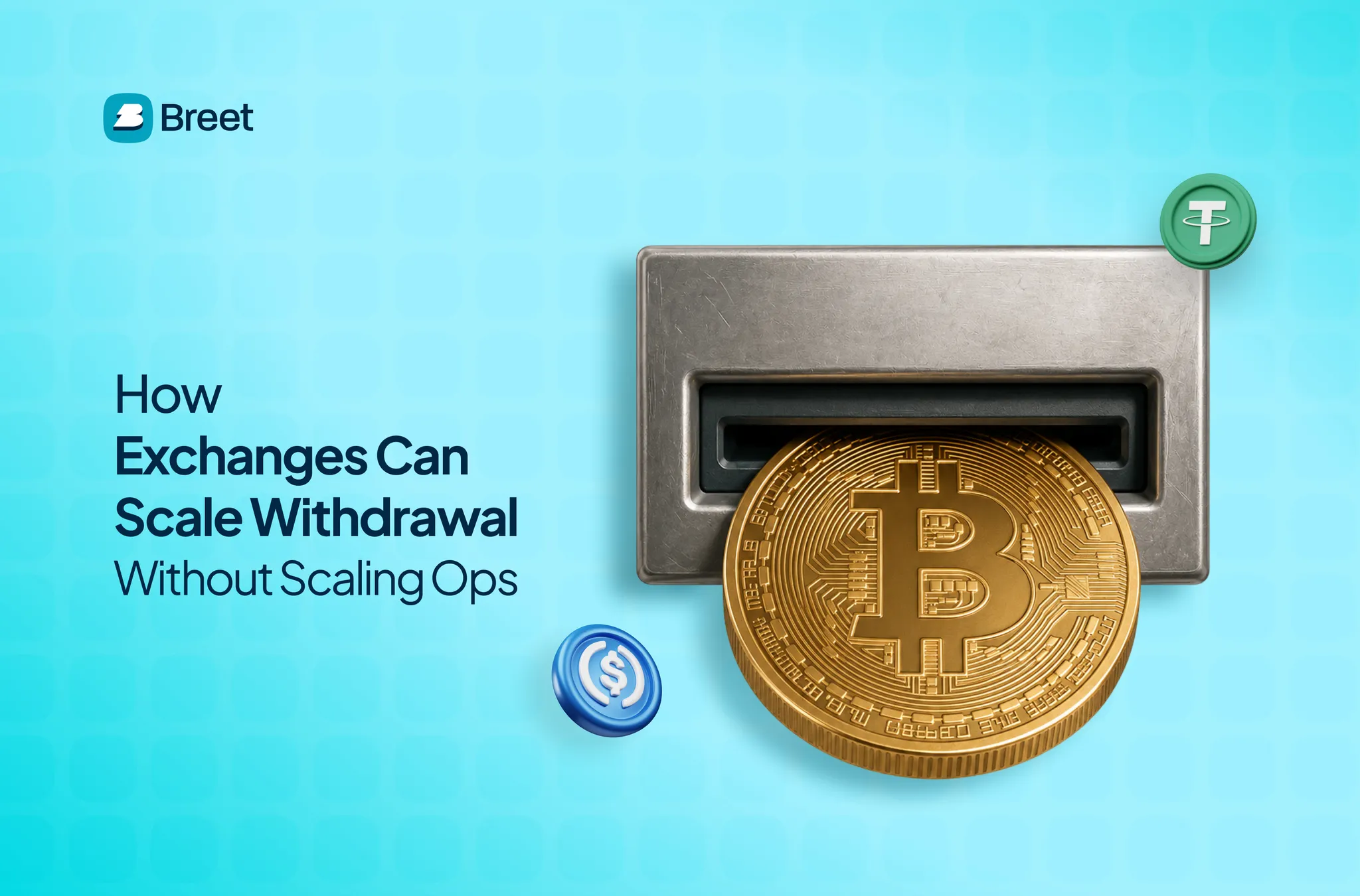
Your users don’t judge your exchange by your charts or your fees. They judge it by one moment: the second they hit withdraw and wait to see if the naira or cedis actually lands. When that moment is slow, or fails, or needs a support ticket to resolve, trust drops faster than any marketing budget can rebuild it. And the painful part is that this moment gets harder to deliver as you grow, not easier.
Most exchanges treat scaling withdrawals as a demand problem. It is almost never a demand problem. It is an operations problem, and the operations live in places that rarely make it onto a product roadmap.
Withdrawals Are the Moment Users Decide to Trust You
A withdrawal is the only part of your product where the user is watching the clock. Everything else can be a little slow, and nobody notices. A payout that hangs for twenty minutes turns a happy user into a worried one, and a worried user into a support ticket.
Behind a single successful payout sits a surprising amount of work. You need local-currency liquidity sitting ready. You need a working path into the banking system. You need the transfer to clear, the receipt to reconcile against the crypto that came in, and a record clean enough to satisfy a compliance review later. The user sees one button. You run a small factory behind it.
You can usually feel the strain before you can measure it. Support tickets about “pending” withdrawals start climbing. Someone on your team is manually topping up the float on a Sunday. Payouts queue up at month-end or during a market spike. These are not user-experience bugs. They are the early symptoms of an operations layer that has not been built to scale.
Operational Complexity Hides in Five Places, Not One
The reason “just hire more ops people” stops working is that the complexity is not in one place. It compounds across five.
First, liquidity and treasury. You have to hold enough naira and cedis to cover withdrawals and rebalance constantly against the crypto flowing in. Hold too little and payouts stall. Hold too much, and you have idle capital doing nothing.
Second, bank-rail reliability. Local transfers fail, queue, or hit cut-off times. Banks have downtime. Every failed transfer becomes a manual investigation and an anxious user.
Third, compliance load. KYC and AML screening have to run on payouts, and the records have to be kept in a way that survives an audit. Done by hand, this scales linearly with volume, which is to say it does not scale at all.
Fourth, reconciliation. Every crypto receipt has to be matched to the fiat you sent out. Get this wrong, and your month-end close turns into a forensic exercise.
Fifth, people cost. Each of the four above quietly demands staff, on-call rotations, and manual interventions. The headcount line grows in lockstep with volume, and your margin shrinks with it.
Building the Payout Machine In-House Solves the Wrong Problem
Faced with this, most exchanges reach for the instinct that got them this far: build it. Stand up the bank integrations, run a treasury desk, and write the compliance tooling. It feels like control.
The problem is fixed cost and fragility. An in-house payout stack carries a high standing cost, whether you process a thousand withdrawals or a hundred thousand. Worse, it tends to crack at exactly the wrong moment, during a volume spike, when the whole point was reliability. You end up paying for capacity you mostly don’t use and still failing on the days that matter most.
The alternative is to treat payouts and settlements as infrastructure you consume rather than software you maintain. The cost becomes variable, scaling with volume instead of sitting fixed in your books. The honest decision rule is simple: build in-house when payout infrastructure is your core product, and buy it when it is the thing standing between you and your core product. For most exchanges, moving money to a bank account is plumbing, not a product.
Automation Lets Volume Grow While Headcount Stays Flat
The goal is not to process more withdrawals with more people. It is to break the link between the two. That link breaks when conversion, settlement, and compliance stop being manual steps.
This is the model we built Breet’s Crypto Payment API around. Crypto a user withdraws is converted automatically and settled to a Nigerian or Ghanaian bank account or mobile money wallet, without an ops person touching it. KYC and AML screening runs in line with the transaction, not as a separate queue that a team has to clear. The settlement lands in minutes, not at the end of someone’s shift.
The real test of any payout system is how it behaves under load, because load is when users are watching most closely. Our infrastructure runs on a 99.9% uptime SLA and is built to hold during the volume spikes that break manual setups, since those are precisely the moments it exists for. When a coin moves and everyone tries to cash out at once, that is the moment your reputation is made or lost.
Reliable Payouts Are a Growth Lever, Not a Cost Line
It is tempting to file withdrawals under “cost of doing business.” That framing leaves money on the table. Reliable, fast payouts are one of the few things in this market that users talk about to other users.
Think about the math both ways. On the cost side, automation lowers your cost per payout and collapses the incident hours your team burns chasing failed transfers. On the growth side, a user who gets paid out in minutes, every time, stays, and tells people. In a market where switching exchanges takes one download, retention earned at the cashout moment is some of the cheapest growth you can buy.
We have seen this on our own platform: across the businesses settling through us, the pattern is consistent. When the payout stops being a source of anxiety, support volume drops, and repeat usage climbs. The withdrawal stops being the weak link and becomes a reason to stay.
Five Questions That Separate Real Infrastructure From the Rest
If you are evaluating whether to keep building payouts yourself or move to infrastructure, five questions cut through the sales decks.
- Settlement speed. Does money reach the user’s bank or mobile money in minutes, or “within a few hours”?
- Coverage. Does it actually serve both Nigeria and Ghana, with the local rails each market needs?
- Compliance. Is KYC and AML screening built into every transaction, or bolted on afterward?
- Uptime. Is there a real SLA, and does the system hold during volume spikes?
- Time-to-live. How long from signing up to the first live payout, days or weeks?
If a provider answers all five cleanly, you are looking at infrastructure. If they hedge on speed, coverage, or uptime, you are looking at software that will become your problem again at scale.
Final thoughts
Scaling withdrawals in Nigeria and Ghana is not about wanting it more. It is about removing the operational machine that quietly taxes every payout you make. The exchanges that win the cashout moment are the ones that stopped treating it as headcount and started treating it as infrastructure.
If you are feeling the strain at the withdrawal step, that is the signal, not a staffing gap. Book a walkthrough, and we will show you what your payout flow looks like when the factory behind the button runs itself.